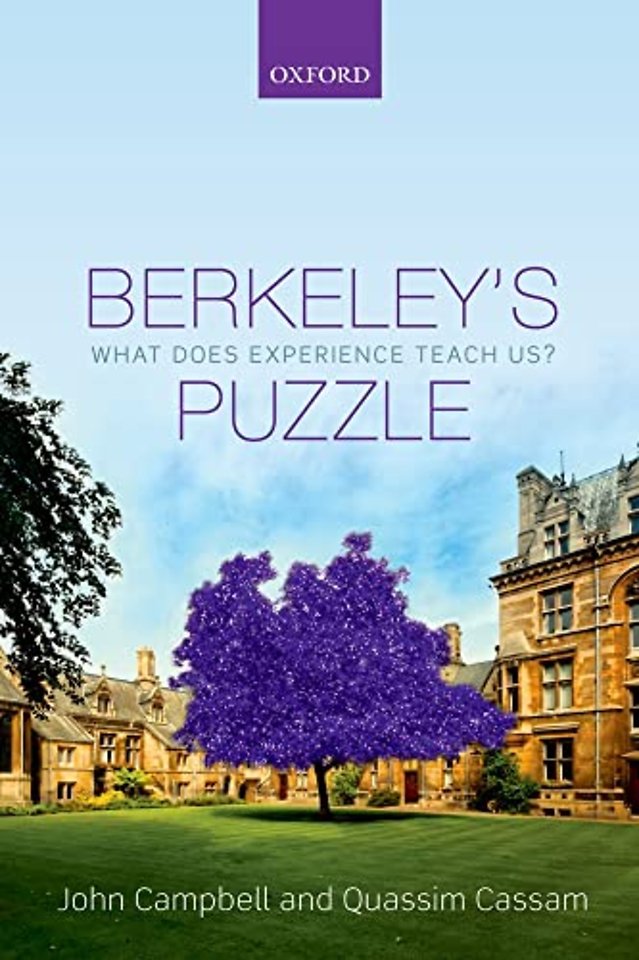
Berkeley's Puzzle
What Does Experience Teach Us?
Samenvatting
Sensory experience seems to be the basis of our knowledge and conception of mind-independent things. The puzzle is to understand how that can be: even if the things we experience (apples, tables, trees, etc), are mind-independent how does our sensory experience of them enable us to conceive of them as mind-independent? George Berkeley thought that sensory experience can only provide us with the conception of mind-dependent things, things which cannot exist when they aren't being perceived.
It's easy to dismiss Berkeley's conclusion but harder to see how to avoid it. In this book, John Campbell and Quassim Cassam propose very different solutions to Berkeley's Puzzle. For Campbell, sensory experience can be the basis of our knowledge of mind-independent things because it is a relation, more primitive than thought, between the perceiver and high-level objects and properties in the mind-independent world. Cassam opposes this 'relationalist' solution to the Puzzle and defends a 'representationalist' solution: sensory experience can give us the conception of mind-independent things because it represents its objects as mind-independent, but does so without presupposing concepts of mind-independent things.
This book is written in the form of a debate between two rival approaches to understanding the relationship between concepts and sensory experience. Although Berkeley's Puzzle frames the debate, the questions addressed by Campbell and Cassam aren't just of historical interest. They are among the most fundamental questions in philosophy.
Specificaties
Net verschenen
Rubrieken
- aanbestedingsrecht
- aansprakelijkheids- en verzekeringsrecht
- accountancy
- algemeen juridisch
- arbeidsrecht
- bank- en effectenrecht
- bestuursrecht
- bouwrecht
- burgerlijk recht en procesrecht
- europees-internationaal recht
- fiscaal recht
- gezondheidsrecht
- insolventierecht
- intellectuele eigendom en ict-recht
- management
- mens en maatschappij
- milieu- en omgevingsrecht
- notarieel recht
- ondernemingsrecht
- pensioenrecht
- personen- en familierecht
- sociale zekerheidsrecht
- staatsrecht
- strafrecht en criminologie
- vastgoed- en huurrecht
- vreemdelingenrecht