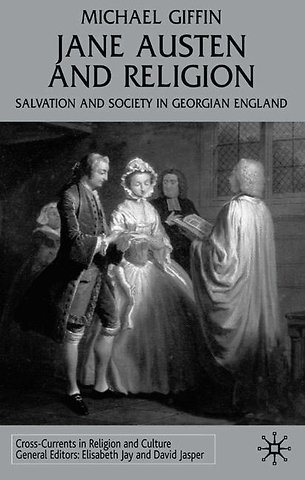
Jane Austen and Religion
Salvation and Society in Georgian England
Samenvatting
Jane Austen is often thought of as a secular author, because religion seems absent from her novels, because she satirises her clerical characters, and because history and literacy criticism - and the literary sensibility of the twenty-first century reader - is overwhelmingly secular. Michael Giffin offers a reading of Austen's published novels against the background of a 'long eighteenth century' that stretched from the Restoration to the end of the Georgian period. He demonstrates that Austen is a neoclassical author of the Enlightenment who writes through the twin prisms of British Empiricism and Georgian Anglicanism. His focus is on how Austen's novels mirror a belief in natural law and natural order; and how they reflect John Locke's theory of knowledge through reason, revelation and reflection on experience. His reading suggests there is a thread of neoclassical philosophy and theology running through and between each of Austen's novels, which is best understood in its cultural context.
Specificaties
Inhoudsopgave
Net verschenen
Rubrieken
- aanbestedingsrecht
- aansprakelijkheids- en verzekeringsrecht
- accountancy
- algemeen juridisch
- arbeidsrecht
- bank- en effectenrecht
- bestuursrecht
- bouwrecht
- burgerlijk recht en procesrecht
- europees-internationaal recht
- fiscaal recht
- gezondheidsrecht
- insolventierecht
- intellectuele eigendom en ict-recht
- management
- mens en maatschappij
- milieu- en omgevingsrecht
- notarieel recht
- ondernemingsrecht
- pensioenrecht
- personen- en familierecht
- sociale zekerheidsrecht
- staatsrecht
- strafrecht en criminologie
- vastgoed- en huurrecht
- vreemdelingenrecht