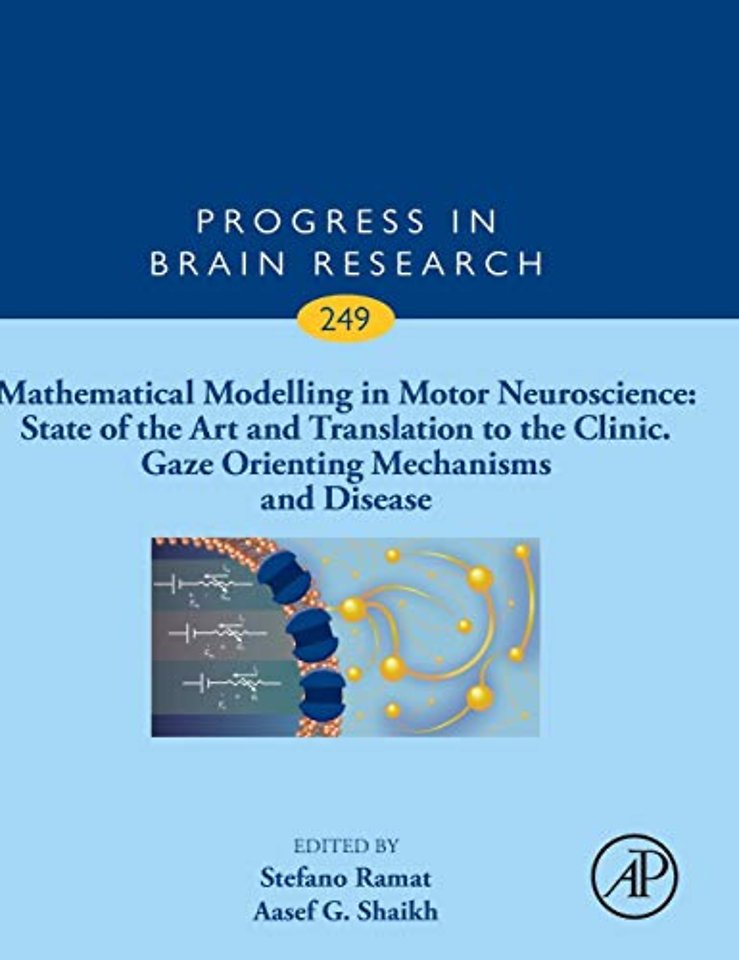
Mathematical Modelling in Motor Neuroscience: State of the Art and Translation to the Clinic, Gaze Orienting Mechanisms and Disease
Specificaties
Gebonden, blz.
|
Engels
Elsevier Science |
e druk, 2019
ISBN13: 9780444642547
Rubricering
Juridisch
:
Onderdeel van serie
Progress in Brain Research
Levertijd ongeveer 9 werkdagen
Gratis verzonden
Samenvatting
Mathematical Modelling in Motor Neuroscience: State of the Art and Translation to the Clinic, Gaze Orienting Mechanisms and Disease, Volume 249, the latest release in the Progress in Brain Research series, highlights new advances in the field, with this new volume presenting interesting chapters on a variety of topics, including Sequential Bayesian updating, Maps and Sensorimotor Transformations for Eye-Head Gaze Shifts: Role of the Midbrain Superior Colliculus, Modeling Gaze Position-Dependent Opsoclonus, Eye Position-Dependent Opsoclonus in Mild Traumatic Brain Injury, Saccades in Parkinson's disease -- hypometric, slow, and maladaptive, Brainstem Neural Circuits for Fixation and Generation of Saccadic Eye Movements, and much more.
Specificaties
Inhoudsopgave
Section I -DIDACTIC: Modeling<br>1. Sequential Bayesian updating as a model for human perception<br>Stefan Glasauer<br>2. Maps and sensorimotor transformations for eye-head gaze shifts: Role of the midbrain superior colliculus<br>A. John van Opstal and Bahadir Kasap<br>3. Modeling gaze position-dependent opsoclonus<br>Lance M. Optican, Janet C. Rucker, John-Ross Rizzo and Todd E. Hudson <p>Section II - DIDACTIC: Translational<br>4. Eye position-dependent opsoclonus in mild traumatic brain injury<br>John-Ross Rizzo, Todd H. Hudson, Alexandra J. Sequeira, Weiwei Dai, Yash Chaudhry, John Martone, David S. Zee, Lance M. Optican, Laura J. Balcer, Steven L. Galetta and Janet C. Rucker</p> <p>Section III - RESEARCH: Saccades<br>5. Saccades in Parkinson’s disease: Hypometric, slow, and maladaptive<br>Aasef G. Shaikh and Fatema F. Ghasia<br>6. Brainstem neural circuits for fixation and generation of saccadic eye movements<br>Yoshikazu Shinoda, Mayu Takahashi and Yuriko Sugiuchi<br>7. Morphological and electrophysiological characteristics of the commissural system in the superior colliculi for control of eye movements<br>Mayu Takahashi<br>8. Potassium channels in omnipause neurons<br>Ümit S Mayadali, Karoline Lienbacher, Michael Mustari, Michael Strupp and Anja KE Horn<br>9. The cerebellum improves the precision of antisaccades by a latency-duration trade-off<br>Pietro Piu, Elena Pretegiani, Francesca Rosini, Valeria Serchi, Domenica Zaino, Tommaso Chiantini and Alessandra Rufa<br>10. Saccade variability in healthy subjects and cerebellar patients<br>Eggert T and Straube A<br>11. Electrical stimulation in a spiking neural network model of monkey superior colliculus<br>A. John van Opstal and Bahadir Kasap</p> <p>Section IV - RESEARCH: Adaptation<br>12. A neuronal process for adaptive control of primate saccadic system<br>Yoshiko Kojima<br>13. A unified computational framework for visual attention dynamics<br>Dario Zanca, Marco Gori and Alessandra Rufa<br>14. Improving the repeatability of two-rate model parameter estimations by using autoencoder networks<br>Ozdemir MC, Eggert T and Straube A</p> <p>Section V - RESEARCH: Nystagmus<br>15. Rebound nystagmus, a window into the oculomotor integrator<br>Jorge Otero-Millan, Ayse I. Colpak, Amir Kheradmand and David S. Zee<br>16. Central positional nystagmus: Characteristics and model-based explanations<br>Jeong-Yoon Choi and Ji-Soo Kim<br>17. Modulation of acquired monocular pendular nystagmus in multiple sclerosis: A modeling approach<br>Ileok Jung, Sung-Hee Kim, Hyo-Jung Kim, Jeong-Yoon Choi and Ji-Soo Kim<br>18. Fixation instability in amblyopia: Oculomotor disease biomarkers predictive of treatment effectiveness<br>M. Scaramuzzi, J. Murray, J. Otero-Millan, Paolo Nucci, A.G. Shaikh and F.F. Ghasia</p> <p>Section VI - RESEARCH: Dystonia<br>19. What can kinematic studies tell us about the mechanisms of dystonia?<br>Anna Sadnicka, Joseph Galea and Mark J. Edwards<br>20. Implications of asymmetric neural activity patterns in the basal ganglia outflow in the integrative neural network model for cervical dystonia<br>Alexey Sedov, Ulia Semenova, Svetlana Usova, Alexey Tomskiy, J. Douglas Crawford, H.A. Jinnah and Aasef G. Shaikh<br>21. A motor control model of task-specific dystonia and its rehabilitation<br>Anna Sadnicka and Jaume Rosset-Llobet<br>22. Tremor in chronic inflammatory demyelinating polyneuropathy: Proof of unifying network model for dystonia<br>Nataliya Pyatka, Alexey Sedov, Benjamin L. Walter, H.A. Jinnah and Aasef G. Shaikh</p> <p>Section VII - RESEARCH: Parkinson's disease<br>23. Oculomotor effects of medical and surgical treatments of Parkinson’s disease<br>Salil Patel, James J. Fitzgerald and Chrystalina A. Antoniades<br>24. Vestibular heading perception in Parkinson's disease<br>Sinem Balta Beylergil, Sarah Ozinga, Mark F. Walker, Cameron McIntyre and Aasef G. Shaikh<br>25. A new approach for estimation of spiketrain patterns in basal ganglia<br>Vladislav Myrov, Alexey Sedov, Alexey Tomskiy, Ludmila Myrova and Elena Belova</p> <p>Section VIII - RESEARCH: Others<br>26. A model-based study of internuclear ophthalmoparesis and ocular-motor fatigue in multiple sclerosis<br>Jonathan B. Jacobs, Clara Chisari, Margaret M. Skelly, Mark F. Walker and Alessandro Serra<br>27. Central positional vertigo: A clinical-imaging study<br>Emiliano De Schutter, Zachariah O. Adham and Jorge C. Kattah<br>28. Eye-hand re-coordination: A pilot investigation of gaze and reach biofeedback in chronic stroke<br>John-Ross Rizzo, Mahya Beheshti, Azadeh Shafieesabet, James Fung, Maryam Hosseini, Janet C. Rucker, Lawrence H. Snyder and Todd E. Hudson<br>29. Kinematics and the neurophysiological study of visually-guided eye movements<br>Laurent Goffart<br>30. Deficient head motor control in functional dizziness: Experimental evidence of central sensory-motor dysfunction in persistent physical symptoms<br>Nadine Lehnen, Lena Schröder, Peter Henningsen, Stefan Glasauer and Cecilia Ramaioli</p>
Net verschenen
Rubrieken
- aanbestedingsrecht
- aansprakelijkheids- en verzekeringsrecht
- accountancy
- algemeen juridisch
- arbeidsrecht
- bank- en effectenrecht
- bestuursrecht
- bouwrecht
- burgerlijk recht en procesrecht
- europees-internationaal recht
- fiscaal recht
- gezondheidsrecht
- insolventierecht
- intellectuele eigendom en ict-recht
- management
- mens en maatschappij
- milieu- en omgevingsrecht
- notarieel recht
- ondernemingsrecht
- pensioenrecht
- personen- en familierecht
- sociale zekerheidsrecht
- staatsrecht
- strafrecht en criminologie
- vastgoed- en huurrecht
- vreemdelingenrecht