
,

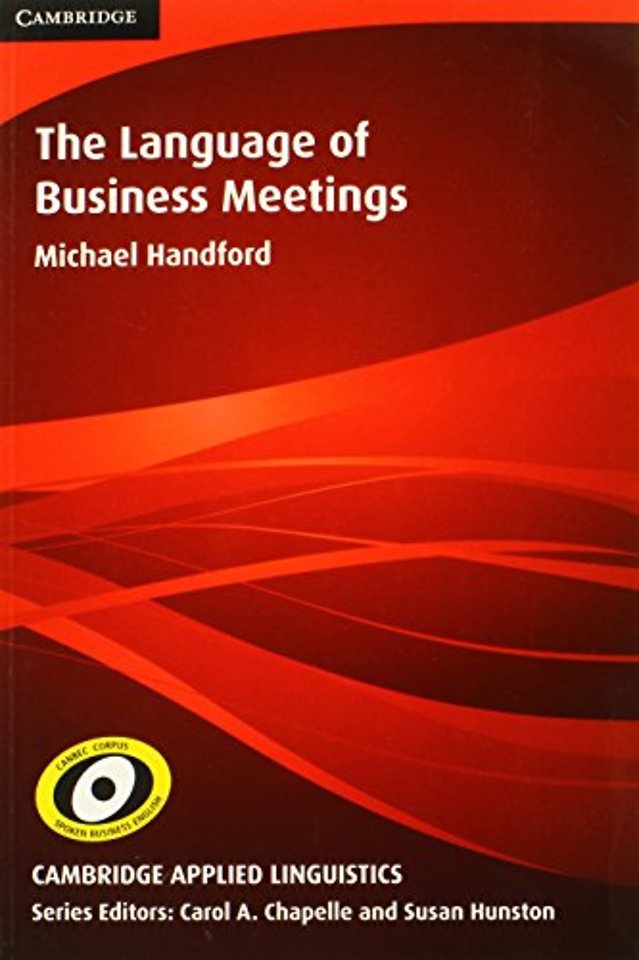
The Language of Business Meetings

Specificaties
Paperback, 286 blz. | Engels
Cambridge University Press | e druk, 2010
ISBN13: 9780521133432
Rubricering
Juridisch :
Cambridge University Press e druk, 2010 9780521133432
Onderdeel van serie Cambridge Applied Li
€ 60,93
Levertijd ongeveer 9 werkdagen
Gratis verzonden

Samenvatting

This innovative volume presents an in-depth study of the language used by participants in business meetings. The cutting-edge research draws on the Cambridge and Nottingham Business English Corpus (CANBEC), a unique resource which brings together meetings of different types both within and between companies, involving speakers whose roles and responsibilities vary, and who represent a range of nationalities and first languages. Keywords, concordance lines and discourse analysis provide thorough insights into aspects such as the structural stages of meetings, participants' discursive practices, interpersonal language and creativity, and power and constraint. The author concludes by making practical suggestions for using these findings to inform the teaching of business English.

Specificaties

ISBN13:9780521133432
Taal:Engels
Bindwijze:Paperback
Aantal pagina's:286

Inhoudsopgave

Series editors' preface; Acknowledgements; Transcription conventions; 1. CANBEC: corpus and context; 1.1. Data collection; 1.2. Corpus constituency; 1.3. Contextual information; 1.4. Transcription and anonymization; 1.5. Corpus size and generalizability; 1.6. Outline of the book; References; 2. Background: theory and methodology; 2.1. Theory; 2.2. Methodology; 2.3. Summary; References; 3. The business-meeting genre: stages and practices; 3.1. Applying Bhatia's multi-perspective model of discourse to business meetings; 3.2. The meeting matrix; 3.3. Applying the meeting matrix; 3.4. Summary; References; 4. Significant meeting words: keywords and concordances; 4.1. Institutional language and everyday English; 4.2. Lexico-grammatical theoretical considerations; 4.3. Word frequencies; 4.4. Keywords; 4.5. Summary; References; 5. Discourse marking and interaction: clusters and practices; 5.1. Defining clusters; 5.2. Clusters in business research; 5.3. Cluster lists; 5.4. Categorization of clusters; 5.5. Clusters in context; 5.6. Summary; References; 6. Interpersonal language: pronouns, backchannels, vague language, hedges and deontic modality; 6.1. The transactional/relational linguistic distinction; 6.2. Pronouns; 6.3. Backchannels; 6.4. Vague language; 6.5. Hedges; 6.6. Deontic modality; 6.7. Summary; References; 7. Interpersonal creativity: problem, issue, if, and metaphors and idioms; 7.1. Problem and issue; 7.2. If; 7.3. Metaphors and idioms; 7.4. Summary; References; 8. Turn-taking: power and constraint; 8.1. Turn-taking in internal meetings; 8.2. Turn-taking in external meetings; 8.3. Summary; References; 9. Teaching and learning implications; 9.1. Who is the learner?; 9.2. Teaching materials: what do they teach?; 9.3. How can a corpus such as CANBEC be exploited?; 9.4. Summary; References; Appendix; Index.

Net verschenen

€ 60,93
Levertijd ongeveer 9 werkdagen
Gratis verzonden

Rubrieken

    Personen

      Trefwoorden

        The Language of Business Meetings