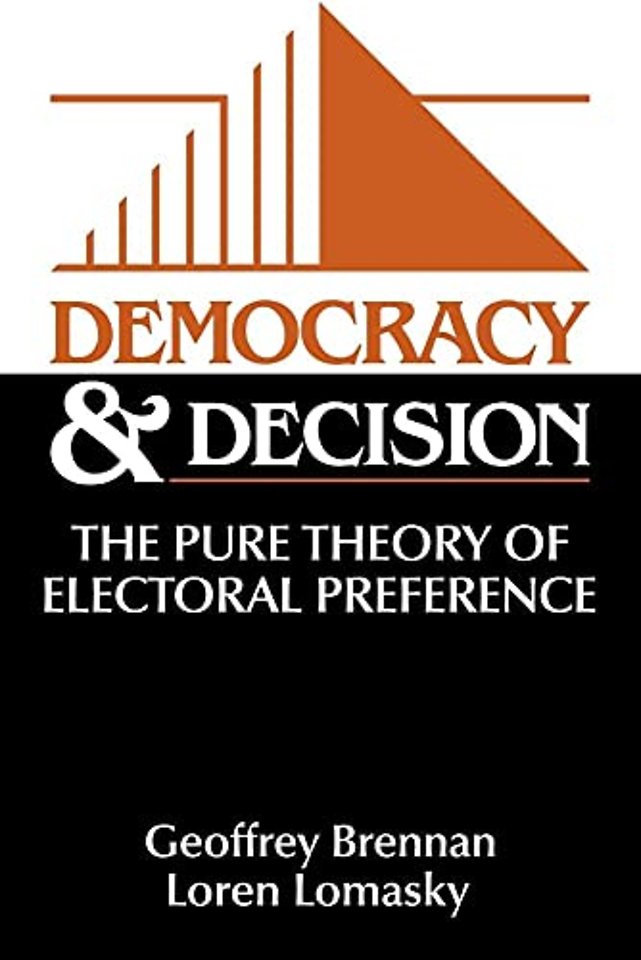
Geoffrey Brennan,
Loren Lomasky
Cambridge University Press
e druk, 1997
9780521585248
Democracy and Decision
The Pure Theory of Electoral Preference
Specificaties
Paperback, 252 blz.
|
Engels
Cambridge University Press |
e druk, 1997
ISBN13: 9780521585248
Rubricering
Juridisch
:
Levertijd ongeveer 9 werkdagen
Gratis verzonden
Samenvatting
Do voters in large scale democracies reliably vote for the electoral outcomes most in their interest? Much of the literature on voting predicts that they do, but this book argues that fully rational voters will not, in fact, consistently vote for the political outcomes they prefer. The authors offer a theory of voting which they term an 'expressive' theory of electoral politics. This theory is shown to be more coherent and more consistent with actual observed voting behaviour. This important book offers a compelling challenge to the central premises of the prevailing theories of voting behaviour.
Specificaties
ISBN13:9780521585248
Taal:Engels
Bindwijze:Paperback
Aantal pagina's:252
Uitgever:Cambridge University Press
Inhoudsopgave
1. Ethics, politics and public choice; 2. The logic of electoral choice; 3. The nature of expressive returns; 4. The analytics of decisiveness; 5. The theory of electoral outcome: implications for public choice theory; 6. From anecdote to analysis; 7. Interpreting the numbers; 8. Consensus, efficiency and contractarian justification; 9. Paternalism, self-paternalism and the state; 10. Towards a democratic morality; 11. Constitutional implications; Bibliography.
Net verschenen
Rubrieken
- aanbestedingsrecht
- aansprakelijkheids- en verzekeringsrecht
- accountancy
- algemeen juridisch
- arbeidsrecht
- bank- en effectenrecht
- bestuursrecht
- bouwrecht
- burgerlijk recht en procesrecht
- europees-internationaal recht
- fiscaal recht
- gezondheidsrecht
- insolventierecht
- intellectuele eigendom en ict-recht
- management
- mens en maatschappij
- milieu- en omgevingsrecht
- notarieel recht
- ondernemingsrecht
- pensioenrecht
- personen- en familierecht
- sociale zekerheidsrecht
- staatsrecht
- strafrecht en criminologie
- vastgoed- en huurrecht
- vreemdelingenrecht