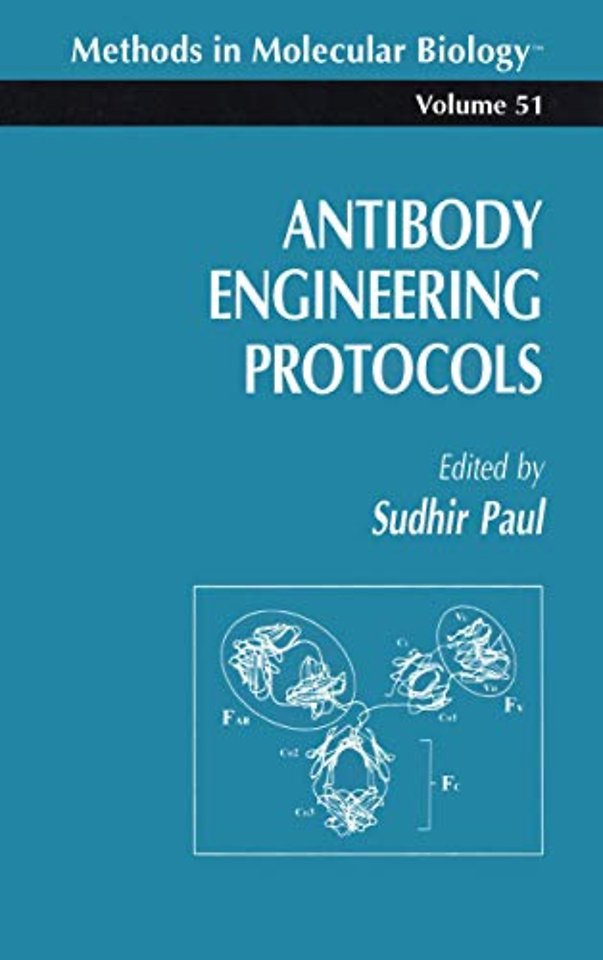
Antibody Engineering Protocols
Samenvatting
Antibodies are the instraments of immune defense and attack. They can bind small atomic arrays as well as large epitopes with high affinity. Antibody Engineering Protocols presents advanced protocols in the field of antibody engineering, reviews of basic principles and methodology, and a historical perspective on the development of cur rently held beliefs about antibody structure-function relationships. The topics cover analysis of antibody sequences, three-dimensional structure, delineation of antibody characteristics in polyclonal mixtures, phage display of natural and synthetic antibodies, and antibody catalysis. Ligand recognition by antibodies occurs primarily at a subset of amino acid residues located in the complementarity determining regions (CDRs) found in the light (L) and heavy (H) chain subunits. Specific antibodies are developed by immunization with molecules identical to or related in structure to the target ligand. The immune repertoire from nonimmunized individuals also contains pre-existing specificities that can be selected by screening libraries composed of hybridoma cells or phage particles displaying F domains or indi vidual variable domains of the light (VJ and heavy (V^^) chains. Ran dom or site-directed mutagenesis in vitro can be used to refine the pre-existing specificities or produce new specificities de novo. Another level at which new specificities may be generated in vitro is V^ and V^ domain-swapping and CDR-swapping. The former procedure embodies a variation of natural mechanisms of generating antibody diversity. The latter procedure produces new intramolecular CDR combinations not found in nature.
Specificaties
Inhoudsopgave
Net verschenen
Rubrieken
- aanbestedingsrecht
- aansprakelijkheids- en verzekeringsrecht
- accountancy
- algemeen juridisch
- arbeidsrecht
- bank- en effectenrecht
- bestuursrecht
- bouwrecht
- burgerlijk recht en procesrecht
- europees-internationaal recht
- fiscaal recht
- gezondheidsrecht
- insolventierecht
- intellectuele eigendom en ict-recht
- management
- mens en maatschappij
- milieu- en omgevingsrecht
- notarieel recht
- ondernemingsrecht
- pensioenrecht
- personen- en familierecht
- sociale zekerheidsrecht
- staatsrecht
- strafrecht en criminologie
- vastgoed- en huurrecht
- vreemdelingenrecht