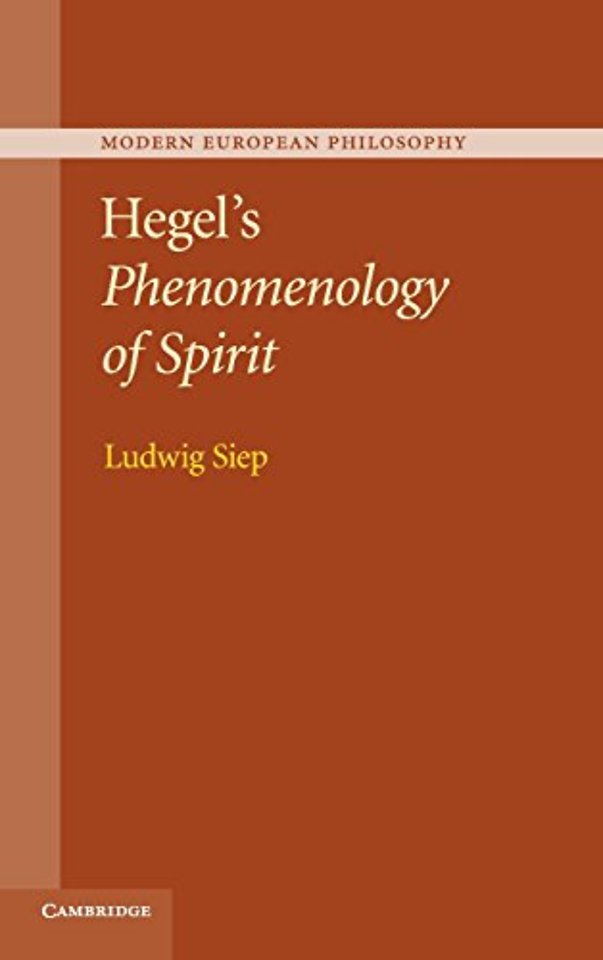
Hegel's Phenomenology of Spirit
Samenvatting
Hegel only published five books in his lifetime, and among them the Phenomenology of Spirit emerges as the most important but also perhaps the most difficult and complex. In this book Ludwig Siep follows the path from Hegel's early writings on religion, love and spirit to the milestones of his 'Jena period'. He shows how the themes of the Phenomenology first appeared in an earlier work, The Difference between Fichte's and Schelling's Systems of Philosophy, and closely examines the direction which Hegel's thought took as he attempted to think through the possibility of a complete system of philosophy. The themes encompassed by the Phenomenology - anti-dualistic epistemology, autonomy, historicality, the sociality of reason - are thoroughly discussed in Siep's subtle and elegantly argued assessment, which appears here in English for the first time. It will be of great interest to all readers studying Hegel's thought.
Specificaties
Inhoudsopgave
Net verschenen
Rubrieken
- aanbestedingsrecht
- aansprakelijkheids- en verzekeringsrecht
- accountancy
- algemeen juridisch
- arbeidsrecht
- bank- en effectenrecht
- bestuursrecht
- bouwrecht
- burgerlijk recht en procesrecht
- europees-internationaal recht
- fiscaal recht
- gezondheidsrecht
- insolventierecht
- intellectuele eigendom en ict-recht
- management
- mens en maatschappij
- milieu- en omgevingsrecht
- notarieel recht
- ondernemingsrecht
- pensioenrecht
- personen- en familierecht
- sociale zekerheidsrecht
- staatsrecht
- strafrecht en criminologie
- vastgoed- en huurrecht
- vreemdelingenrecht