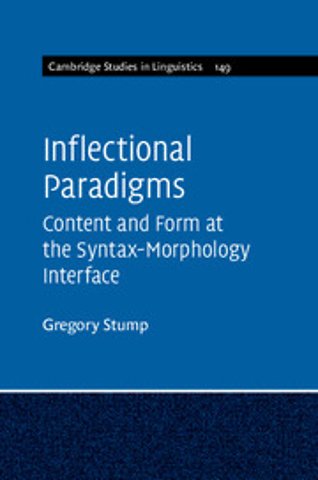
Inflectional Paradigms
Content and Form at the Syntax-Morphology Interface
Samenvatting
Sometimes dismissed as linguistically epiphenomenal, inflectional paradigms are, in reality, the interface of a language's morphology with its syntax and semantics. Drawing on abundant evidence from a wide range of languages (French, Hua, Hungarian, Kashmiri, Latin, Nepali, Noon, Old Norse, Sanskrit, Turkish, Twi and others), Stump examines a variety of mismatches between words' content and form, including morphomic patterns, defectiveness, overabundance, syncretism, suppletion, deponency and polyfunctionality. He demonstrates that such mismatches motivate a new grammatical architecture in which two kinds of paradigms are distinguished: content paradigms, which determine word forms' syntactic distribution and semantic interpretation, and form paradigms, which determine their inflectional realization. In this framework, the often nontrivial linkage between a lexeme's content paradigm and its stems' form paradigm is the nexus at which incongruities of content and form are resolved. Stump presents clear and precise analyses of a range of morphological phenomena in support of this theoretical innovation.
Specificaties
Inhoudsopgave
Net verschenen
Rubrieken
- aanbestedingsrecht
- aansprakelijkheids- en verzekeringsrecht
- accountancy
- algemeen juridisch
- arbeidsrecht
- bank- en effectenrecht
- bestuursrecht
- bouwrecht
- burgerlijk recht en procesrecht
- europees-internationaal recht
- fiscaal recht
- gezondheidsrecht
- insolventierecht
- intellectuele eigendom en ict-recht
- management
- mens en maatschappij
- milieu- en omgevingsrecht
- notarieel recht
- ondernemingsrecht
- pensioenrecht
- personen- en familierecht
- sociale zekerheidsrecht
- staatsrecht
- strafrecht en criminologie
- vastgoed- en huurrecht
- vreemdelingenrecht