Gratis boekenweekgeschenk bij een bestelling boven de €17,50 (geldt alleen voor Nederlandstalige boeken)

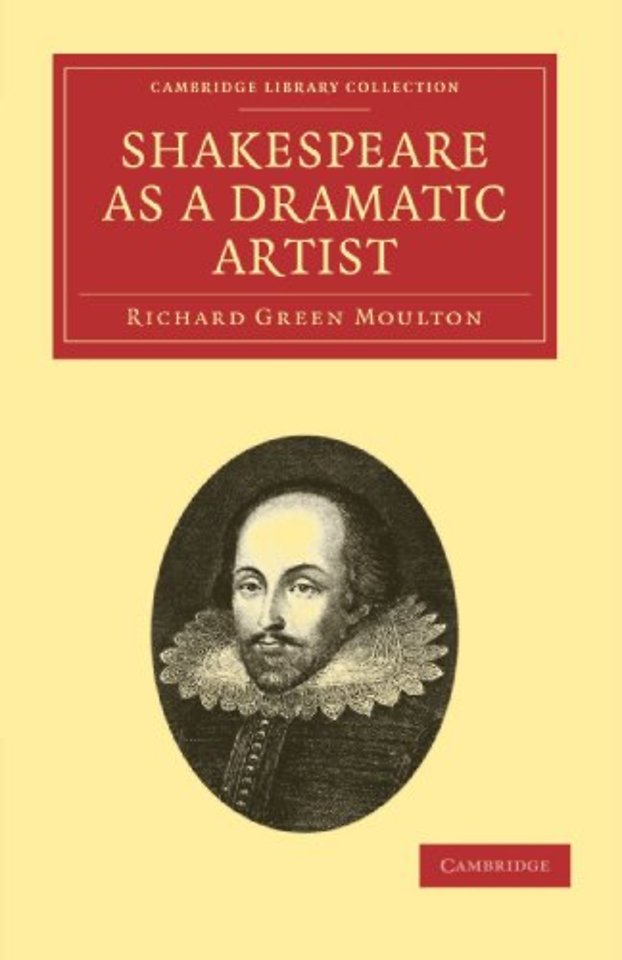
Shakespeare as a Dramatic Artist

A Popular Illustration of the Principles of Scientific Criticism

Specificaties
Paperback, 464 blz. | Engels
Cambridge University Press | e druk, 2011
ISBN13: 9781108030823
Rubricering
Juridisch :
Cambridge University Press e druk, 2011 9781108030823
Onderdeel van serie Cambridge Library Co
€ 53,01
Levertijd ongeveer 9 werkdagen
Gratis verzonden

Samenvatting

Written by British American critic Richard Moulton (1849–1924), this influential study of Shakespeare's dramatic technique introduces Moulton's 'prescience' of scientific criticism, an approach to literature that would later develop into modern literary theory. Moulton, who served as professor of English literature at Chicago, stated that his object was to 'claim for criticism a position amongst the inductive sciences, and to sketch in outline a plan for the dramatic side of such a critical science', arguing that Shakespeare's genius lay in his mastery of his dramatic art as much as in his deep knowledge of human nature. Published in 1893, this third edition expands significantly on the material in the first edition (1885) and the second (1888), as Moulton includes analysis of three additional Shakespearean plays, using work that had originally been presented to the New Shakespeare Society of London. Subsequent editions were produced in 1897 and 1906.

Specificaties

ISBN13:9781108030823
Taal:Engels
Bindwijze:Paperback
Aantal pagina's:464

Inhoudsopgave

Preface to the third edition; Preface to the second edition; Preface to the first edition; Introduction: plea for an inductive science of literary criticism; Part I. Shakespeare Considered as a Dramatic Artist, in Fifteen Studies: 1. The two stories Shakespeare borrows for his Merchant of Venice. A study in the raw material of the romantic drama; 2. How Shakespeare manipulates the stories in dramatising them. A study in dramatic workmanship; 3. How Shakespeare makes his plot more complex in order to make it more simple. A study in underplot; 4. A picture of ideal villainy in Richard III. A study in character-interpretation; 5. Richard III, how Shakespeare weaves Nemesis into history. A study in plot; 6. How Nemesis and destiny are interwoven in Macbeth. A further study in plot; 7. Macbeth, Lord and Lady. A study in character-contrast; 8. Julius Caesar beside his murderers and his avenger. A study in character-grouping; 9. How the play of Julius Caesar works up to a climax at the centre. A study in passion and movement; 10. How climax meets climax in the centre of Lear. A study in more complex passion and movement; 11. Othello as a picture of jealousy and intrigue. A study in character and plot; 12. How The Tempest is a drama of enchantment. A study in dramatic colouring; 13. How the enchantment of The Tempest presents personal providence. A study in central ideas; 14. How Loves Labour's Lost presents simple humour in conflict with various affections and conventionalities. A further study in central ideas; 15. How As You Like It presents varied forms of humour in conflict with a single conventionality. A study of more complex dramatic colouring; Part II. Survey of Dramatic Criticism as an Inductive Science: 16. Topics of dramatic criticism; 17. Interest of character; 18. Interest of passion; 19. Interest of plot: statics; 20. Interest of plot: dynamics; Appendix; Index.

Net verschenen

€ 53,01
Levertijd ongeveer 9 werkdagen
Gratis verzonden

Rubrieken

    Personen

      Trefwoorden

        Shakespeare as a Dramatic Artist