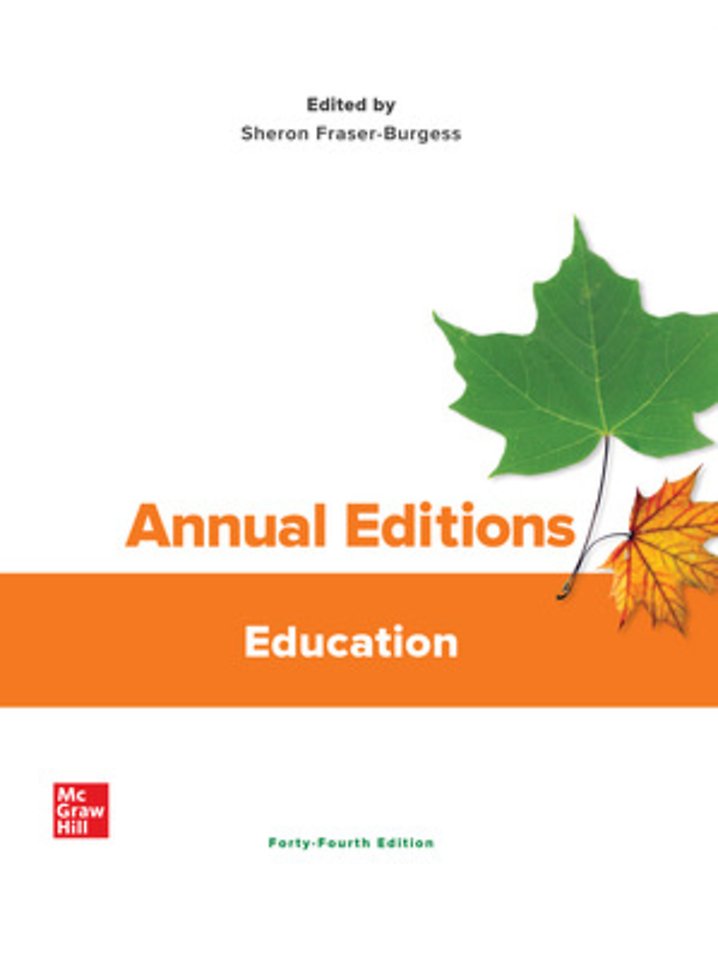
Annual Editions: Education
Samenvatting
The Annual Editions series is designed to provide convenient inexpensive access to a wide range of current articles from some of the most respected magazines, newspapers and journals published today. Annual Editions are updated on a regular basis through a continuous monitoring of over 300 periodical sources. The articles selected are authored by prominent scholars, researchers, and commentators writing for a general audience. Each Annual Editions volume has a number of features designed to make them especially valuable for classroom use; including a brief overview for each unit, as well as Learning Outcomes, Critical Thinking questions, and Internet References to accompany each article. Go to the McGraw-Hill Create® Annual Editions Article Collection at http://www.mcgrawhillcreate.com/annualeditions to browse the entire collection. Select individual Annual Editions articles to enhance your course, or access and select the entire Fraser-Burgess: Annual Editions: Education, 44/e book here http://create.mheducation.com/createonline/index.html#qlink=search%2Ftext%3Disbn:1259922839 for an easy, pre-built teaching resource. Visit http://create.mheducation.com for more information on other McGraw-Hill titles and special collections.
Specificaties
Inhoudsopgave
ongoing challenge of complying with standards in multiple domains. Using the Technological, Pedagogical, and Content Knowledge (TPACK) model, the article discusses ways in which bilingual curriculum can advance literacy through technology integration.<br><br>Utilizing Technology in Physical Education: Addressing the Obstacles of Integration, Beth Pyle and Keri Esslinger, Delta Kappa Gamma Bulletin, 2014<br>Perhaps you have wondered why teachers in physical education, the arts, and other activity-centered classes need to be concerned with technology standards? This article explains why technology is important in physical education and obstacle to technology integration.<br><br>Implications of Shifting Technology in Education, Janet Holland and John Holland, TechTrends, 2014<br>Recently many of us feel that every day brings newer, bigger, and better technology devices. This explosion of technology choices comes with increased quality of the tools and more research to practice articles for integrating technology. How are teachers to implement meaningful integration of new technologies while aligning research to practice?<br><br>Assistive Tech for Everyone? Michelle R. Davis, Education Week, 2014<br>What were once technology tools designed for and used by persons with disabilities are moving into the mainstream and being used by students who do not have an identified disability. A primary reason is the adoption of Universal Design for Learning methods and materials for all students.<br><br>UNIT: Special & Exceptional Education<br><br>Inclusive Education: Lessons from History, Barbara. Boroson, Educational Leadership, 2017<br>Boroson aligns advocacy for inclusive placements for students with disabilities with the advocacy of persons from previous civil rights efforts that were anti-desegregation.<br><br>Text-to-Speech: Not Just for Special Education Students! Kristine Napper, McGraw-Hill, 2019<br>The benefits of text-to-speech for students who are blind or vision-impaired are well known. However, all students can benefit from the independence and confidences that it fosters.<br><br>Mobile Apps the Educational Solution for Autistic Students in Secondary Education, Agathi Stathopoulou, et al., International Journal of Interactive Mobile Technologies, 2019<br>This article explores the extent to which autistic children can be served by mobile apps that compensate for their gap and comfort level with social skills. These apps allow for self-guided instruction and have a structured approach that is compatible with the way that autistic students learn.<br><br>5 Strategies for Inclusivity in Special Education, Karen Achtman, McGraw-Hill, 2018<br>Instructional strategies to promote inclusivity offer a broad pedagogical umbrella that increases the likelihood that every child in the classroom overcomes hurdles to learning. Fostering an inclusive classroom environment requires the teacher to have a high level of awareness of the needs of all children in her classroom.<br><br>Education of All Handicapped Children Act, U.S. Congress, Public Law 94-142, 1975<br>This legislation established the nomenclature and policy basis for extending equal rights to children with disabilities in their education. It mandated that individualized education plans (IEP) be standard for all identified special education students as part of a comprehensive plan that was designed to meet their educational needs.<br><br>UNIT: Ethics & Community Engagement<br><br>The Next “Evolution” of Civic Learning, Tania D. Mitchell, Peer Review: Emerging Trends and Key Debates in Undergraduate Education, 2017<br>Community-engaged learning is a new buzz term in higher education; Mitchell reflects on whether there is true reciprocity of commitment between university and the community and whether sufficient efforts are being made to foster community leadership. <br><br>Using Appreciative Inquiry to Foster Intergenerational Collaboration for Positive Change in a Struggling School System, Megan Tschannen-Moran et al., Center for School Transformation, 2015<br>Using a case study method, the authors describe what happened in a community that adopted Appreciative Inquiry (AI) to build a climate of positive change through intergenerational collaboration. Their story includes the steps they took to build trust and a sense of community.<br><br>Democracy in Education, John Dewey, The Elementary School Teacher, 1903<br>This excerpt from John Dewey’s tome still stands as the most in-depth and thorough theorization of democracy and the role of schools within it. The work centers the consistently of democratic ends with groups who are seeking to be stable and sustainable.<br><br>UNIT: Identity & Intersectionality in Education<br><br>Building LGBTQ Awareness and Allies in Our Teacher Education Community and Beyond, Laura-Lee Kearns, Jennifer Mitton Kukner, and Joanne Tompkins, Collected Essays on Learning and Teaching, 2014<br>The authors discuss how they work to build awareness and allies within the higher-education context. They developed a curriculum to use in their pre-service teacher education program with the purpose of creating a pedagogy that embraces, celebrates, and honors all learners.<br><br>Here’s What I Wish White Teachers Knew When Teaching My Black Children, Afrika Afeni Mills, Education Post, 2019<br>Afrika Afeni Mills challenges predominantly white teachers in K-12 schools to broaden their cultural competence of America history in the context of the experience of minoritized persons. Only by disrupting their predominant cultural lens can they be effective teachers of all students.<br><br>UNIT: STEM<br><br>Elements of Making: A Framework to Support Making in the Science Classroom, Shelly Rodriguez et al., Science Teacher, 2018<br>Making is a curricular innovation that fosters a do-it-yourself mindset in problem-solving from design to production. The authors offer a matrix for lesson develop and implementation.<br><br>Don’t Ask Me Why: Preschool Teachers’ Knowledge in Technology as a Determinant of Leadership Behavior, Anna Öqvist and Per Högström, Journal of Technology Education, 2018<br>This research study examines the correlation between the attitudes that preschool teachers have toward the underlying elements of implementing technology in the classroom and their confidence in guiding their students’ learning.<br><br>The U.S. Is Falling Way Behind in STEM But Kentucky’s Powering the Comeback, Garris Landon Stroud, Education Post, 2018<br>Reliable strategies for expansion of rigorous STEM education are well documented but not broadly implemented in the United States. Through making schools accountable for science education, providing cutting edge computer science classes and partnering with community and business stakeholders, Kentucky K-12 schools are bucking the downward national trend.<br><br>
Net verschenen
Rubrieken
- aanbestedingsrecht
- aansprakelijkheids- en verzekeringsrecht
- accountancy
- algemeen juridisch
- arbeidsrecht
- bank- en effectenrecht
- bestuursrecht
- bouwrecht
- burgerlijk recht en procesrecht
- europees-internationaal recht
- fiscaal recht
- gezondheidsrecht
- insolventierecht
- intellectuele eigendom en ict-recht
- management
- mens en maatschappij
- milieu- en omgevingsrecht
- notarieel recht
- ondernemingsrecht
- pensioenrecht
- personen- en familierecht
- sociale zekerheidsrecht
- staatsrecht
- strafrecht en criminologie
- vastgoed- en huurrecht
- vreemdelingenrecht