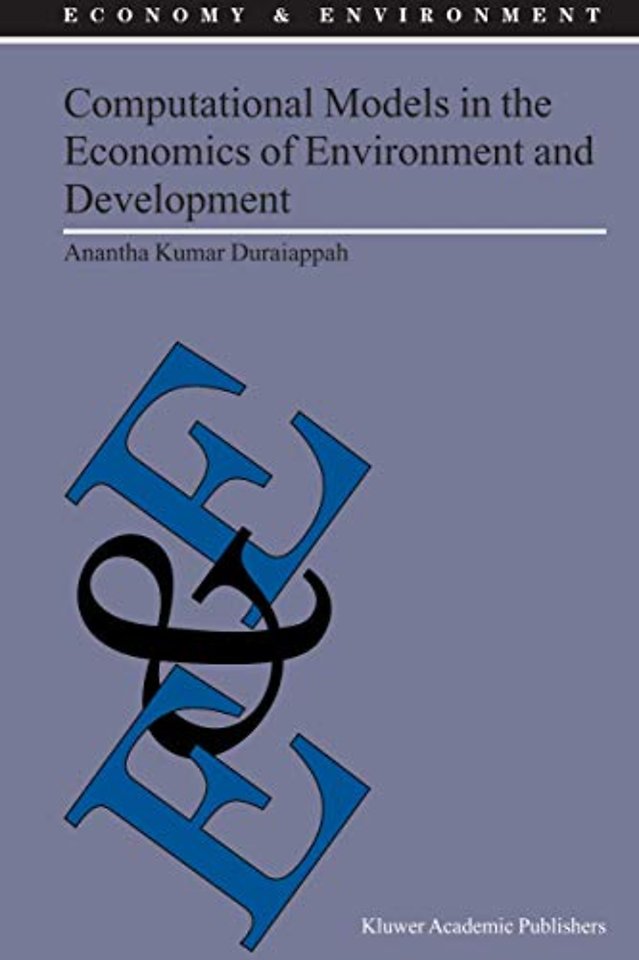
Computational Models in the Economics of Environment and Development
Samenvatting
Computational Models in the Economics of Environment and Development provides a step-by-step guide in designing, developing, and solving non-linear environment-development models. It accomplishes this by focusing on applied models, using real examples as case studies. Additionally, it gives examples of developing policy interventions based on quantitative model results. Finally, it uses a simple computer program, GAMS, to develop and solve models.
This book is targeted towards university lecturers and students in economic modeling and sustainable development, but is also of particular interest to researchers at sustainable development research institutes and policy makers at international sustainable development policy institutions such the World Bank, UNDP, and UNEP.
Specificaties
Inhoudsopgave
Acknowledgements
Introduction
1: A Generalized Integrated Economic-Environmental Growth Model
1.1. Introduction
1.2. Conceptual Model
1.3. The Mathematical Model
1.4. Experiments and Results
1.5. Conclusion
Bibliography
Appendix 1
2: Formulating and Solving Non-Linear Integrated Ecological-Economic Models Using GAMS
2.1. Introduction
2.2. The Formulation of Integrated Ecologica1Economic Models
2.3. Solution of Non-Linear TEE Models in GAMS
2.4. Conclusion
Bibliography
3: Investing in Clean Technology: An Exercise in Methodology
3.1. Introduction
3.2. Conventional Style of Investment Decision Making
3.3. An Alternative Planning Process
3.4. The Mathematical Model
3.5. Model Limitations
3.6. Conclusion
Bibliography
4: Issues in Production, Recycling and International Trade: Analyzing the Plastic Sector Using an Optimal Life Cycle (OLC) Model
4.1. Introduction
4.2. Plastics in China
4.3. The Main Issues
4.4. Optimized Life Cycle (OLC) Model
4.5. The Mathematical Model
4.6. Simulation Results
4.7. Policy Options
4.8. Sensitivity Analysis
4.9. Spatial Dimension of the Model
4.10. Conclusion
Bibliography
Appendix 1 : The GAMS Model
5: The Economic and Environmental Impact of Waste Paper Trade and Recycling in India: A Life Cycle Approach with an Endogenous Input-Output Technology Matrix
5.1. Introduction
5.2. The Indian Paper Cycle
5.3. The Conceptual Model
5.4. The Mathematical Model
5.5. Results
5.6. Conclusions
Bibliography
Appendix 1: The GAMS Model
6: Farm Permits and Optimal Shrimp Management in Thailand: An Integrated Inter-Temporal and Spatial Planning Model
6.1. Introduction
6.2. The Thailand Shrimp Sector
6.3. The Shrimp Integrated Assessment Model (SIAM)
6.4. Land Use and Exchange System
6.5. Water Exchange
6.6. Economic Aspects
6.7. Model Dynamics
6.8. Mathematical Model
6.9. Results
6.10. Sensitivity Analysis
6.11. Discussion
6.12. Conclusions
Bibliography
Appendix 1: The GAMS Model
Appendix 2
7: Sustainable Livestock Management in the Kalahari
7.1. Introduction
7.2. Livestock Sector in Botswana
7.3. Ecology of the Rangelands
7.4. The Economics of the Livestock Sector
7.5. The Model Scope
7.6. Empirical Results
7.7. Policy Implications
7.8. Conclusion
Bibliography
Appendix 1 : The GAMS Model
Anderen die dit kochten, kochten ook
-
 Wim Hulleman€ 60,95
 -
Barbara Minto€ 47,95
-
Nassim Nicholas Taleb€ 24,99
-
Ha-Joon Chang€ 26,99
-
Brenda de Zeeuw€ 43,95
-
Paul Schenderling€ 27,50



Net verschenen
Rubrieken
- aanbestedingsrecht
- aansprakelijkheids- en verzekeringsrecht
- accountancy
- algemeen juridisch
- arbeidsrecht
- bank- en effectenrecht
- bestuursrecht
- bouwrecht
- burgerlijk recht en procesrecht
- europees-internationaal recht
- fiscaal recht
- gezondheidsrecht
- insolventierecht
- intellectuele eigendom en ict-recht
- management
- mens en maatschappij
- milieu- en omgevingsrecht
- notarieel recht
- ondernemingsrecht
- pensioenrecht
- personen- en familierecht
- sociale zekerheidsrecht
- staatsrecht
- strafrecht en criminologie
- vastgoed- en huurrecht
- vreemdelingenrecht