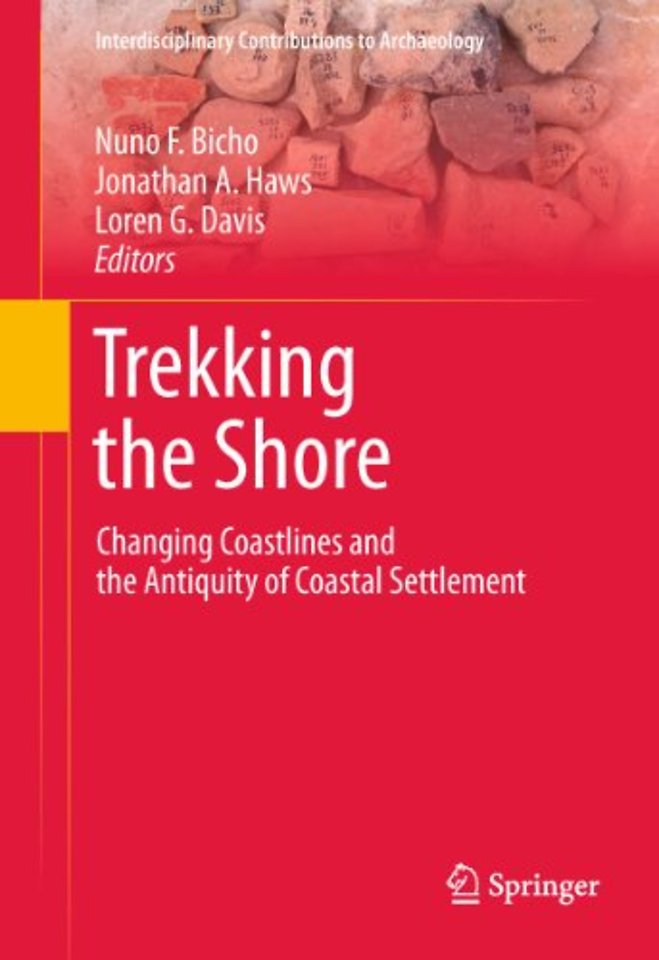
Trekking the Shore
Changing Coastlines and the Antiquity of Coastal Settlement
Samenvatting
Human settlement has often centered around coastal areas and waterways. Until recently, however, archaeologists believed that marine economies did not develop until the end of the Pleistocene, when the archaeological record begins to have evidence of marine life as part of the human diet. This has long been interpreted as a postglacial adaptation, due to the rise in sea level and subsequent decrease in terrestrial resources. Coastal resources, particularly mollusks, were viewed as fallback resources, which people resorted to only when terrestrial resources were scarce, included only as part of a more complex diet.
Recent research has significantly altered this understanding, known as the Broad Spectrum Revolution (BSR) model. The contributions to this volume revise the BSR model, with evidence that coastal resources were an important part of human economies and subsistence much earlier than previously thought, and even the main focus of diets for some Pleistocene and early Holocene hunter-gatherer societies.
With evidence from North and South America, Europe, Africa, Asia, and Australia, this volume comprehensively lends a new understanding to coastal settlement from the Middle Paleolithic to the Middle Holocene.
Specificaties
Inhoudsopgave
Net verschenen
Rubrieken
- aanbestedingsrecht
- aansprakelijkheids- en verzekeringsrecht
- accountancy
- algemeen juridisch
- arbeidsrecht
- bank- en effectenrecht
- bestuursrecht
- bouwrecht
- burgerlijk recht en procesrecht
- europees-internationaal recht
- fiscaal recht
- gezondheidsrecht
- insolventierecht
- intellectuele eigendom en ict-recht
- management
- mens en maatschappij
- milieu- en omgevingsrecht
- notarieel recht
- ondernemingsrecht
- pensioenrecht
- personen- en familierecht
- sociale zekerheidsrecht
- staatsrecht
- strafrecht en criminologie
- vastgoed- en huurrecht
- vreemdelingenrecht