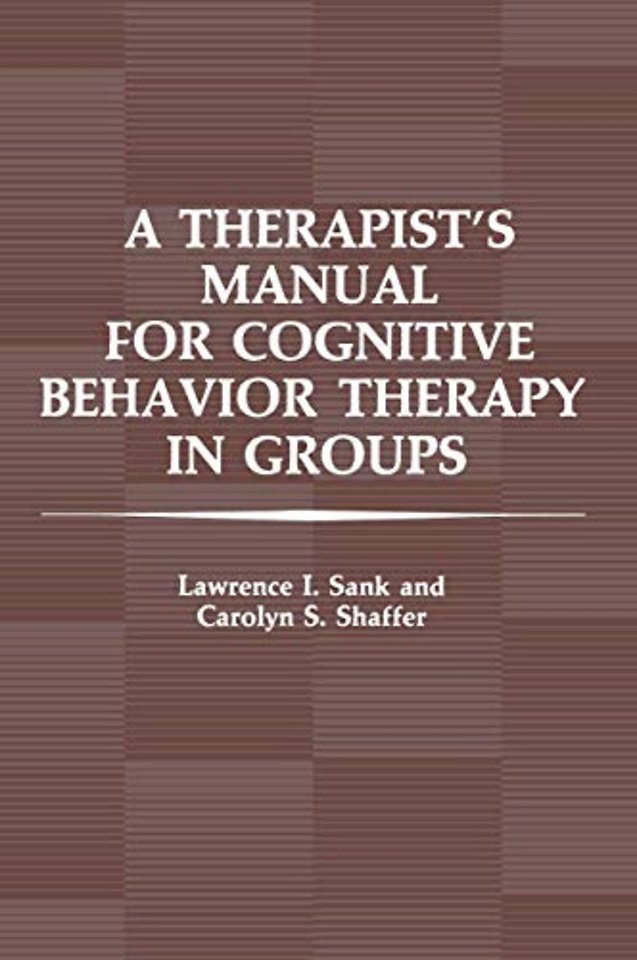
A Therapist’s Manual for Cognitive Behavior Therapy in Groups
Samenvatting
One of the great advantages of rational-emotive therapy (RET) and cog nitive behavior therapy (CBT) is that they frequently employ psycho educational methods-including bibliotherapy, workshops, lectures, courses, recordings, and films. I created RET at the beginning of 1955 after I had abandoned the practice of psychoanalysis because I found it to be highly inefficient and philosophically superficial. Being almost addicted to one-to-one therapy as a result of my analytic training and experience, I at first did RET only with individual clients and found this pioneering form of CBT considerably more effective than the other ther apies with which I had experimented. By 1957, however, I realized that RET could be taught to large num bers of persons through self-help books and articles and that RET -ori ented writings could not only prove valuable to the general public but that they could also be successfully employed to hasten and intensify the therapy of my individual clients. I therefore wrote a number of RET self help books-especially How to Live with a Neurotic (1957), Sex without Guilt (1958), A New Guide to Rational Living (with Robert A. Harper; original edition, 1961), and A Guide to Successful Marriage (with Robert A. Harper, 1961).
Specificaties
Inhoudsopgave
Net verschenen
Rubrieken
- aanbestedingsrecht
- aansprakelijkheids- en verzekeringsrecht
- accountancy
- algemeen juridisch
- arbeidsrecht
- bank- en effectenrecht
- bestuursrecht
- bouwrecht
- burgerlijk recht en procesrecht
- europees-internationaal recht
- fiscaal recht
- gezondheidsrecht
- insolventierecht
- intellectuele eigendom en ict-recht
- management
- mens en maatschappij
- milieu- en omgevingsrecht
- notarieel recht
- ondernemingsrecht
- pensioenrecht
- personen- en familierecht
- sociale zekerheidsrecht
- staatsrecht
- strafrecht en criminologie
- vastgoed- en huurrecht
- vreemdelingenrecht