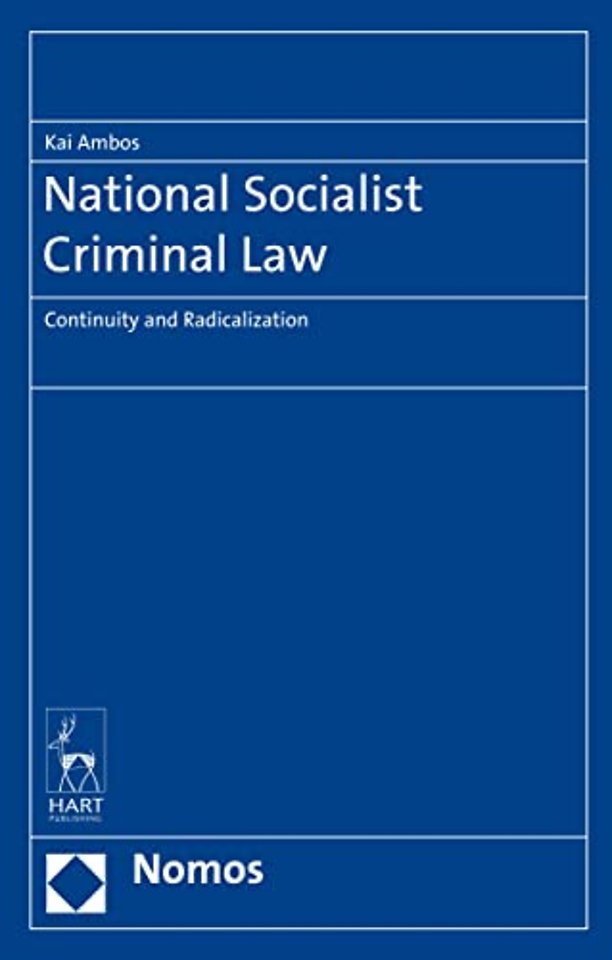
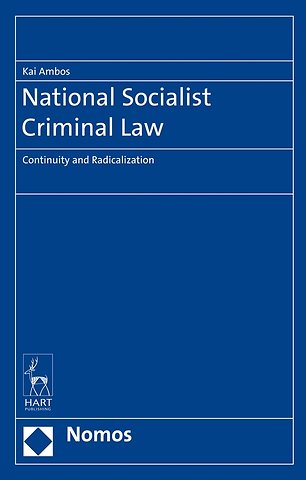
Nationalist Socialist Criminal Law

Continuity and Radicalization

Specificaties
Gebonden, 208 blz. | Engels
Hart Publishing | 1e druk, 2019
ISBN13: 9781509936786
Hart Publishing 1e druk, 2019 9781509936786
€ 123,56
Levertijd ongeveer 11 werkdagen
Gratis verzonden

Samenvatting

In line with theories of National Socialism as a continuation and radicalization of existing trends, this innovative study interprets Nazi criminal law as a racist (anti-Semitic), nationalist (“Germanic”), and totalitarian construct that continues and develops further the authoritarian and anti-liberal tendencies of German criminal law of the fin-de-siècle and the Weimar Republic. This is borne out by a systematic analysis of writings by relevant authors that focuses first and foremost on the texts, which speak for themselves, and is less concerned with morally judging the scholars who produced them.

Furthermore, the study shares novel insights on the reception of German (National Socialist) criminal law in Latin America. The aforementioned continuity existed not only between the Nazi period and the eras preceding it, but also between National Socialism and the period that followed (the Bonn Republic). In short, National Socialist criminal law neither came out of nowhere nor disappeared completely after 1945. Current identitarian attempts by the so-called Neue Rechte (“New Right”) to reconstruct the Germanic myth represent yet another continuation that links seamlessly to National Socialist ideology.

Specificaties

ISBN13:9781509936786
Taal:Engels
Bindwijze:gebonden
Aantal pagina's:208
Druk:1
Verschijningsdatum:14-11-2019

Over Kai Ambos

Kai Ambos, Professor of Criminal Law, Criminal Procedure, Comparative Law and International Criminal Law, Georg-August- Universität Göttingen, Germany; Judge, Provincial Court Göttingen Kai Ambos has been Chair of Criminal Law, Criminal Procedure, Comparative Law and International Criminal Law at the Georg-August-Universität Göttingen since May 2003 and Judge at the Provincial Court (Landgericht) of Göttingen since 2006. He has been Dean of Student Affairs between summer 2008 and 2010. From 1991 to 2003, he was senior research fellow at the Max-Planck-Institute for Foreign and International Criminal Law (Freiburg im Breisgau, Germany) in charge of the International Criminal Law and Spanish-speaking Latin America Sections. On behalf of Germany, he has participated in the negotiations on the creation of the International Criminal Court and later became a member of the expert working group of the German Federal Ministry of Justice on implementing the Rome Statute. He has also worked extensively in Latin America on human rights, drug-related issues and criminal law reforms. He has written widely on international criminal law and procedure.
Andere boeken door Kai Ambos

Inhoudsopgave

Chapter I. Preliminary Remarks
1. Zaffaroni's “Doctrina Penal Nazi”
2. My approach

Chapter II. The Foundations of National Socialist Criminal Law
1. Racism, Volksgemeinschaft, Führer state, Führer principle and exclusion
2. The material concept of justice and wrongdoing, ethicisation, “total” criminal law and deformalisation
3. General preventive and atonement-focused Willensstrafrecht (criminal law of the will)

Chapter III. Continuity and the “Schulenstreit” (“Dispute between the Schools”) (?)

Chapter IV. National Socialist Criminal Law and Neo-Kantianism
1. The (alleged) influence of Neo-Kantianism
2. The “Marburg School of Neo-Kantianism”
3. Neo-Kantianism-a forerunner of National Socialist criminal law?
4. Collectivism and material theories of value-forerunners of National Socialist criminal law?

Chapter V. The Independent National Socialist Criminal Law of the Kiel School
1. Basic orientation and main representatives
2. Criminal policy: an authoritarian NS criminal law
3. The role of the judge in the NS Führer state
4. Loyalty, breaches of duty, honour punishments
5. Concrete Wesensschau (focus on the substance of the offence), Täterstrafrecht (agent-focused criminal law) and Willensstrafrecht (criminal law of the will)
6. A comprehensive actus reus defined by overall disvalue (“offence type”) instead of a structured theory of crime

Chapter VI. Erik Wolf: From Perpetrator Types to an Attitudinal Theory of Agency
1. Authoritarian-social criminal law and theory of agency
2. Wolf's turn towards and away from National Socialism

Chapter VII. Some (preliminary) conclusions
1. Selective reception of German (NS-inspired) criminal law in Latin America
2. Did Hans Welzel truly overcome (Neo-Kantian) NS criminal law?
3. A continuity of National Socialist criminal law thought in Latin America?

Net verschenen

€ 123,56
Levertijd ongeveer 11 werkdagen
Gratis verzonden

Rubrieken

    Personen

      Trefwoorden

        Nationalist Socialist Criminal Law