O Cazacu
John Wiley & Sons
e druk, 2008
9781848210479
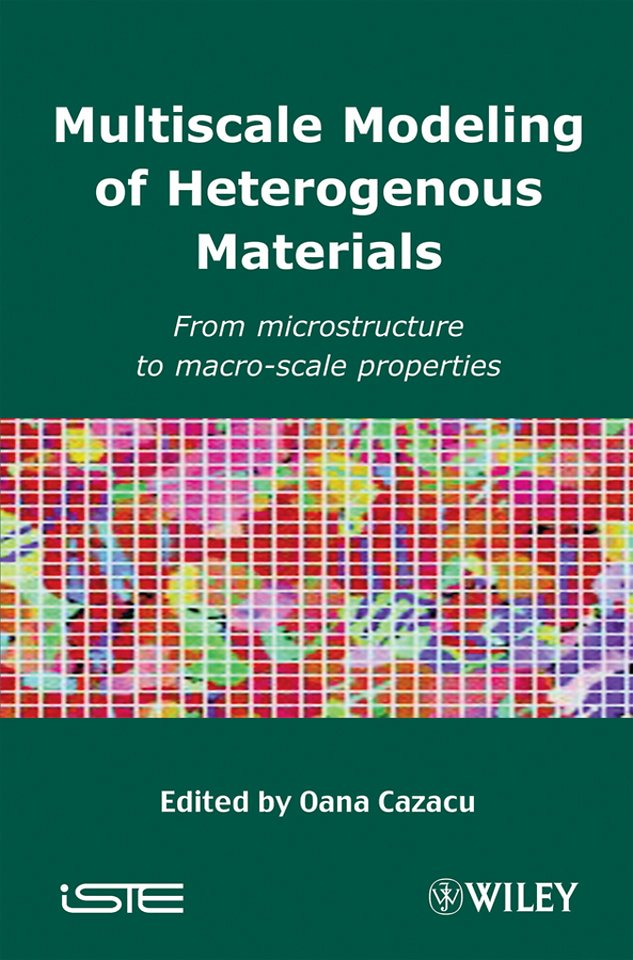
Multiscale Modeling of Heterogenous Materials – From Microstructure to Macro–Scale Properties
From Microstructure to Macro–Scale Properties
Specificaties
Gebonden, 344 blz.
|
Engels
John Wiley & Sons |
e druk, 2008
ISBN13: 9781848210479
Rubricering
Juridisch
:
Onderdeel van serie
ISTE
Levertijd ongeveer 16 werkdagen
Gratis verzonden
Samenvatting
A material′s various proprieties is based on its microscopic and nanoscale structures. This book provides an overview of recent advances in computational methods for linking phenomena in systems that span large ranges of time and spatial scales. Particular attention is given to predicting macroscopic properties based on subscale behaviors. Given the book s extensive coverage of multi–scale methods for modeling both metallic and geologic materials, it will be an invaluable reading for graduate students, scientists, and practitioners alike.
Specificaties
ISBN13:9781848210479
Taal:Engels
Bindwijze:gebonden
Aantal pagina's:344
Uitgever:John Wiley & Sons
Serie:ISTE
Inhoudsopgave
<p>Foreword xiii</p>
<p>Chapter 1. Accounting for Plastic Strain Heterogenities in Modeling Polycrystalline Plasticity: Microstructure–based Multi–laminate Approaches 1<br /> Patrick FRANCIOSI</p>
<p>1.1. Introduction 1</p>
<p>1.2. Polycrystal morphology in terms of grain and sub–grain boundaries 2</p>
<p>1.2.1. Some evidence of piece–wise regularity for grain boundaries 2</p>
<p>1.2.2. Characteristics of plastic–strain due to sub–grain boundaries 3</p>
<p>1.3. Sub–boundaries and multi–laminate structure for heterogenous plasticity 5</p>
<p>1.3.1. Effective moduli tensor and Green operator of multi–laminate structures 6</p>
<p>1.3.2. Multi–laminate structures and piece–wise homogenous plasticity 10</p>
<p>1.4. Application to polycrystal plasticity within the affine approximation 10</p>
<p>1.4.1. Constitutive relations 10</p>
<p>1.4.2. Fundamental properties for multi–laminate modeling of plasticity 14</p>
<p>1.5. Conclusion 15</p>
<p>1.6. Bibliography 15</p>
<p>Chapter 2. Discrete Dislocation Dynamics: Principles and Recent Applications 17<br /> Marc FIVEL</p>
<p>2.1. Discrete Dislocation Dynamics as a link in multiscale modeling 17</p>
<p>2.2. Principle of Discrete Dislocation Dynamics 19</p>
<p>2.3. Example of scale transition: from DD to Continuum Mechanics 21</p>
<p>2.3.1. Introduction to a dislocation density model 21</p>
<p>2.3.1.1. Constitutive equations of a dislocation based model of crystal plasticity 22</p>
<p>2.3.1.2. Parameter identification 24</p>
<p>2.3.1.3. Application to copper simulations 25</p>
<p>2.3.1.4. Taking into account kinematic hardening 26</p>
<p>2.4. Example of DD analysis: simulations of crack initiation in fatigue 29</p>
<p>2.4.1. Case of single phase AISI 31GL 29</p>
<p>2.5. Conclusions 32</p>
<p>2.6. Bibliography 33<br /> <br /> Chapter 3. Multiscale Modeling of Large Strain Phenomenain Polycrystalline Metals 37<br /> Kaan INAL and Raj. K. MISHRA</p>
<p>3.1. Implementation of polycrystal plasticity in finite element analysis 39</p>
<p>3.2. Kinematics and constitutive framework 41</p>
<p>3.3. Forward Euler algorithm 44</p>
<p>3.4. Validation of the forward Euler algorithm 46</p>
<p>3.5. Time step issues in the forward Euler scheme 49</p>
<p>3.6. Comparisons of CPU times: the rate tangent versus the forward Euler methods 51</p>
<p>3.7. Conclusions 52</p>
<p>3.8. Acknowledgements 52</p>
<p>3.9. Bibliography 52</p>
<p>Chapter 4. Earth Mantle Rheology Inferred from Homogenization Theories 55<br /> Olivier CASTELNAU, Ricardo LEBENSOHN, Pedro Ponte CASTAÑEDA and Donna BLACKMAN</p>
<p>4.1. Introduction 55</p>
<p>4.2. Grain local behavior 57</p>
<p>4.3. Full–field reference solutions 59</p>
<p>4.4. Mean–field estimates 62</p>
<p>4.4.1. Basic features of mean–field theories 62</p>
<p>4.4.2. Results 64</p>
<p>4.5. Concluding observations 66</p>
<p>4.6. Bibliography 68</p>
<p>Chapter 5. Modeling Plastic Anistropy and Strength Differential Effects in Metallic Materials 71<br /> Oana CAZACU and Frédéric BARLAT</p>
<p>5.1. Introduction 71</p>
<p>5.2. Isotropic yield criteria 72</p>
<p>5.2.1. Pressure insensitive materials deforming by slip 72</p>
<p>5.2.2. Pressure insensitive materials deforming by twinning 73</p>
<p>5.2.3. Pressure insensitive materials with non–Schmid effects 76</p>
<p>5.2.4. Pressure sensitive materials 78</p>
<p>5.2.5. SD effect and plastic flow 80</p>
<p>5.3. Anisotropic yield criteria with SD effects 80</p>
<p>5.3.1. Cazacu and Barlat [CAZ 04] orthotropic yield criterion 80</p>
<p>5.3.2. Cazacu Plunkett Barlat yield criterion [CAZ 06] 82</p>
<p>5.4. Modeling anisotropic hardening due to texture evolution 83</p>
<p>5.5. Conclusions and future perspectives 86</p>
<p>5.6. Bibliography 87</p>
<p>Chapter 6. Shear Bands in Steel Plates under Impact Loading 91<br /> George Z. VOYIADJIS and Amin H. ALMASRI</p>
<p>6.1. Introduction 91</p>
<p>6.2. Viscoplasticity and constitutive modeling 92</p>
<p>6.3. Higher order gradient theory 97</p>
<p>6.4. Two–dimensional plate subjected to velocity boundary conditions 102</p>
<p>6.5. Shear band in steel plate punch 105</p>
<p>6.6. Conclusions 108</p>
<p>6.7. Bibliography 109</p>
<p>Chapter 7. Viscoplastic Modeling of Anisotropic Textured Metals 111<br /> Brian PLUNKETT and Oana CAZACU</p>
<p>7.1. Introduction 111</p>
<p>7.2. Anisotropic elastoviscoplastic model 113</p>
<p>7.3. Application to zirconium. 115</p>
<p>7.3.1. Quasi–static deformation of zirconium 115</p>
<p>7.3.2. High strain–rate deformation of zirconium 120</p>
<p>7.4. High strain–rate deformation of tantalum 124</p>
<p>7.5. Conclusions125</p>
<p>7.6. Bibliography 126</p>
<p>Chapter 8. Non–linear Elastic Inhomogenous Materials: Uniform Strain Fields and Exact Relations 129<br /> Qi–Chang HE, B. BARY and Hung LE QUANG</p>
<p>8.1. Introduction 129</p>
<p>8.2. Locally uniform strain fields 130</p>
<p>8.3. Exact relations for the effective elastic tangent moduli 136</p>
<p>8.4. Cubic polycrystals 139</p>
<p>8.5. Power–law fibrous composites 144</p>
<p>8.6. Conclusion 149</p>
<p>8.7. Bibliography 149</p>
<p>Chapter 9. 3D Continuous and Discrete Modeling of Bifurcations in Geomaterials 153<br /> Florent PRUNIER, Félix DARVE, Luc SIBILLE and François NICOT</p>
<p>9.1. Introduction 153</p>
<p>9.2. 3D bifurcations exhibited by an incrementally non–linear constitutive relation 155</p>
<p>9.2.1. Incrementally non–linear and piecewise linear relations 155</p>
<p>9.2.2. 3D analysis of the second–order work with phenomenological constitutive models 157</p>
<p>9.3. Discrete modeling of the failure mode related to second–order work criterion 165</p>
<p>9.4. Conclusions 173</p>
<p>9.5. Acknowledgements 174</p>
<p>9.6. Bibliography 174</p>
<p>Chapter 10. Non–linear Micro–cracked Geomaterials: Anisotropic Damage and Coupling with Plasticity 177<br /> Djimédo KONDO, Qizhi ZHU, Vincent MONCHIET and Jian–Fu SHAO</p>
<p>10.1. Introduction 177</p>
<p>10.2. Anisotropic elastic damage model with unilateral effects 179</p>
<p>10.2.1. Homogenization of elastic micro–cracked media 179</p>
<p>10.2.1.1. Micromechanics of media with random microstructure 179</p>
<p>10.2.1.2. Application to micro–cracked media 180</p>
<p>10.2.2. Micro–crack closure condition and damage evolution 181</p>
<p>10.2.2.1. Micro–crack closure effects and unilateral damage 181</p>
<p>10.2.2.2. Damage criterion and evolution law 182</p>
<p>10.2.3. Non–local micromechanics–based damage model 183</p>
<p>10.2.4. Application of the model 184</p>
<p>10.2.4.1. Uniaxial tensile tests 184</p>
<p>10.2.4.2. Predictions of the anisotropic damage model for William s test 185</p>
<p>10.2.4.3. Numerical analysis of Hassanzadeh s direct tension test 188</p>
<p>10.3. A new model for ductile micro–cracked materials 188</p>
<p>10.3.1. Introductory observations 188</p>
<p>10.3.2. Basic concepts and methodology of the limit analysis approach 190</p>
<p>10.3.2.1. Representative volume element with oblate voids 190</p>
<p>10.3.2.2. The Eshelby–like velocity field 191</p>
<p>10.3.3. Determination of the macroscopic yield surface 192</p>
<p>10.3.3.1. The question of the boundary conditions 192</p>
<p>10.3.3.2. Principle of the determination of the yield function 193</p>
<p>10.3.3.3. Closed form expression of the macroscopic yield function 193</p>
<p>10.3.4. The particular case of penny–shaped cracks 195</p>
<p>10.4. Conclusions 197</p>
<p>10.5. Acknowledgement 198</p>
<p>10.6. Appendix 198</p>
<p>10.7. Bibliography 198</p>
<p>Chapter 11. Bifurcation in Granular Materials: A Multiscale Approach 203<br /> François NICOT, Luc SIBILLE and Félix DARVE</p>
<p>11.1. Introduction 203</p>
<p>11.2. Microstructural origin of the vanishing of the second–order work 205</p>
<p>11.2.1. The micro–directional model 205</p>
<p>11.2.2. Microstructural expression of the macroscopic second–order work 206</p>
<p>11.2.3. From micro to macro second–order work 208</p>
<p>11.2.4. Micromechanical analysis of the vanishing of the second–order work 210</p>
<p>11.3. Some remarks on the basic micro–macro relation for the second–order work 212</p>
<p>11.4. Conclusion 213</p>
<p>11.5. Bibliography 214</p>
<p>Chapter 12. Direct Scale Transition Approach for Highly–filled Viscohyperelastic Particulate Composites: Computational Study 215<br /> Carole NADOT–MARTIN, Marion TOUBOUL, André DRAGON and Alain FANGET</p>
<p>12.1. Morphological approach in the finite strain framework 216</p>
<p>12.1.1. Geometric schematization 216</p>
<p>12.1.2. Localization–homogenization problem 217</p>
<p>12.1.2.1. Principal tools and stages 217</p>
<p>12.1.2.2. Solving procedure 219</p>
<p>12.2. Evaluation involving FEM/MA confrontations 221</p>
<p>12.2.1. Material geometry, relative representations 221</p>
<p>12.2.2. Loading paths, methodology of analysis 223</p>
<p>12.2.3. MA estimates compared to FEM results for hyperelastic constituents 225</p>
<p>12.2.4. Evaluation involving viscohyperelastic behavior of the matrix 229</p>
<p>12.3. Conclusions and prospects 232</p>
<p>12.4. Bibliography 234</p>
<p>Chapter 13. A Modified Incremental Homogenization Approach for Non–linear Behaviors of Heterogenous Cohesive Geomaterials 237<br /> Ariane ABOU–CHAKRA GUÉRY, Fabrice CORMERY, Jian–Fu SHAO and Djimédo KONDO</p>
<p>13.1. Introduction 237</p>
<p>13.2. Experimental observations on the Callovo–Oxfordian argillite behavior 238</p>
<p>13.2.1. Microstructure and mineralogical composition of the material 238</p>
<p>13.2.2. Brief summary of the macroscopic behavior of the material 239</p>
<p>13.3. Incremental formulation of the homogenized constitutive relation 240</p>
<p>13.3.1. Introduction 240</p>
<p>13.3.2. Limitations of Hill s incremental method 242</p>
<p>13.3.3. Modified Hill s incremental method 243</p>
<p>13.4. Modifying of the local constituents behaviors 244</p>
<p>13.4.1. Elastoplastic behavior of the clay phase 244</p>
<p>13.4.2. Elastic unilateral damage behavior of the calcite phase 245</p>
<p>13.5. Implementation and numerical validation of the model 247</p>
<p>13.5.1. Local integration of the micromechanical model 247</p>
<p>13.5.2. Comparison with unit cell (finite element) calculation 248</p>
<p>13.6. Calibration and experimental validations of the modified incremental micromechanical model 248</p>
<p>13.7. Conclusions 249</p>
<p>13.8. Acknowledgement 251</p>
<p>13.9. Bibliography 251</p>
<p>Chapter 14. Meso– to Macro–scale Probability Aspects for Size Effects and Heterogenous Materials Failure 253<br /> Jean–Baptiste COLLIAT, Martin HAUTEFEUILLE and Adnan IBRAHIMBEGOVIC</p>
<p>14.1. Introduction 253</p>
<p>14.2. Meso–scale deterministic model 254</p>
<p>14.2.1. Structured meshes and kinematic enhancements 255</p>
<p>14.2.2. Operator split solution for interface failure 257</p>
<p>14.2.3. Comparison between structured and unstructured mesh approach 258</p>
<p>14.3. Probability aspects of inelastic localized failure for heterogenous materials 259</p>
<p>14.3.1. Meso–scale geometry description 260</p>
<p>14.3.2. Stochastic integration 261</p>
<p>14.4. Results of the probabilistic characterization of the two phase material 263</p>
<p>14.4.1. Determination of SRVE size 263</p>
<p>14.4.2. Numerical results and discussion 264</p>
<p>14.5. Size effect modeling 266</p>
<p>14.5.1. Random fields and the Karhunen–Loeve expansion 267</p>
<p>14.5.2. Size effect and correlation length 269</p>
<p>14.6. Conclusion 271</p>
<p>14.7. Acknowledgments 272</p>
<p>14.8. Bibliography 272</p>
<p>Chapter 15. Damage and Permeability in Quasi–brittle Materials: from Diffuse to Localized Properties 277<br /> Gilles PIJAUDIER–CABOT, Frédéric DUFOUR and Marta CHOINSKA</p>
<p>15.1. Introduction 277</p>
<p>15.2. Mechanical problem continuum damage modeling 279</p>
<p>15.3. Permeability matching law 281</p>
<p>15.3.1. Diffuse damage 281</p>
<p>15.3.2. Localized damage crack opening versus permeability 281</p>
<p>15.3.3. Matching law 283</p>
<p>15.4. Calculation of a crack opening in continuum damage calculations 283</p>
<p>15.5. Structural simulations 286</p>
<p>15.5.1. Mechanical problem Brazilian splitting test 287</p>
<p>15.5.2. Evolution of apparent permeability 289</p>
<p>15.6. Conclusions 291</p>
<p>15.7. Acknowledgement 291</p>
<p>15.8. Bibliography 291</p>
<p>Chapter 16. A Multiscale Modeling of Granular Materials with Surface Energy Forces 293<br /> Pierre–Yves HICHER and Ching S. CHANG</p>
<p>16.1. Introduction 293</p>
<p>16.2. Stress–strain model 294</p>
<p>16.2.1. Inter–particle behavior 296</p>
<p>16.2.1.1. Elastic part 296</p>
<p>16.2.1.2. Plastic part 296</p>
<p>16.2.1.3. Interlocking influence 297</p>
<p>16.2.1.4. Elastoplastic force–displacement relationship 298</p>
<p>16.2.2. Stress–strain relationship 298</p>
<p>16.2.2.1. Micro–macro relationship 298</p>
<p>16.2.2.2. Calculation scheme 300</p>
<p>16.2.3. Summary of parameters 301</p>
<p>16.3. Results of numerical simulation without surface energy forces consideration 302</p>
<p>16.4. Granular material with surface energy forces: the example of lunar soil 306</p>
<p>16.4.1. Van der Waals forces 308</p>
<p>16.4.2. Triaxial tests with consideration of surface energy forces 311</p>
<p>16.5. Summary and conclusion 314</p>
<p>16.6. Bibliography 315</p>
<p>Chapter 17. Length Scales in Mechanics of Granular Solids 319<br /> Farhang RADJAI</p>
<p>17.1. Introduction 319</p>
<p>17.2. Model description 320</p>
<p>17.3. Force chains 321</p>
<p>17.3.1. Probability density functions 321</p>
<p>17.3.2. Bimodal character of stress transmission 322</p>
<p>17.3.3. Spatial correlations 324</p>
<p>17.4. Fluctuating particle displacements 325</p>
<p>17.4.1. Uniform strain and fluctuations 325</p>
<p>17.4.2. Scale–dependent pdfs 326</p>
<p>17.4.3. Spatial correlations 328</p>
<p>17.4.4. Granulence 329</p>
<p>17.5. Friction mobilization 330</p>
<p>17.5.1. Critical contacts 330</p>
<p>17.5.2. Evolution of critical contacts 330</p>
<p>17.5.3. Spatial correlations 331</p>
<p>17.6. Conclusion 332</p>
<p>17.7. Acknowledgements 333</p>
<p>17.8. Bibliography 333</p>
<p>List of Authors 337</p>
<p>Index 341</p>
<p>Chapter 1. Accounting for Plastic Strain Heterogenities in Modeling Polycrystalline Plasticity: Microstructure–based Multi–laminate Approaches 1<br /> Patrick FRANCIOSI</p>
<p>1.1. Introduction 1</p>
<p>1.2. Polycrystal morphology in terms of grain and sub–grain boundaries 2</p>
<p>1.2.1. Some evidence of piece–wise regularity for grain boundaries 2</p>
<p>1.2.2. Characteristics of plastic–strain due to sub–grain boundaries 3</p>
<p>1.3. Sub–boundaries and multi–laminate structure for heterogenous plasticity 5</p>
<p>1.3.1. Effective moduli tensor and Green operator of multi–laminate structures 6</p>
<p>1.3.2. Multi–laminate structures and piece–wise homogenous plasticity 10</p>
<p>1.4. Application to polycrystal plasticity within the affine approximation 10</p>
<p>1.4.1. Constitutive relations 10</p>
<p>1.4.2. Fundamental properties for multi–laminate modeling of plasticity 14</p>
<p>1.5. Conclusion 15</p>
<p>1.6. Bibliography 15</p>
<p>Chapter 2. Discrete Dislocation Dynamics: Principles and Recent Applications 17<br /> Marc FIVEL</p>
<p>2.1. Discrete Dislocation Dynamics as a link in multiscale modeling 17</p>
<p>2.2. Principle of Discrete Dislocation Dynamics 19</p>
<p>2.3. Example of scale transition: from DD to Continuum Mechanics 21</p>
<p>2.3.1. Introduction to a dislocation density model 21</p>
<p>2.3.1.1. Constitutive equations of a dislocation based model of crystal plasticity 22</p>
<p>2.3.1.2. Parameter identification 24</p>
<p>2.3.1.3. Application to copper simulations 25</p>
<p>2.3.1.4. Taking into account kinematic hardening 26</p>
<p>2.4. Example of DD analysis: simulations of crack initiation in fatigue 29</p>
<p>2.4.1. Case of single phase AISI 31GL 29</p>
<p>2.5. Conclusions 32</p>
<p>2.6. Bibliography 33<br /> <br /> Chapter 3. Multiscale Modeling of Large Strain Phenomenain Polycrystalline Metals 37<br /> Kaan INAL and Raj. K. MISHRA</p>
<p>3.1. Implementation of polycrystal plasticity in finite element analysis 39</p>
<p>3.2. Kinematics and constitutive framework 41</p>
<p>3.3. Forward Euler algorithm 44</p>
<p>3.4. Validation of the forward Euler algorithm 46</p>
<p>3.5. Time step issues in the forward Euler scheme 49</p>
<p>3.6. Comparisons of CPU times: the rate tangent versus the forward Euler methods 51</p>
<p>3.7. Conclusions 52</p>
<p>3.8. Acknowledgements 52</p>
<p>3.9. Bibliography 52</p>
<p>Chapter 4. Earth Mantle Rheology Inferred from Homogenization Theories 55<br /> Olivier CASTELNAU, Ricardo LEBENSOHN, Pedro Ponte CASTAÑEDA and Donna BLACKMAN</p>
<p>4.1. Introduction 55</p>
<p>4.2. Grain local behavior 57</p>
<p>4.3. Full–field reference solutions 59</p>
<p>4.4. Mean–field estimates 62</p>
<p>4.4.1. Basic features of mean–field theories 62</p>
<p>4.4.2. Results 64</p>
<p>4.5. Concluding observations 66</p>
<p>4.6. Bibliography 68</p>
<p>Chapter 5. Modeling Plastic Anistropy and Strength Differential Effects in Metallic Materials 71<br /> Oana CAZACU and Frédéric BARLAT</p>
<p>5.1. Introduction 71</p>
<p>5.2. Isotropic yield criteria 72</p>
<p>5.2.1. Pressure insensitive materials deforming by slip 72</p>
<p>5.2.2. Pressure insensitive materials deforming by twinning 73</p>
<p>5.2.3. Pressure insensitive materials with non–Schmid effects 76</p>
<p>5.2.4. Pressure sensitive materials 78</p>
<p>5.2.5. SD effect and plastic flow 80</p>
<p>5.3. Anisotropic yield criteria with SD effects 80</p>
<p>5.3.1. Cazacu and Barlat [CAZ 04] orthotropic yield criterion 80</p>
<p>5.3.2. Cazacu Plunkett Barlat yield criterion [CAZ 06] 82</p>
<p>5.4. Modeling anisotropic hardening due to texture evolution 83</p>
<p>5.5. Conclusions and future perspectives 86</p>
<p>5.6. Bibliography 87</p>
<p>Chapter 6. Shear Bands in Steel Plates under Impact Loading 91<br /> George Z. VOYIADJIS and Amin H. ALMASRI</p>
<p>6.1. Introduction 91</p>
<p>6.2. Viscoplasticity and constitutive modeling 92</p>
<p>6.3. Higher order gradient theory 97</p>
<p>6.4. Two–dimensional plate subjected to velocity boundary conditions 102</p>
<p>6.5. Shear band in steel plate punch 105</p>
<p>6.6. Conclusions 108</p>
<p>6.7. Bibliography 109</p>
<p>Chapter 7. Viscoplastic Modeling of Anisotropic Textured Metals 111<br /> Brian PLUNKETT and Oana CAZACU</p>
<p>7.1. Introduction 111</p>
<p>7.2. Anisotropic elastoviscoplastic model 113</p>
<p>7.3. Application to zirconium. 115</p>
<p>7.3.1. Quasi–static deformation of zirconium 115</p>
<p>7.3.2. High strain–rate deformation of zirconium 120</p>
<p>7.4. High strain–rate deformation of tantalum 124</p>
<p>7.5. Conclusions125</p>
<p>7.6. Bibliography 126</p>
<p>Chapter 8. Non–linear Elastic Inhomogenous Materials: Uniform Strain Fields and Exact Relations 129<br /> Qi–Chang HE, B. BARY and Hung LE QUANG</p>
<p>8.1. Introduction 129</p>
<p>8.2. Locally uniform strain fields 130</p>
<p>8.3. Exact relations for the effective elastic tangent moduli 136</p>
<p>8.4. Cubic polycrystals 139</p>
<p>8.5. Power–law fibrous composites 144</p>
<p>8.6. Conclusion 149</p>
<p>8.7. Bibliography 149</p>
<p>Chapter 9. 3D Continuous and Discrete Modeling of Bifurcations in Geomaterials 153<br /> Florent PRUNIER, Félix DARVE, Luc SIBILLE and François NICOT</p>
<p>9.1. Introduction 153</p>
<p>9.2. 3D bifurcations exhibited by an incrementally non–linear constitutive relation 155</p>
<p>9.2.1. Incrementally non–linear and piecewise linear relations 155</p>
<p>9.2.2. 3D analysis of the second–order work with phenomenological constitutive models 157</p>
<p>9.3. Discrete modeling of the failure mode related to second–order work criterion 165</p>
<p>9.4. Conclusions 173</p>
<p>9.5. Acknowledgements 174</p>
<p>9.6. Bibliography 174</p>
<p>Chapter 10. Non–linear Micro–cracked Geomaterials: Anisotropic Damage and Coupling with Plasticity 177<br /> Djimédo KONDO, Qizhi ZHU, Vincent MONCHIET and Jian–Fu SHAO</p>
<p>10.1. Introduction 177</p>
<p>10.2. Anisotropic elastic damage model with unilateral effects 179</p>
<p>10.2.1. Homogenization of elastic micro–cracked media 179</p>
<p>10.2.1.1. Micromechanics of media with random microstructure 179</p>
<p>10.2.1.2. Application to micro–cracked media 180</p>
<p>10.2.2. Micro–crack closure condition and damage evolution 181</p>
<p>10.2.2.1. Micro–crack closure effects and unilateral damage 181</p>
<p>10.2.2.2. Damage criterion and evolution law 182</p>
<p>10.2.3. Non–local micromechanics–based damage model 183</p>
<p>10.2.4. Application of the model 184</p>
<p>10.2.4.1. Uniaxial tensile tests 184</p>
<p>10.2.4.2. Predictions of the anisotropic damage model for William s test 185</p>
<p>10.2.4.3. Numerical analysis of Hassanzadeh s direct tension test 188</p>
<p>10.3. A new model for ductile micro–cracked materials 188</p>
<p>10.3.1. Introductory observations 188</p>
<p>10.3.2. Basic concepts and methodology of the limit analysis approach 190</p>
<p>10.3.2.1. Representative volume element with oblate voids 190</p>
<p>10.3.2.2. The Eshelby–like velocity field 191</p>
<p>10.3.3. Determination of the macroscopic yield surface 192</p>
<p>10.3.3.1. The question of the boundary conditions 192</p>
<p>10.3.3.2. Principle of the determination of the yield function 193</p>
<p>10.3.3.3. Closed form expression of the macroscopic yield function 193</p>
<p>10.3.4. The particular case of penny–shaped cracks 195</p>
<p>10.4. Conclusions 197</p>
<p>10.5. Acknowledgement 198</p>
<p>10.6. Appendix 198</p>
<p>10.7. Bibliography 198</p>
<p>Chapter 11. Bifurcation in Granular Materials: A Multiscale Approach 203<br /> François NICOT, Luc SIBILLE and Félix DARVE</p>
<p>11.1. Introduction 203</p>
<p>11.2. Microstructural origin of the vanishing of the second–order work 205</p>
<p>11.2.1. The micro–directional model 205</p>
<p>11.2.2. Microstructural expression of the macroscopic second–order work 206</p>
<p>11.2.3. From micro to macro second–order work 208</p>
<p>11.2.4. Micromechanical analysis of the vanishing of the second–order work 210</p>
<p>11.3. Some remarks on the basic micro–macro relation for the second–order work 212</p>
<p>11.4. Conclusion 213</p>
<p>11.5. Bibliography 214</p>
<p>Chapter 12. Direct Scale Transition Approach for Highly–filled Viscohyperelastic Particulate Composites: Computational Study 215<br /> Carole NADOT–MARTIN, Marion TOUBOUL, André DRAGON and Alain FANGET</p>
<p>12.1. Morphological approach in the finite strain framework 216</p>
<p>12.1.1. Geometric schematization 216</p>
<p>12.1.2. Localization–homogenization problem 217</p>
<p>12.1.2.1. Principal tools and stages 217</p>
<p>12.1.2.2. Solving procedure 219</p>
<p>12.2. Evaluation involving FEM/MA confrontations 221</p>
<p>12.2.1. Material geometry, relative representations 221</p>
<p>12.2.2. Loading paths, methodology of analysis 223</p>
<p>12.2.3. MA estimates compared to FEM results for hyperelastic constituents 225</p>
<p>12.2.4. Evaluation involving viscohyperelastic behavior of the matrix 229</p>
<p>12.3. Conclusions and prospects 232</p>
<p>12.4. Bibliography 234</p>
<p>Chapter 13. A Modified Incremental Homogenization Approach for Non–linear Behaviors of Heterogenous Cohesive Geomaterials 237<br /> Ariane ABOU–CHAKRA GUÉRY, Fabrice CORMERY, Jian–Fu SHAO and Djimédo KONDO</p>
<p>13.1. Introduction 237</p>
<p>13.2. Experimental observations on the Callovo–Oxfordian argillite behavior 238</p>
<p>13.2.1. Microstructure and mineralogical composition of the material 238</p>
<p>13.2.2. Brief summary of the macroscopic behavior of the material 239</p>
<p>13.3. Incremental formulation of the homogenized constitutive relation 240</p>
<p>13.3.1. Introduction 240</p>
<p>13.3.2. Limitations of Hill s incremental method 242</p>
<p>13.3.3. Modified Hill s incremental method 243</p>
<p>13.4. Modifying of the local constituents behaviors 244</p>
<p>13.4.1. Elastoplastic behavior of the clay phase 244</p>
<p>13.4.2. Elastic unilateral damage behavior of the calcite phase 245</p>
<p>13.5. Implementation and numerical validation of the model 247</p>
<p>13.5.1. Local integration of the micromechanical model 247</p>
<p>13.5.2. Comparison with unit cell (finite element) calculation 248</p>
<p>13.6. Calibration and experimental validations of the modified incremental micromechanical model 248</p>
<p>13.7. Conclusions 249</p>
<p>13.8. Acknowledgement 251</p>
<p>13.9. Bibliography 251</p>
<p>Chapter 14. Meso– to Macro–scale Probability Aspects for Size Effects and Heterogenous Materials Failure 253<br /> Jean–Baptiste COLLIAT, Martin HAUTEFEUILLE and Adnan IBRAHIMBEGOVIC</p>
<p>14.1. Introduction 253</p>
<p>14.2. Meso–scale deterministic model 254</p>
<p>14.2.1. Structured meshes and kinematic enhancements 255</p>
<p>14.2.2. Operator split solution for interface failure 257</p>
<p>14.2.3. Comparison between structured and unstructured mesh approach 258</p>
<p>14.3. Probability aspects of inelastic localized failure for heterogenous materials 259</p>
<p>14.3.1. Meso–scale geometry description 260</p>
<p>14.3.2. Stochastic integration 261</p>
<p>14.4. Results of the probabilistic characterization of the two phase material 263</p>
<p>14.4.1. Determination of SRVE size 263</p>
<p>14.4.2. Numerical results and discussion 264</p>
<p>14.5. Size effect modeling 266</p>
<p>14.5.1. Random fields and the Karhunen–Loeve expansion 267</p>
<p>14.5.2. Size effect and correlation length 269</p>
<p>14.6. Conclusion 271</p>
<p>14.7. Acknowledgments 272</p>
<p>14.8. Bibliography 272</p>
<p>Chapter 15. Damage and Permeability in Quasi–brittle Materials: from Diffuse to Localized Properties 277<br /> Gilles PIJAUDIER–CABOT, Frédéric DUFOUR and Marta CHOINSKA</p>
<p>15.1. Introduction 277</p>
<p>15.2. Mechanical problem continuum damage modeling 279</p>
<p>15.3. Permeability matching law 281</p>
<p>15.3.1. Diffuse damage 281</p>
<p>15.3.2. Localized damage crack opening versus permeability 281</p>
<p>15.3.3. Matching law 283</p>
<p>15.4. Calculation of a crack opening in continuum damage calculations 283</p>
<p>15.5. Structural simulations 286</p>
<p>15.5.1. Mechanical problem Brazilian splitting test 287</p>
<p>15.5.2. Evolution of apparent permeability 289</p>
<p>15.6. Conclusions 291</p>
<p>15.7. Acknowledgement 291</p>
<p>15.8. Bibliography 291</p>
<p>Chapter 16. A Multiscale Modeling of Granular Materials with Surface Energy Forces 293<br /> Pierre–Yves HICHER and Ching S. CHANG</p>
<p>16.1. Introduction 293</p>
<p>16.2. Stress–strain model 294</p>
<p>16.2.1. Inter–particle behavior 296</p>
<p>16.2.1.1. Elastic part 296</p>
<p>16.2.1.2. Plastic part 296</p>
<p>16.2.1.3. Interlocking influence 297</p>
<p>16.2.1.4. Elastoplastic force–displacement relationship 298</p>
<p>16.2.2. Stress–strain relationship 298</p>
<p>16.2.2.1. Micro–macro relationship 298</p>
<p>16.2.2.2. Calculation scheme 300</p>
<p>16.2.3. Summary of parameters 301</p>
<p>16.3. Results of numerical simulation without surface energy forces consideration 302</p>
<p>16.4. Granular material with surface energy forces: the example of lunar soil 306</p>
<p>16.4.1. Van der Waals forces 308</p>
<p>16.4.2. Triaxial tests with consideration of surface energy forces 311</p>
<p>16.5. Summary and conclusion 314</p>
<p>16.6. Bibliography 315</p>
<p>Chapter 17. Length Scales in Mechanics of Granular Solids 319<br /> Farhang RADJAI</p>
<p>17.1. Introduction 319</p>
<p>17.2. Model description 320</p>
<p>17.3. Force chains 321</p>
<p>17.3.1. Probability density functions 321</p>
<p>17.3.2. Bimodal character of stress transmission 322</p>
<p>17.3.3. Spatial correlations 324</p>
<p>17.4. Fluctuating particle displacements 325</p>
<p>17.4.1. Uniform strain and fluctuations 325</p>
<p>17.4.2. Scale–dependent pdfs 326</p>
<p>17.4.3. Spatial correlations 328</p>
<p>17.4.4. Granulence 329</p>
<p>17.5. Friction mobilization 330</p>
<p>17.5.1. Critical contacts 330</p>
<p>17.5.2. Evolution of critical contacts 330</p>
<p>17.5.3. Spatial correlations 331</p>
<p>17.6. Conclusion 332</p>
<p>17.7. Acknowledgements 333</p>
<p>17.8. Bibliography 333</p>
<p>List of Authors 337</p>
<p>Index 341</p>
Net verschenen
Rubrieken
- aanbestedingsrecht
- aansprakelijkheids- en verzekeringsrecht
- accountancy
- algemeen juridisch
- arbeidsrecht
- bank- en effectenrecht
- bestuursrecht
- bouwrecht
- burgerlijk recht en procesrecht
- europees-internationaal recht
- fiscaal recht
- gezondheidsrecht
- insolventierecht
- intellectuele eigendom en ict-recht
- management
- mens en maatschappij
- milieu- en omgevingsrecht
- notarieel recht
- ondernemingsrecht
- pensioenrecht
- personen- en familierecht
- sociale zekerheidsrecht
- staatsrecht
- strafrecht en criminologie
- vastgoed- en huurrecht
- vreemdelingenrecht