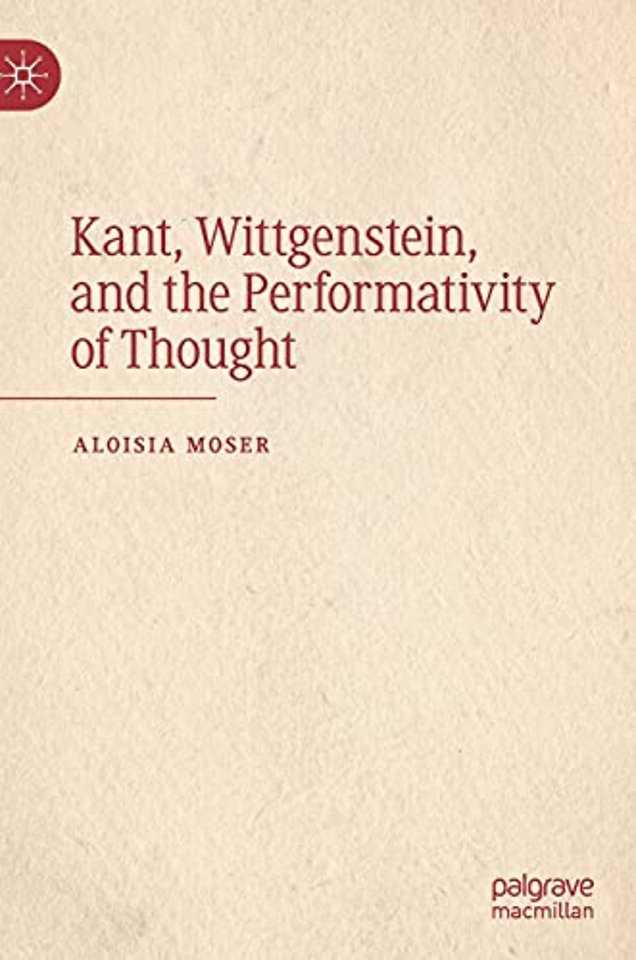
Kant, Wittgenstein, and the Performativity of Thought
Samenvatting
This book explores the idea that there is a certain performativity of thought connecting Kant’s Critique of Pure Reason and Wittgenstein’s Tractatus Logico-Philosophicus. On this view, we make judgments and use propositions because we presuppose that our thinking is about something, and that our propositions have sense. Kant’s requirement of an a priori connection between intuitions and concepts is akin to Wittgenstein’s idea of the general propositional form as sharing a form with the world.
Aloisia Moser argues that Kant speaks about acts of the mind, not about static categories. Furthermore, she elucidates the Tractatus’ logical form as a projection method that turns into a so-called ‘zero method’, whereby propositions are merely the scaffolding of the world. In so doing, Moser connects Kantian reflective judgment to Wittgensteinian rule-following. She thereby presents an account of performativity centering neither on theories nor methods, but on the application enacting them in the first place.
Specificaties
Inhoudsopgave
Net verschenen
Rubrieken
- aanbestedingsrecht
- aansprakelijkheids- en verzekeringsrecht
- accountancy
- algemeen juridisch
- arbeidsrecht
- bank- en effectenrecht
- bestuursrecht
- bouwrecht
- burgerlijk recht en procesrecht
- europees-internationaal recht
- fiscaal recht
- gezondheidsrecht
- insolventierecht
- intellectuele eigendom en ict-recht
- management
- mens en maatschappij
- milieu- en omgevingsrecht
- notarieel recht
- ondernemingsrecht
- pensioenrecht
- personen- en familierecht
- sociale zekerheidsrecht
- staatsrecht
- strafrecht en criminologie
- vastgoed- en huurrecht
- vreemdelingenrecht