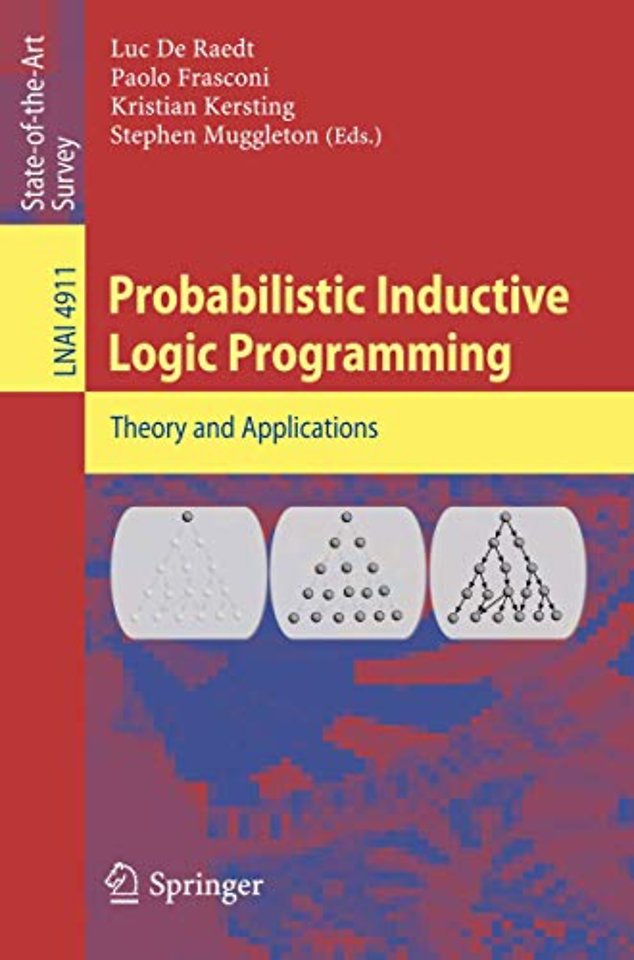
Probabilistic Inductive Logic Programming
Samenvatting
One of the key open questions within arti?cial intelligence is how to combine probability and logic with learning. This question is getting an increased - tentioninseveraldisciplinessuchasknowledgerepresentation,reasoningabout uncertainty, data mining, and machine learning simulateously, resulting in the newlyemergingsub?eldknownasstatisticalrelationallearningandprobabil- ticinductivelogicprogramming.Amajordriving forceisthe explosivegrowth in the amount of heterogeneous data that is being collected in the business and scienti?c world. Example domains include bioinformatics, chemoinform- ics, transportation systems, communication networks, social network analysis, linkanalysis,robotics,amongothers.Thestructuresencounteredcanbeass- pleassequencesandtrees(suchasthosearisinginproteinsecondarystructure predictionandnaturallanguageparsing)orascomplexascitationgraphs,the WorldWideWeb,andrelationaldatabases. This book providesan introduction to this ?eld with an emphasison those methods based on logic programming principles. The book is also the main resultofthesuccessfulEuropeanISTFETprojectno.FP6-508861onAppli- tionofProbabilisticInductiveLogicProgramming(APRILII,2004-2007).This projectwascoordinatedbytheAlbertLudwigsUniversityofFreiburg(Germany, Luc De Raedt) and the partners were Imperial College London (UK, Stephen MuggletonandMichaelSternberg),theHelsinkiInstituteofInformationTe- nology(Finland,HeikkiMannila),theUniversit` adegliStudidiFlorence(Italy, PaoloFrasconi),andtheInstitutNationaldeRechercheenInformatiqueet- tomatiqueRocquencourt(France,FrancoisFages).Itwasconcernedwiththeory, implementationsandapplicationsofprobabilisticinductivelogicprogramming. Thisstructureisalsore?ectedinthebook. The book starts with an introductory chapter to “Probabilistic Inductive LogicProgramming”byDeRaedtandKersting.Inasecondpart,itprovidesa detailedoverviewofthemostimportantprobabilisticlogiclearningformalisms and systems. We are very pleased and proud that the scientists behind the key probabilistic inductive logic programming systems (also those developed outside the APRIL project) have kindly contributed a chapter providing an overviewoftheircontributions.Thisincludes:relationalsequencelearningte- niques (Kersting et al.), using kernels with logical representations (Frasconi andPasserini),MarkovLogic(Domingosetal.), the PRISMsystem (Satoand Kameya),CLP(BN)(SantosCostaetal.),BayesianLogicPrograms(Kersting andDeRaedt),andtheIndependentChoiceLogic(Poole).Thethirdpartthen provides a detailed account of some show-caseapplications of probabilistic - ductive logic programming, more speci?cally: in protein fold discovery (Chen et al.), haplotyping (Landwehr and Mielik¨ ainen) and systems biology (Fages andSoliman). The ?nal parttouchesupon sometheoreticalinvestigationsand VI Preface includes chaptersonbehavioralcomparisonof probabilisticlogicprogramming representations(MuggletonandChen)andamodel-theoreticexpressivityan- ysis(Jaeger).
Specificaties
Inhoudsopgave
Net verschenen
Rubrieken
- aanbestedingsrecht
- aansprakelijkheids- en verzekeringsrecht
- accountancy
- algemeen juridisch
- arbeidsrecht
- bank- en effectenrecht
- bestuursrecht
- bouwrecht
- burgerlijk recht en procesrecht
- europees-internationaal recht
- fiscaal recht
- gezondheidsrecht
- insolventierecht
- intellectuele eigendom en ict-recht
- management
- mens en maatschappij
- milieu- en omgevingsrecht
- notarieel recht
- ondernemingsrecht
- pensioenrecht
- personen- en familierecht
- sociale zekerheidsrecht
- staatsrecht
- strafrecht en criminologie
- vastgoed- en huurrecht
- vreemdelingenrecht