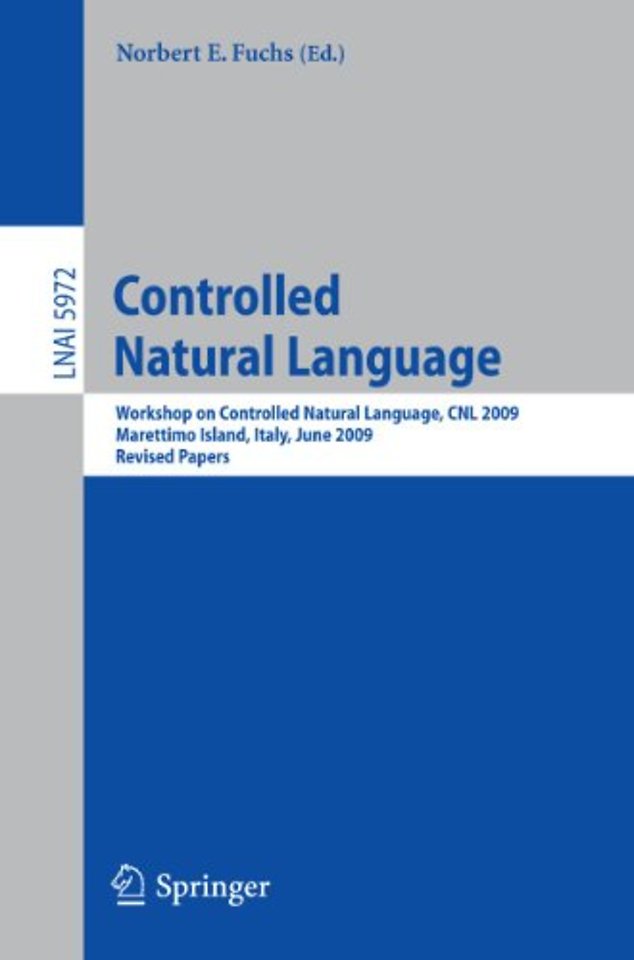
Controlled Natural Language
Workshop on Controlled Natural Language, CNL 2009, Marettimo Island, Italy, June 8-10, 2009, Revised Papers
Samenvatting
Controlled natural languages (CNLs) are subsets of natural languages, obtained by - stricting the grammar and vocabulary in order to reduce or eliminate ambiguity and complexity. Traditionally, controlled languagesfall into two major types: those that - prove readability for human readers, and those that enable reliable automatic semantic analysis of the language. [. . . ] The second type of languages has a formal logical basis, i. e. they have a formal syntax and semantics, and can be mapped to an existing formal language, such as ?rst-order logic. Thus, those languages can be used as knowledge representation languages, and writing of those languages is supported by fully au- matic consistency and redundancy checks, query answering, etc. Wikipedia Variouscontrollednatural languagesof the second type have been developedby a n- ber of organizations, and have been used in many different application domains, most recently within the Semantic Web. The workshop CNL 2009 was dedicated to discussing the similarities and the d- ferences of existing controlled natural languages of the second type, possible impro- ments to these languages, relations to other knowledge representation languages, tool support, existing and future applications, and further topics of interest.
Specificaties
Inhoudsopgave
Net verschenen
Rubrieken
- aanbestedingsrecht
- aansprakelijkheids- en verzekeringsrecht
- accountancy
- algemeen juridisch
- arbeidsrecht
- bank- en effectenrecht
- bestuursrecht
- bouwrecht
- burgerlijk recht en procesrecht
- europees-internationaal recht
- fiscaal recht
- gezondheidsrecht
- insolventierecht
- intellectuele eigendom en ict-recht
- management
- mens en maatschappij
- milieu- en omgevingsrecht
- notarieel recht
- ondernemingsrecht
- pensioenrecht
- personen- en familierecht
- sociale zekerheidsrecht
- staatsrecht
- strafrecht en criminologie
- vastgoed- en huurrecht
- vreemdelingenrecht