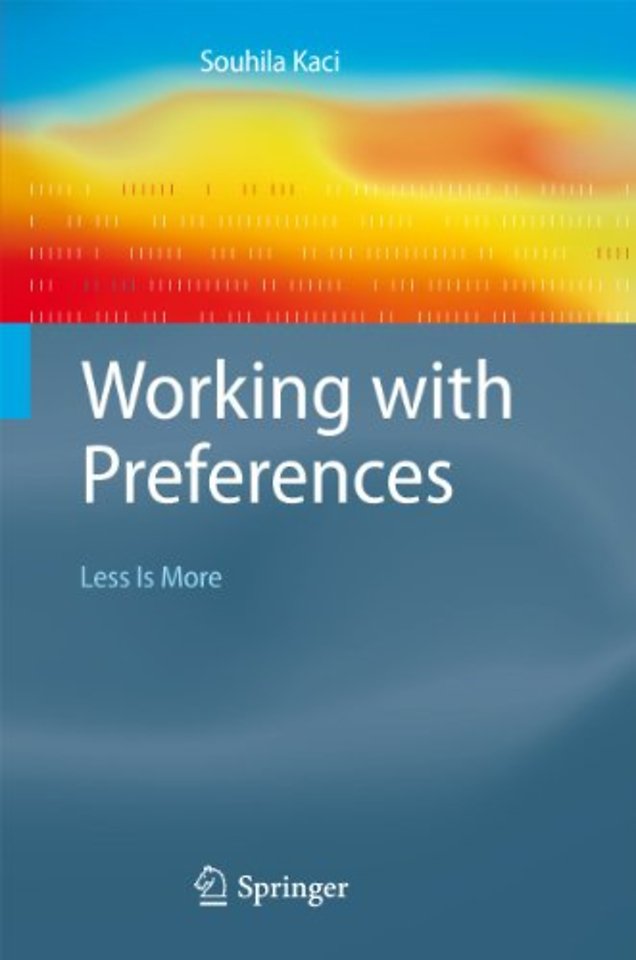
Working with Preferences: Less Is More
Samenvatting
Preferences are useful in many real-life problems, guiding human decision making from early childhood up to complex professional and organizational decisions. In artificial intelligence specifically, preferences is a relatively new topic of relevance to nonmonotonic reasoning, multiagent systems, constraint satisfaction, decision making, social choice theory and decision-theoretic planning
The first part of this book deals with preference representation, with specific chapters dedicated to representation languages, nonmonotonic logics of preferences, conditional preference networks, positive and negative preferences, and the study of preferences in cognitive psychology. The second part of the book deals with reasoning with preferences, and includes chapters dedicated to preference-based argumentation, preferences database queries, and rank-ordering outcomes and intervals. The author concludes by examining forthcoming research perspectives.
This is inherently a multidisciplinary topic and this book will be of interest to computer scientists, economists, operations researchers, mathematicians, logicians, philosophers and psychologists.
Specificaties
Inhoudsopgave
Net verschenen
Rubrieken
- aanbestedingsrecht
- aansprakelijkheids- en verzekeringsrecht
- accountancy
- algemeen juridisch
- arbeidsrecht
- bank- en effectenrecht
- bestuursrecht
- bouwrecht
- burgerlijk recht en procesrecht
- europees-internationaal recht
- fiscaal recht
- gezondheidsrecht
- insolventierecht
- intellectuele eigendom en ict-recht
- management
- mens en maatschappij
- milieu- en omgevingsrecht
- notarieel recht
- ondernemingsrecht
- pensioenrecht
- personen- en familierecht
- sociale zekerheidsrecht
- staatsrecht
- strafrecht en criminologie
- vastgoed- en huurrecht
- vreemdelingenrecht