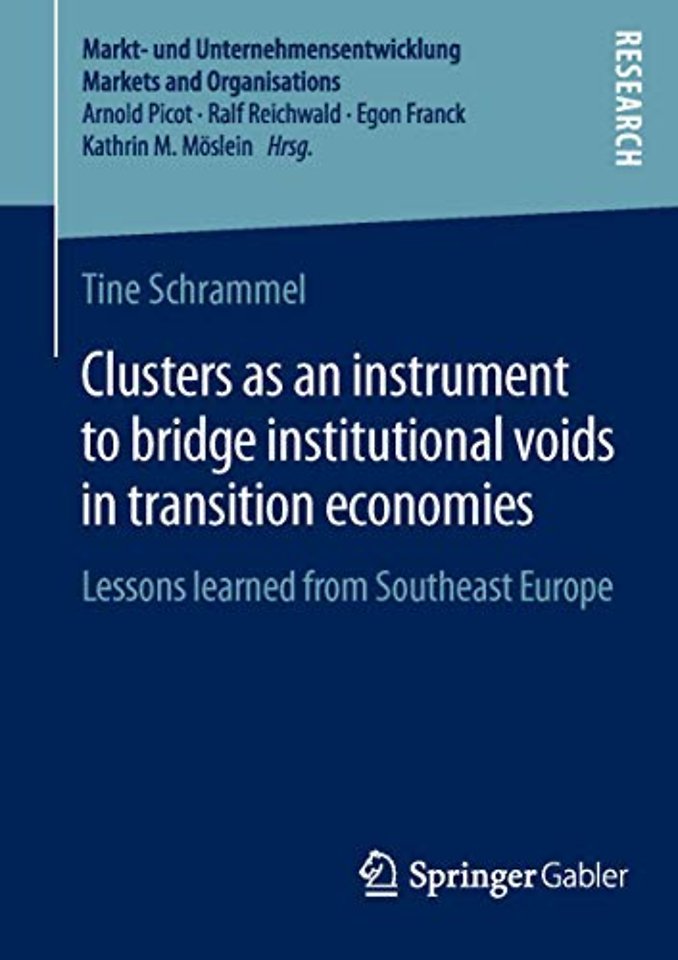
Clusters as an instrument to bridge institutional voids in transition economies
Lessons learned from Southeast Europe
Samenvatting
Transition economies, such as the countries in Southeast Europe, face an expeditious institutional transition from a centrally planned to a market economy. The state withdraws from its monitoring function, which results in institutional voids that affect the economy in general and small and medium sized enterprises (SMEs) in specific. With a qualitative case study approach Tine Schrammel develops a scheme to detect institutional voids as one source of competitive disadvantages of SMEs in transition economies. In a second step she demonstrates that specific cluster services bridge institutional voids and improve the competitive position of SMEs in environments of institutional voids. The findings add to the understanding of institutional voids and to the role of clusters in transition economies.
Specificaties
Inhoudsopgave
Anderen die dit kochten, kochten ook
-
 Susanne van Der Velden€ 34,99
 -
Henry Meijer€ 39,50
-
Peter Antonioni€ 29,99
-
Ben Kuiken€ 24,42
-
Jolien Grandia€ 34,99
-
Paul Schenderling€ 25,00





Net verschenen
Rubrieken
- aanbestedingsrecht
- aansprakelijkheids- en verzekeringsrecht
- accountancy
- algemeen juridisch
- arbeidsrecht
- bank- en effectenrecht
- bestuursrecht
- bouwrecht
- burgerlijk recht en procesrecht
- europees-internationaal recht
- fiscaal recht
- gezondheidsrecht
- insolventierecht
- intellectuele eigendom en ict-recht
- management
- mens en maatschappij
- milieu- en omgevingsrecht
- notarieel recht
- ondernemingsrecht
- pensioenrecht
- personen- en familierecht
- sociale zekerheidsrecht
- staatsrecht
- strafrecht en criminologie
- vastgoed- en huurrecht
- vreemdelingenrecht