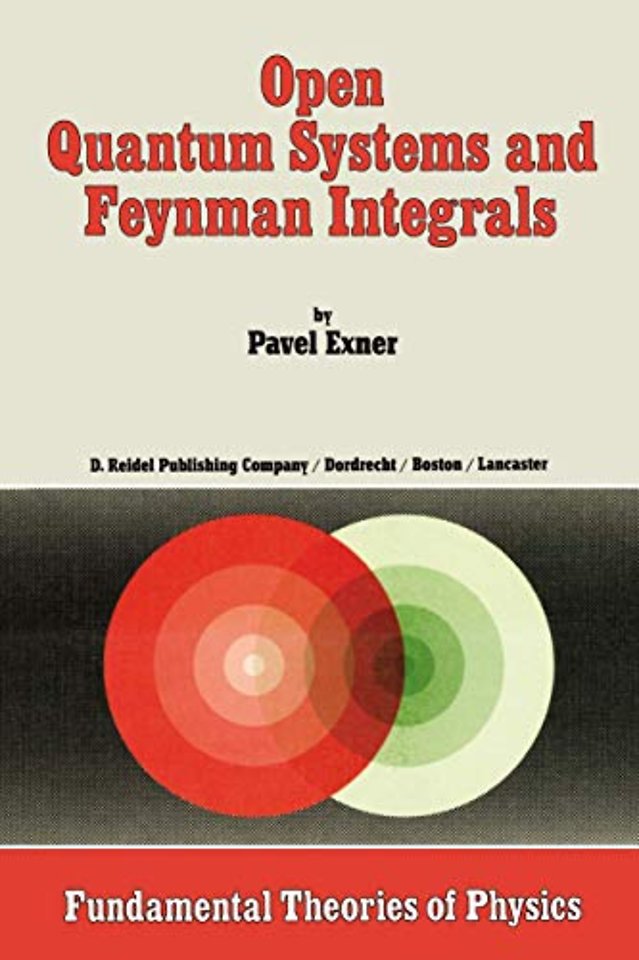
Open Quantum Systems and Feynman Integrals
Samenvatting
Every part of physics offers examples of non-stability phenomena, but probably nowhere are they so plentiful and worthy of study as in the realm of quantum theory. The present volume is devoted to this problem: we shall be concerned with open quantum systems, i.e. those that cannot be regarded as isolated from the rest of the physical universe. It is a natural framework in which non-stationary processes can be investigated. There are two main approaches to the treatment of open systems in quantum theory. In both the system under consideration is viewed as part of a larger system, assumed to be isolated in a reasonable approximation. They are differentiated mainly by the way in which the state Hilbert space of the open system is related to that of the isolated system - either by orthogonal sum or by tensor product. Though often applicable simultaneously to the same physical situation, these approaches are complementary in a sense and are adapted to different purposes. Here we shall be concerned with the first approach, which is suitable primarily for a description of decay processes, absorption, etc. The second approach is used mostly for the treatment of various relaxation phenomena. It is comparably better examined at present; in particular, the reader may consult a monograph by E. B. Davies.
Specificaties
Inhoudsopgave
Net verschenen
Rubrieken
- aanbestedingsrecht
- aansprakelijkheids- en verzekeringsrecht
- accountancy
- algemeen juridisch
- arbeidsrecht
- bank- en effectenrecht
- bestuursrecht
- bouwrecht
- burgerlijk recht en procesrecht
- europees-internationaal recht
- fiscaal recht
- gezondheidsrecht
- insolventierecht
- intellectuele eigendom en ict-recht
- management
- mens en maatschappij
- milieu- en omgevingsrecht
- notarieel recht
- ondernemingsrecht
- pensioenrecht
- personen- en familierecht
- sociale zekerheidsrecht
- staatsrecht
- strafrecht en criminologie
- vastgoed- en huurrecht
- vreemdelingenrecht