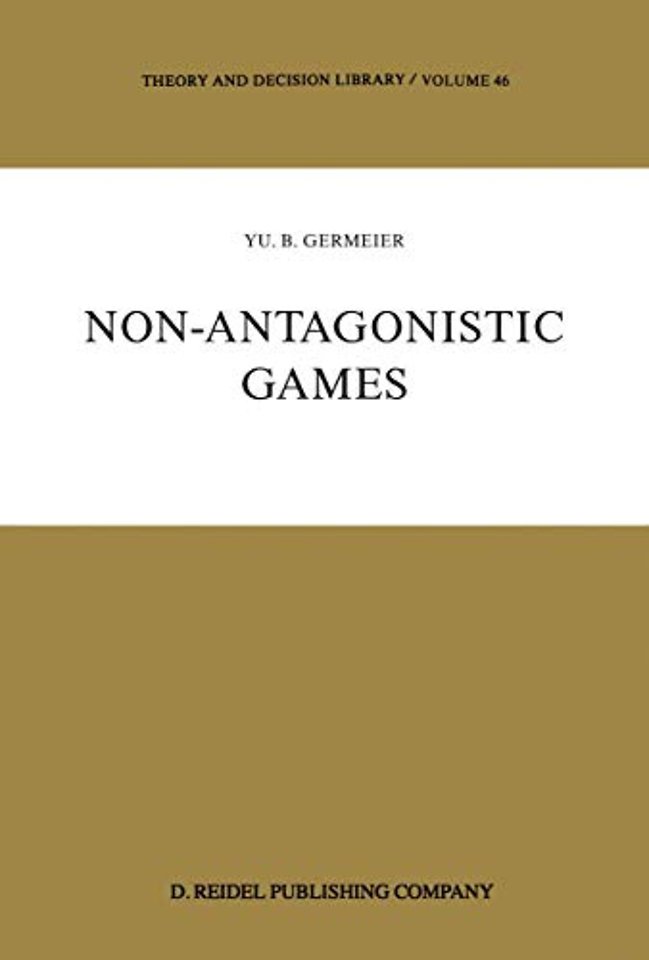
Non-Antagonistic Games
Samenvatting
The reality around us constantly demonstrates physical and social processes in which the interests of the participants are not diametrically opposed, though they by no means always coincide. The study of such processes (interesting in itw own right) is essential for working out ways of making decisions, that is, for choosing among available parameters of the processes. If, in view of certain considerations, a participant i h 1 f 0 h' . b c ooses a va ue Xi 0 a parameter Xi' ~s act~on can e formally described as an attempt to maximize the function f. = -llx. - x~ll. For this reason any decision on the part of ~ ~ ~ the i-th participant in the process can be treated (at least a posteriori) as agoal-directed act, aimed at increasing the value of some function w. (a criterion of efficiency, a payoff, a gain, etc.), wfiich generally depends on the choices of all n participants in the process. That is w = f. (x ' ..• ,x ), i = 1, 2, ..• ,n. 1 i ~ n A process described in this manner, involving several participants, each pursuing different interests and constrained in his choices of parameters by the condition X E x. is called a game - a term firmly entrenched though evide~tly not felicitous.
Specificaties
Inhoudsopgave
Anderen die dit kochten, kochten ook
-
 Gert Biesta€ 13,99
 -
Japke-d. Bouma€ 16,99
-
Pim Blom€ 23,50
-
Sandra van Thiel€ 40,50
-
Genieke Hertoghs€ 34,50
-
Tom van der Meer€ 21,99






Net verschenen
Rubrieken
- aanbestedingsrecht
- aansprakelijkheids- en verzekeringsrecht
- accountancy
- algemeen juridisch
- arbeidsrecht
- bank- en effectenrecht
- bestuursrecht
- bouwrecht
- burgerlijk recht en procesrecht
- europees-internationaal recht
- fiscaal recht
- gezondheidsrecht
- insolventierecht
- intellectuele eigendom en ict-recht
- management
- mens en maatschappij
- milieu- en omgevingsrecht
- notarieel recht
- ondernemingsrecht
- pensioenrecht
- personen- en familierecht
- sociale zekerheidsrecht
- staatsrecht
- strafrecht en criminologie
- vastgoed- en huurrecht
- vreemdelingenrecht