
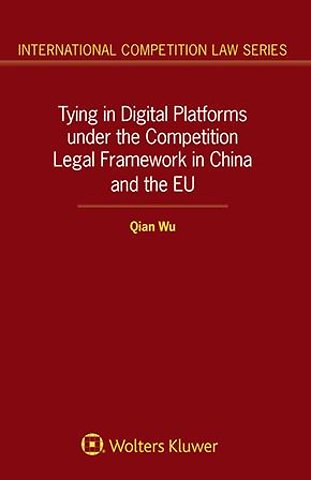
Tying in Digital Platforms under Competition Law in China, the EU and the US
A Comparative Law and Economics Perspective
Samenvatting
Tying in Digital Platforms under the Competition Legal Framework in China and the EU is an important study providing a comprehensive, systematic, and administrable legal test about how to weigh the dual competitive effects of tying arrangements in digital platforms, showing how two of the world’s largest trading economies—China and the EU—have integrated advantages of the U.S. economics while preserving their own cultural and social characteristics. In today’s digital markets, dominant firms often use tying (the practice of making the purchase of one product conditional on purchasing other products) as a mechanism to extend their dominance. Because the practice could generate both pro-competitive effects and anti-competitive effects, the distinction between lawful and unlawful tying is fraught with legal uncertainties.
Through case studies, the book, on the one hand, reveals how economic theories on tying are incorporated into legal frameworks, and, on the other hand, explores the underlying socio-cultural foundations of convergences and divergences between the two jurisdictions. In the course of its investigation, the book elucidates such issues and topics as the following:
- specific tying rules applied to digital platforms in China and the EU, respectively;
- explaining and evaluating these rules from a law and economics perspective;
- detailed examination of the EU’s fines of Google and Microsoft and the contrasting decision in China’s Tencent case;
- economic implications for competition law, including enforcement challenges;
- common goal shared by China and the EU—safeguarding healthy market competition in the interest of consumers with distributional considerations;
- divergent choices of consumer interests by China and consumer choice by the EU because of their underlying cultural and social roots;
- standards and best practices derived from the experience of both jurisdictions.
In its comparative law and economics analysis and its concrete guidance on how regulatory frameworks can incorporate economic analysis while navigating the tension with legal certainty, the book distills complex criteria into clear standards that can aid in formulating a context-sensitive framework for refining a competition policy of tying in the digital age. At the same time, the book offers of the social context and cultural reasons behind the emergence and existence of distinct legal rules in China and the EU. Practitioners, policymakers, and academics will gain useful insights for global antitrust dialogue and assess what can be done to foster innovation and pro-competitive tying while regulating anti-competitive tying in digital platforms.
Specificaties
Inhoudsopgave
List of Abbreviations
List of Figures
List of Tables
Foreword
Acknowledgments
CHAPTER 1
Introduction
CHAPTER 2
Economic Analysis of Tying
CHAPTER 3
Economic Analysis of Digital Platforms
CHAPTER 4
Economic Analysis of Tying in Digital Platforms
CHAPTER 5
Law and Economics Analysis of Tying in Digital Platforms under the Competition Legal Framework in China
CHAPTER 6
Law and Economics Analysis of Tying in Digital Platforms under the Competition Legal Framework in the EU
CHAPTER 7
Understanding Convergences and Divergences in China and the EU
CHAPTER 8
Common Challenges and Policy Implications
CHAPTER 9
Conclusions
Impact
Summary
Bibliography
Table of Cases
Table of Legislation
Anderen die dit boek kochten, kochten ook
-
 Simon Cornielje€ 57,50
 -
Alex Meijer€ 29,50
-
R.C. Stam€ 52,00
-
Tineke Cleiren€ 360,01
-
Adri van Amelsvoort€ 67,71
-
Adri van Amelsvoort€ 55,30





Net verschenen
Rubrieken
- aanbestedingsrecht
- aansprakelijkheids- en verzekeringsrecht
- accountancy
- algemeen juridisch
- arbeidsrecht
- bank- en effectenrecht
- bestuursrecht
- bouwrecht
- burgerlijk recht en procesrecht
- europees-internationaal recht
- fiscaal recht
- gezondheidsrecht
- insolventierecht
- intellectuele eigendom en ict-recht
- management
- mens en maatschappij
- milieu- en omgevingsrecht
- notarieel recht
- ondernemingsrecht
- pensioenrecht
- personen- en familierecht
- sociale zekerheidsrecht
- staatsrecht
- strafrecht en criminologie
- vastgoed- en huurrecht
- vreemdelingenrecht