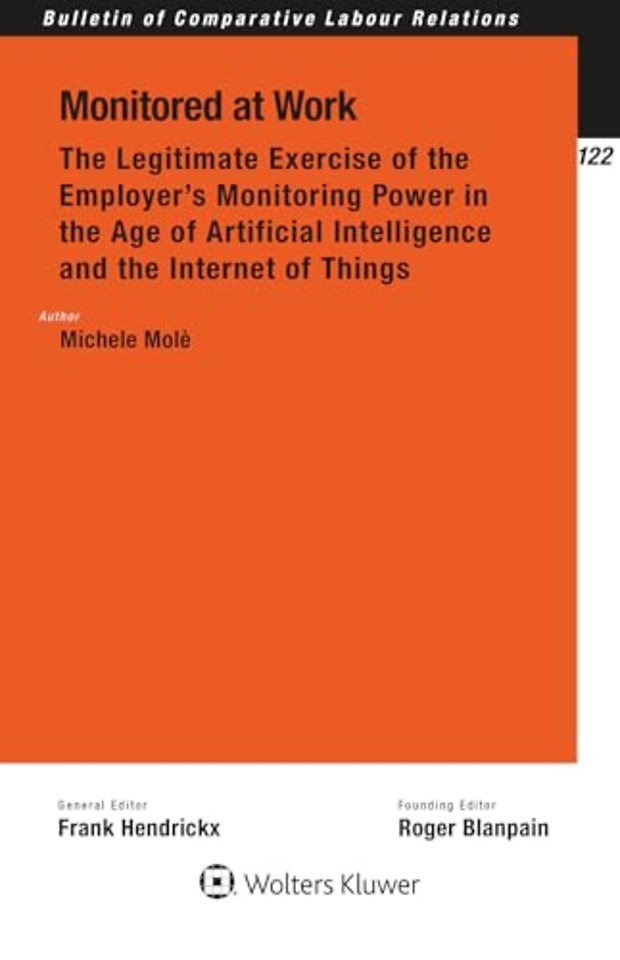
Monitored at Work
The Legitimate Exercise of the Employer's Monitoring Power in the Age of Artificial Intelligence and the Internet of Things
Samenvatting
Monitored at Work is a legal study, beyond the traditional privacy paradigm, that explores the historical and conceptual foundations of the employer’s monitoring power, tracing its evolution from the Industrial Revolution to the most recent developments in data science – Artificial Intelligence (AI) and Internet of Things (IoT). Employers deploy these technologies to evaluate work performance, assess personal characteristics, and safeguard property, health, and safety. The book highlights how technological innovation has reshaped managerial authority and examines the influential role of technology developers in this process. The study further analyses how these developments affect the enjoyment of employees’ fundamental rights within the European Union (EU) legal framework, including the rights to non-discrimination, freedom of expression, and freedom of assembly and association. The book offers a holistic understanding of the employer’s monitoring power and examines the conditions for its legitimate exercise under the General Data Protection Regulation (GDPR) and the Artificial Intelligence Act (AI Act). It provides a normative critique of both Regulations, exploring the specific protection needs of employees.
What’s in this book:
The Author’s focus is on:
- historical and conceptual roots of workplace monitoring, exposing the fundamental reasons and interests that drive employers to monitor their workforces;
- features of AI and IoT technologies that reshape the practical implementation of workplace monitoring;
- conditions in the European fundamental rights framework under which the exercise of the employer’s monitoring power can be considered legitimate;
- whether the deployment of AI and IoT technologies violates employees’ fundamental rights;
- strengths and shortcomings in the legal protection of employees provided by the GDPR and AI Act;
- role and accountability of AI and IoT technology providers who develop, sell, and maintain monitoring systems;
- the potential role for employees’ representatives in enforcing the GDPR and AI Act; and
- potential future legislation regulating the use of digital technologies for monitoring employees.
Furthermore, the analysis integrates relevant jurisprudence from the European Court of Human Rights (ECtHR) and the European Court of Justice (ECJ) to assess the legitimacy of monitoring practices. The study also outlines potential solutions to address existing limitations and gaps in the GDPR and the AI Act, drawing in particular on the Data Protection Impact Assessment (DPIA, Article 35 GDPR), Article 88 GDPR, and recent legislative developments introduced by the Platform Work Directive (PWD).
How this will help you:
Through its assessment of the effectiveness of EU legislation in safeguarding employees against the illegitimate exercise of the employer’s monitoring power, this book offers a comprehensive examination of how AI and IoT-enabled monitoring technologies challenge employees’ rights. By elucidating the legal and ethical implications of these technologies, it equips practitioners with the tools to anticipate and mitigate compliance risks under both the GDPR and the AI Act. Furthermore, the book contributes to the ongoing scholarly and policymaking debate by analysing emerging regulatory developments that could further shape the future of the digitally monitored workplace.
Specificaties
Inhoudsopgave
Funding Acknowledgements
List of Abbreviations
List of Tables
CHAPTER 1
Introduction
CHAPTER 2
Between Mirrors and Sensors: On the Origins of the Employer’s Monitoring Power
CHAPTER 3
On the Legitimate Exercise of the Employer’s Monitoring Power in the European Fundamental Rights Framework
CHAPTER 4
The Impact of AI and IoT-Enabled Technologies on the Exercise of the Employer’s Monitoring Power
CHAPTER 5
A Fundamental Rights Assessment of the Exercise of an AI and IoT-Enabled Employer’s Monitoring Power
CHAPTER 6
Putting the GDPR to Work: Requirements for a Legitimate Exercise of the Employer’s Monitoring Power via AI and IoT-Enabled Technologies
CHAPTER 7
Applying the AI Act to the Employment Context: Requirements for a Legitimate Exercise of the Employer’s Monitoring Power via AI and IoT-Enabled Technologies
CHAPTER 8
The Limitations of the GDPR and AI Act in the Employment Context
CHAPTER 9
Existing Avenues Within the Current EU Legal Framework to Address an Illegitimate Exercise of the AI and IoT-Enabled Employer’s Monitoring Power
CHAPTER 10
Conclusion
Bibliography
Table of Cases
Table of Legislation
Anderen die dit boek kochten, kochten ook
-
 NBA€ 94,50
 -
Bram van Dokkum€ 94,50
-
Frans Sonneveldt€ 112,59
-
Dineke de Groot€ 39,00
-
W.L. Roozendaal€ 39,00
-
Simon Cornielje€ 57,50




Net verschenen
Rubrieken
- aanbestedingsrecht
- aansprakelijkheids- en verzekeringsrecht
- accountancy
- algemeen juridisch
- arbeidsrecht
- bank- en effectenrecht
- bestuursrecht
- bouwrecht
- burgerlijk recht en procesrecht
- europees-internationaal recht
- fiscaal recht
- gezondheidsrecht
- insolventierecht
- intellectuele eigendom en ict-recht
- management
- mens en maatschappij
- milieu- en omgevingsrecht
- notarieel recht
- ondernemingsrecht
- pensioenrecht
- personen- en familierecht
- sociale zekerheidsrecht
- staatsrecht
- strafrecht en criminologie
- vastgoed- en huurrecht
- vreemdelingenrecht