Rainer Matyssek,
N Clarke,
P. Cudlin,
T.N. Mikkelsen,
J-P. Tuovinen,
G Wieser,
E. Paoletti
e.a.
Elsevier Science
e druk, 2013
9780080983493
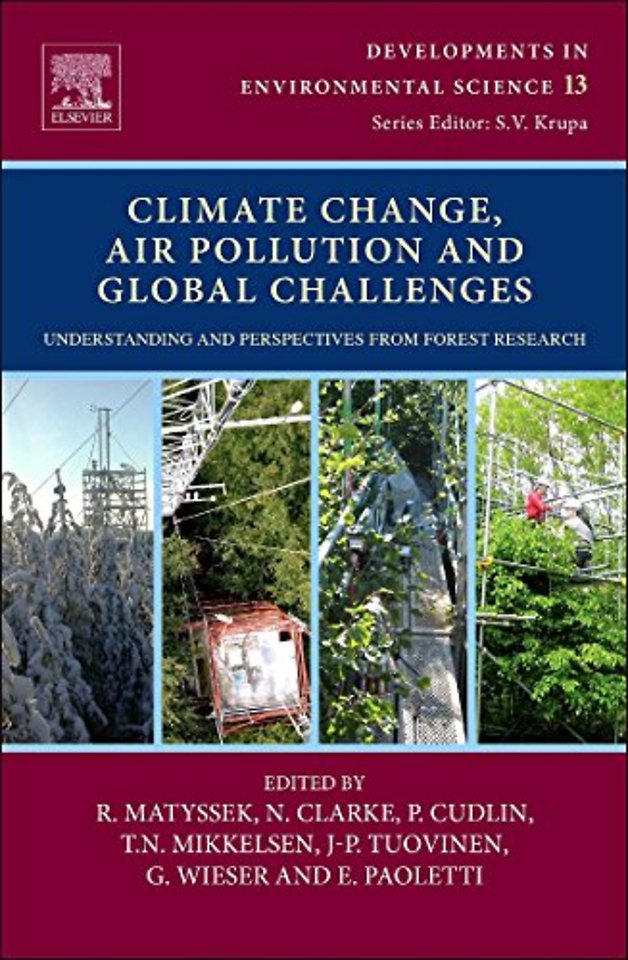
Climate Change, Air Pollution and Global Challenges
Understanding and Perspectives from Forest Research
Specificaties
Gebonden, blz.
|
Engels
Elsevier Science |
e druk, 2013
ISBN13: 9780080983493
Rubricering
Juridisch
:
Onderdeel van serie
Developments in Environmental Science
Levertijd ongeveer 9 werkdagen
Gratis verzonden
Samenvatting
There are significant pressures from climate change and air pollution that forests currently face. This book aims to increase understanding of the state and potential of forest ecosystems to mitigate and adapt to climate change in a polluted environment. It reconciles process-oriented research, long-term monitoring and applied modeling through comprehensive forest ecosystem research. Furthermore, it introduces "forest super sites for research for integrating soil, plant and atmospheric sciences and monitoring. It also provides mechanistic and policy-oriented modeling with scientifically sound risk indications regarding atmospheric changes and ecosystem services.
Specificaties
Inhoudsopgave
<p>PART I Introduction into the scope and structure of the book<br>Ch. 1 Climate Change, Air Pollution and Global Challenges: Knowledge, Understanding and Perspectives from Forest Research, R. Matyssek et al.<br>PART II Interactions between trace gases, climate change and vegetation<br>Ch. 2 Gaseous exchange between forests and the atmosphere, S. Cieslik, et al.<br>Ch. 3 Nutrients or pollutants? — Nitrogen deposition to European forests, W. Eugster, M. Haeni <br>Ch. 4 Biogenic Volatile Organic Compounds and their impacts on biosphere-atmosphere interactions, F. Loreto, S. Fares<br>Ch. 5 Air pollution risks to northern European forests in a changing climate, J.-P. Tuovinen, et al.<br>PART III Significance of biotic processes in forest ecosystem response <br>Ch. 6 Ozone Research, quo vadis ? Lessons from the free-air canopy fumigation experiment at Kranzberg Forest, R. Matyssek, et al.<br>Ch. 7 Soil respiration and soil organic matter (SOM) decomposition in response to climate change, J. Kruse, et al.<br>Ch. 8 Mycorrhizosphere complexity, H. Kraigher, M. Bajc, T. Grebenc<br>Ch. 9 Tree and forest responses to interacting elevated atmospheric CO2 and tropospheric O3: A synthesis of experimental evidence, J. King, et al.<br>Ch. 10 Belowground Carbon Cycling at Aspen FACE: Dynamic Responses to CO2 and O3 in Developing Forests, K.S. Pregitzer and A. F. Talhelm<br>Ch. 11 Impacts of atmospheric change on tree-arthropod interactions, J.J. Couture and R. L. Lindroth<br>PART IV Mechanistic and diagnostic understanding for risk assessment and up-scaling<br>Ch. 12 Flux-based ozone risk assessment for adult beech and spruce forests, L. Grünhage, et al.<br>Ch. 13 Integrative leaf level phytotoxic ozone dose assessment for forest risk modelling, P. Dizengremel, et al.<br>Ch. 14 Integrated studies on abiotic stress defence in trees: The case of ozone, D. Ernst<br>Ch. 15 Metabolomics and transcriptomics increase our understanding about defence responses and genotypic differences of northern deciduous trees to elevating ozone, CO2 and climate warming, E. Oksanen, et al.<br>PART V Global dimension of air pollution as part of climate change<br>Ch. 16 Interactive effects of air pollution and climate change on forest ecosystems in the United States – current understanding and future scenarios, A. Bytnerowicz, M. Fenn, S. McNulty, F. Yuan, A. Pourmokhtarian, C. Driscoll, and T. Meixner<br>Ch. 17 Effects of ozone on forest ecosystems in East and Southeast Asia, T. Koike, et al.<br>Ch. 18 Impacts of Air Pollution and Climate Change on plants: Implications for India, V. Pandey, et al.<br>Ch. 19 Land use change, air pollution and climate change – vegetation response in Latin America, A.R. Kozovits, M. M. C. Bustamante<br>Ch. 20 Ozone concentrations and their potential impacts on vegetation in southern Africa, L. Laakso, et al.<br>Ch. 21 Wild-land fires: monitoring, plume modelling, impact on atmospheric composition and climate, M. Sofiev<br>PART VI The potential of “Supersites for research on forest ecosystems<br>Ch. 22 Towards supersites in forest ecosystem monitoring and research, T. N. Mikkelsen, et al.<br>Ch. 23 Key indicators of air pollution and climate change impacts at forest Supersites, E. Paoletti, et al.<br>PART VII Knowledge transfer and socio-economic aspects<br>Ch. 24 Forest ecosystem services under climate change and air pollution, P. Cudlín, et al.<br>Ch. 25 Targeting sustainable provision of forest ecosystem services with special focus on carbon sequestration, M. Nijnik, D. Miller<br>Ch. 26 Global change and the role of forests in future land-use systems, T. Knoke, A. Hahn<br>PART VIII Conclusions and perspectives <br>Ch. 27 Conclusions and perspectives, R. Matyssek, et al.</p>
Net verschenen
Rubrieken
- aanbestedingsrecht
- aansprakelijkheids- en verzekeringsrecht
- accountancy
- algemeen juridisch
- arbeidsrecht
- bank- en effectenrecht
- bestuursrecht
- bouwrecht
- burgerlijk recht en procesrecht
- europees-internationaal recht
- fiscaal recht
- gezondheidsrecht
- insolventierecht
- intellectuele eigendom en ict-recht
- management
- mens en maatschappij
- milieu- en omgevingsrecht
- notarieel recht
- ondernemingsrecht
- pensioenrecht
- personen- en familierecht
- sociale zekerheidsrecht
- staatsrecht
- strafrecht en criminologie
- vastgoed- en huurrecht
- vreemdelingenrecht