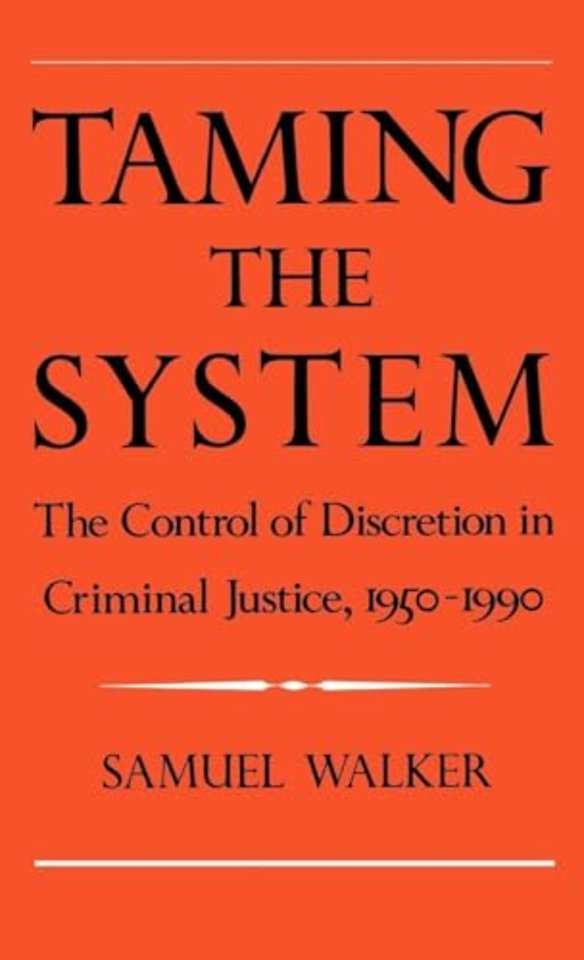
Taming the System
The Control of Discretion in Criminal Justice, 1950-1990
Samenvatting
Since the American Bar Foundation Survey of the Administration of Criminal Justice (1953 - 1969) "discovered" the phenomenon of discretion in criminal justice, it has become something of a truism that the administration of criminal justice in the United States consists of a series of discretionary decisions by officials in regard to police discretion, bail, plea bargaining and sentencing.
This book is a history of the attempts over the past forty years to control these discretionary powers in the criminal justice system.
Walker brings together an enormous literature in a synthesis that will be of great value to professionals, reformers and students of the criminal justice system. In a field which largely produces short-ranged "evaluation research", this study, in taking a wider approach, distinguishes between the role of the courts and the role of administrative bodies (the police) and evaluates the longer-term trends and the successful reforms in criminal justice history.
Specificaties
Net verschenen
Rubrieken
- aanbestedingsrecht
- aansprakelijkheids- en verzekeringsrecht
- accountancy
- algemeen juridisch
- arbeidsrecht
- bank- en effectenrecht
- bestuursrecht
- bouwrecht
- burgerlijk recht en procesrecht
- europees-internationaal recht
- fiscaal recht
- gezondheidsrecht
- insolventierecht
- intellectuele eigendom en ict-recht
- management
- mens en maatschappij
- milieu- en omgevingsrecht
- notarieel recht
- ondernemingsrecht
- pensioenrecht
- personen- en familierecht
- sociale zekerheidsrecht
- staatsrecht
- strafrecht en criminologie
- vastgoed- en huurrecht
- vreemdelingenrecht