The Reasoning of the Court of Justice of the EU
A Normative Assessment
Samenvatting
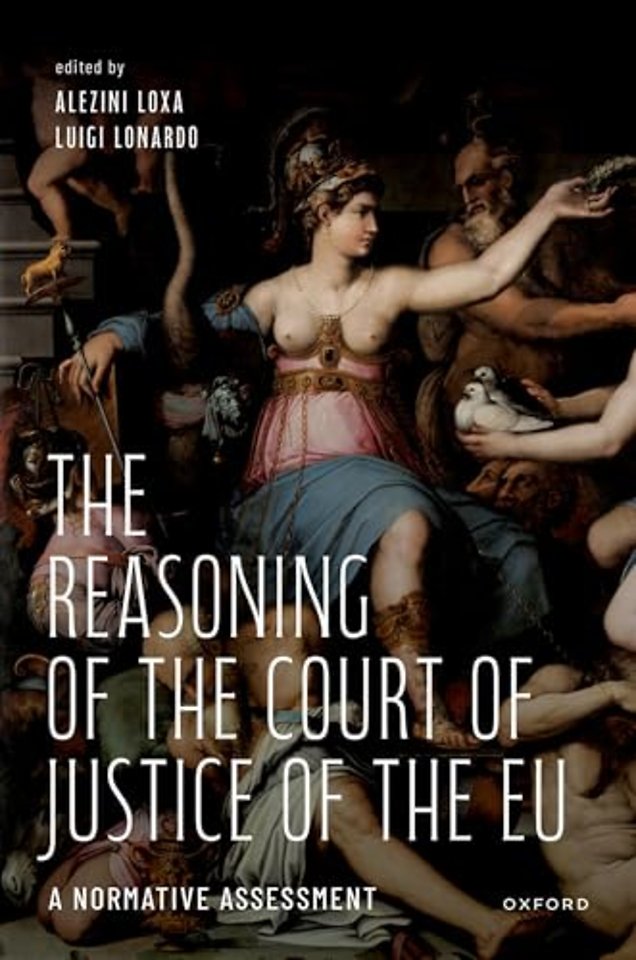
This edited volume offers a groundbreaking contribution to the study of the Court of Justice of the European Union (CJEU) by shifting the focus from descriptive accounts of its jurisprudence to normative evaluations of its legal reasoning. Building on a shared conceptual foundation derived from the Court's adjudicative practices, the book brings together a diverse array of scholarly perspectives that critically assess the CJEU's reasoning both in abstract terms and within specific doctrinal contexts.
The volume is structured around two complementary approaches: one that examines the Court's techniques of adjudication across policy areas through a horizontal, theoretical lens, and another that engages deeply with specific aspects of case law, offering alternative interpretations grounded in distinct normative frameworks. This dual structure enables a rich and pluralistic exploration of what constitutes sound judicial reasoning in the EU legal order.
Unlike previous scholarship that has either endorsed the Court's approach or critiqued it from isolated perspectives-constitutional, democratic, or social-this volume uniquely integrates theoretical abstraction with doctrinal specificity, all while maintaining a coherent conceptual unity. The contributors rigorously engage with the text of judicial decisions, articulating their assessments through clearly stated normative assumptions, theoretical grounding, and an appreciation of the institutional constraints under which the Court operates. While The Reasoning of the Court of Justice of the EU does not seek to define a singular model of a 'good' judgment, it advances the debate by offering methodologically robust and normatively transparent analyses.
Specificaties
Inhoudsopgave
Part I. A Question of Paradigm?
2:Quality of the Judgments of the Court of Justice: Coherence, Efficiency, and the Context of Explanation, Joxerramon Bengoetxea andLuigi Lonardo
3:Reasoning of the Court of Justice of the EU: Challenging the Interpretation Framework, Dorota Leczykiewicz
Part II. Normative Indeterminacy and Justificatory Premises
4:A Normative Case for the Principle of Lex Specialis in EU Law, Emily Hancox
5:Primary Law as Pyramid: The Case for Substantive Hierarchies in EU Primary Law, Luke Dimitrios Spieker
6:Between Values and Self-Preservation in the Interpretation of EU Law, Davor Petrić
7:An Assessment of the Reasoning by Implied Hierarchy in the Case Law of the Court of Justice in Common Foreign and Security Policy, Luigi Lonardo
Part III. Formal Logic and Consistency
8:The Road Not Taken: Applying the EU Charter of Fundamental Rights to Migration and Asylum Cases, Emiliya Bratanova van Harten
9:Insiders, Outsiders, and the Limits of Analogous Interpretation in the ECJ Case Law, Alezini Loxa
10:The CJEU's Centre of Gravity Theory in Legal Basis Litigation: A Flawed Concept, Annegret Engel
11:The Legal Reasoning of the Court of Justice of the European Union in the Area of Economic and Monetary Union: A Normative Assessment, Menelaos Markakis
Part IV. Procedural Fairness and Internal Processes
12:How Does the Court of Justice Deal with Its Own Previous Case Law in the Field of Union Citizenship? Assessing and Refining Methods of Communicative Reasoning, Niamh Nic Shuibhne
13:The Omnipotent Legislature in the Interpretation of Primary Law by the Court of Justice in the Fields of EU Citizenship and Direct Taxation, Alexandros Politis
14:Deciding Not to Decide: Dismissal, Narrowing, and Relinquishment at the Court of Justice of the European Union, Graham Butler
15:The Different Institutional Roles of the General Court and the Court of Justice and their Impact on the CJEU's Reasoning in the Field of EU Competition Law, Nathan Cambien
16:Conclusion: On the Horizon of Possibilities for Normative Assessments, Alezini Loxa
Anderen die dit boek kochten, kochten ook
-
 Luigi Lonardo€ 152,64
 -
E. Bakker€ 49,00
-
F.G.H. Kristen€ 79,95
-
Vina Wijkhuijs€ 49,95
-
Wim Van de Voorde€ 85,00
-
René Repasi€ 46,00






Net verschenen
Rubrieken
- aanbestedingsrecht
- aansprakelijkheids- en verzekeringsrecht
- accountancy
- algemeen juridisch
- arbeidsrecht
- bank- en effectenrecht
- bestuursrecht
- bouwrecht
- burgerlijk recht en procesrecht
- europees-internationaal recht
- fiscaal recht
- gezondheidsrecht
- insolventierecht
- intellectuele eigendom en ict-recht
- management
- mens en maatschappij
- milieu- en omgevingsrecht
- notarieel recht
- ondernemingsrecht
- pensioenrecht
- personen- en familierecht
- sociale zekerheidsrecht
- staatsrecht
- strafrecht en criminologie
- vastgoed- en huurrecht
- vreemdelingenrecht