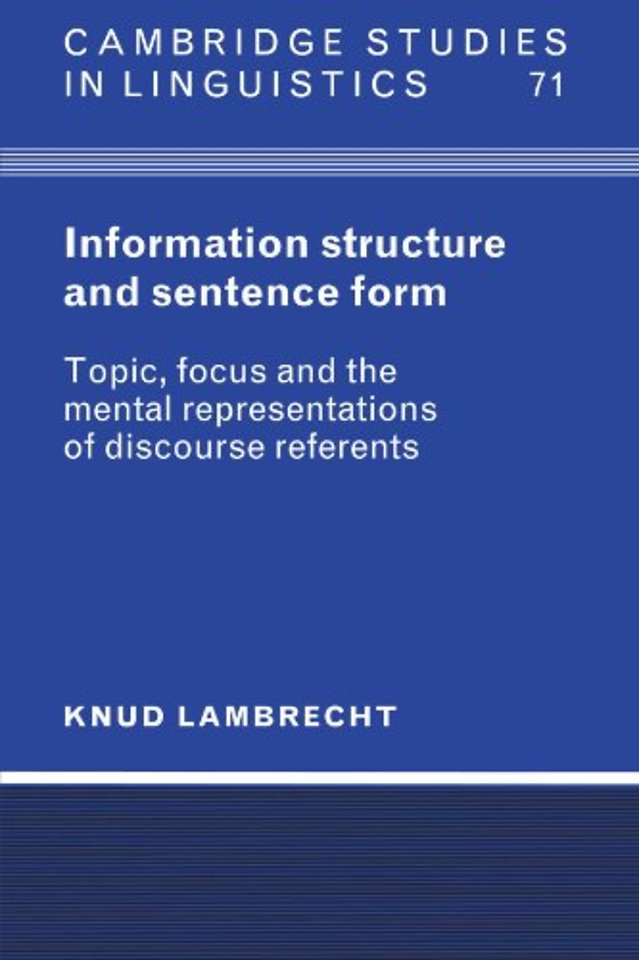
Information Structure and Sentence Form
Topic, Focus, and the Mental Representations of Discourse Referents
Samenvatting
Why do speakers of all languages use different grammatical structures under different communicative circumstances to express the same idea? Professor Lambrecht explores the relationship between the structure of the sentence and the linguistic and extra-linguistic context in which it is used. His analysis is based on the observation that the structure of a sentence reflects a speaker's assumption about the hearer's state of knowledge and consciousness at the time of the utterance. This relationship between speaker assumptions and formal sentence structure is governed by rules and conventions of grammar, in a component called 'information structure'. Four independent but interrelated categories are analysed: presupposition and assertion, identifiability and activation, topic, and focus.
Specificaties
Inhoudsopgave
Net verschenen
Rubrieken
- aanbestedingsrecht
- aansprakelijkheids- en verzekeringsrecht
- accountancy
- algemeen juridisch
- arbeidsrecht
- bank- en effectenrecht
- bestuursrecht
- bouwrecht
- burgerlijk recht en procesrecht
- europees-internationaal recht
- fiscaal recht
- gezondheidsrecht
- insolventierecht
- intellectuele eigendom en ict-recht
- management
- mens en maatschappij
- milieu- en omgevingsrecht
- notarieel recht
- ondernemingsrecht
- pensioenrecht
- personen- en familierecht
- sociale zekerheidsrecht
- staatsrecht
- strafrecht en criminologie
- vastgoed- en huurrecht
- vreemdelingenrecht