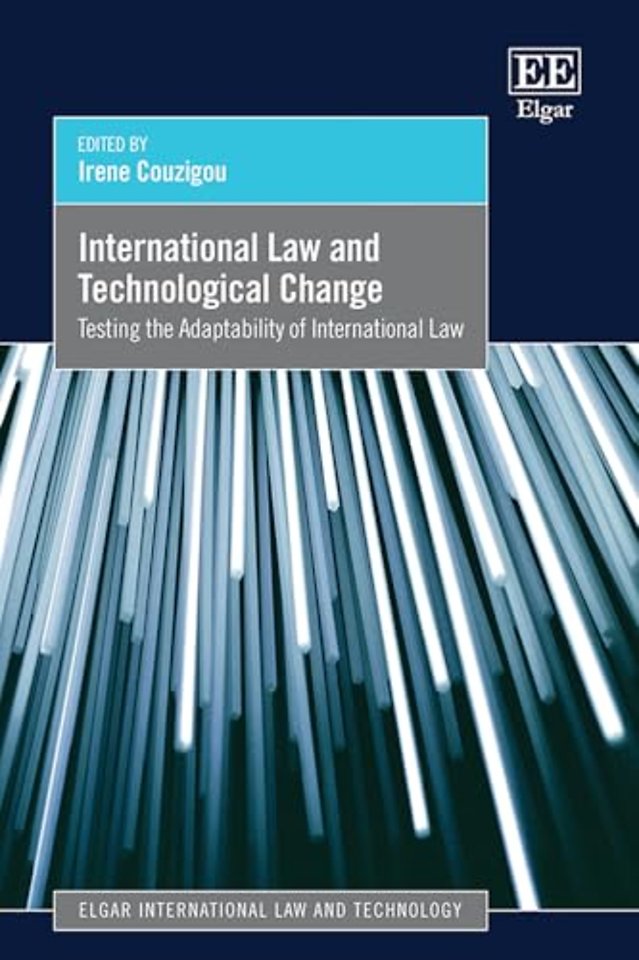
International Law and Technological Change
Testing the Adaptability of International Law
Samenvatting
This comprehensive book explores the consequences of modern technology for procedural and substantive areas of international law. It examines to what extent existing principles and rules of international law can adapt to unprecedented technological changes.
Contributors outline the impact of technological advancements on international law across key areas such as communications, governance, surveillance and security, immigration, warfare, and economics. They consider whether and how the use of new technologies, including information and communication technology, autonomous artificial intelligence systems, and blockchain infrastructures, should be regulated. Chapters investigate the impact of technology use on international legal discourse, international law-making, implementation of international law, and international accountability across the globe. This book ultimately demonstrates the numerous advantages of technology in aiding the interpretation, identification, formation, implementation, and enforcement of international law, provided that the application of technology is appropriately regulated.
This book is an essential resource for scholars and students of international law, particularly those with an interest in law and technology. It is also highly beneficial for legal professionals seeking to understand the evolving dynamics of international law within the new technological landscape.
Specificaties
Inhoudsopgave
1 Introduction: International law and technological change 1
Irene Couzigou
PART I TECHNOLOGY, INTERNATIONAL LEGAL DISCOURSE AND INTERNATIONAL LAW-MAKING 17
2 Investigations with digital open-source information and the stabilization of international norms: Protecting the principle of non-refoulement 19
Henning Lahmann
3 The challenges posed to democratic governance by Big Tech: What role for international law? 47
Neli Frost
4 A computational turn in customary international law: A solution to the discontents with the identification of custom? 73
Emilie van den Hoven
PART II TECHNOLOGY, IMPLEMENTATION AND DEVELOPMENT OF INTERNATIONAL LAW 97
Section 1 Challenges for international human rights law and refugee law 99
5 Translating and developing international human rights law in the online sphere: The role of Meta’s Oversight Board 101
Stefania Di Stefano
6 The European Union’s border security ecosystem – reconciling technological development, human rights and security threats at the borders of Europe 129
Lauren E Elrick
7 International refugee law in the digital age: Opportunities and challenges 157
Sandrine Turgis
Section 2 Challenges for international humanitarian law 181
8 Hypersonic weapons and international law: Incompatibilities with arms control treaties and international humanitarian law 183
Elisabeth Hoffberger-Pippan
9 The law of targeting’s mechanization and objectivization through the use of artificial intelligence 211
Tobias Vestner
PART III TECHNOLOGY AND INTERNATIONAL ACCOUNTABILITY 235
10 ‘The computer did it, not me!’ The challenges of allocating international legal responsibility for the use of autonomous cyber capabilities enabled by artificial intelligence 237
Samuli Haataja and Simon McKenzie
11 International human rights law in the era of blockchain: Redefining accountability in decentralized systems 261
José Gustavo Prieto Muñoz
12 Conclusion: International law and technological change 289
Irene Couzigou
Index 301
Anderen die dit boek kochten, kochten ook
-
 Tineke Cleiren€ 360,01
 -
Arie-Jan Kwak€ 49,95
-
Jonathan Soeharno€ 39,90
-
Zouridis€ 59,95
-
Marcel Ruygvoorn€ 54,00
-
Ybo Buruma€ 39,99





Net verschenen
Rubrieken
- aanbestedingsrecht
- aansprakelijkheids- en verzekeringsrecht
- accountancy
- algemeen juridisch
- arbeidsrecht
- bank- en effectenrecht
- bestuursrecht
- bouwrecht
- burgerlijk recht en procesrecht
- europees-internationaal recht
- fiscaal recht
- gezondheidsrecht
- insolventierecht
- intellectuele eigendom en ict-recht
- management
- mens en maatschappij
- milieu- en omgevingsrecht
- notarieel recht
- ondernemingsrecht
- pensioenrecht
- personen- en familierecht
- sociale zekerheidsrecht
- staatsrecht
- strafrecht en criminologie
- vastgoed- en huurrecht
- vreemdelingenrecht