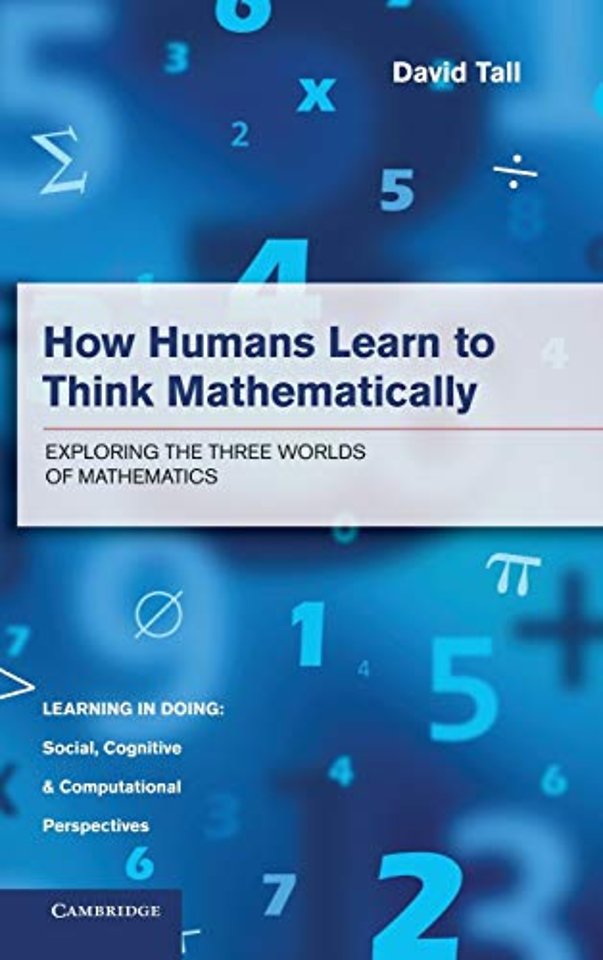
How Humans Learn to Think Mathematically
Exploring the Three Worlds of Mathematics
Samenvatting
How Humans Learn to Think Mathematically describes the development of mathematical thinking from the young child to the sophisticated adult. Professor David Tall reveals the reasons why mathematical concepts that make sense in one context may become problematic in another. For example, a child's experience of whole number arithmetic successively affects subsequent understanding of fractions, negative numbers, algebra, and the introduction of definitions and proof. Tall's explanations for these developments are accessible to a general audience while encouraging specialists to relate their areas of expertise to the full range of mathematical thinking. The book offers a comprehensive framework for understanding mathematical growth, from practical beginnings through theoretical developments, to the continuing evolution of mathematical thinking at the highest level.
Specificaties
Inhoudsopgave
Net verschenen
Rubrieken
- aanbestedingsrecht
- aansprakelijkheids- en verzekeringsrecht
- accountancy
- algemeen juridisch
- arbeidsrecht
- bank- en effectenrecht
- bestuursrecht
- bouwrecht
- burgerlijk recht en procesrecht
- europees-internationaal recht
- fiscaal recht
- gezondheidsrecht
- insolventierecht
- intellectuele eigendom en ict-recht
- management
- mens en maatschappij
- milieu- en omgevingsrecht
- notarieel recht
- ondernemingsrecht
- pensioenrecht
- personen- en familierecht
- sociale zekerheidsrecht
- staatsrecht
- strafrecht en criminologie
- vastgoed- en huurrecht
- vreemdelingenrecht