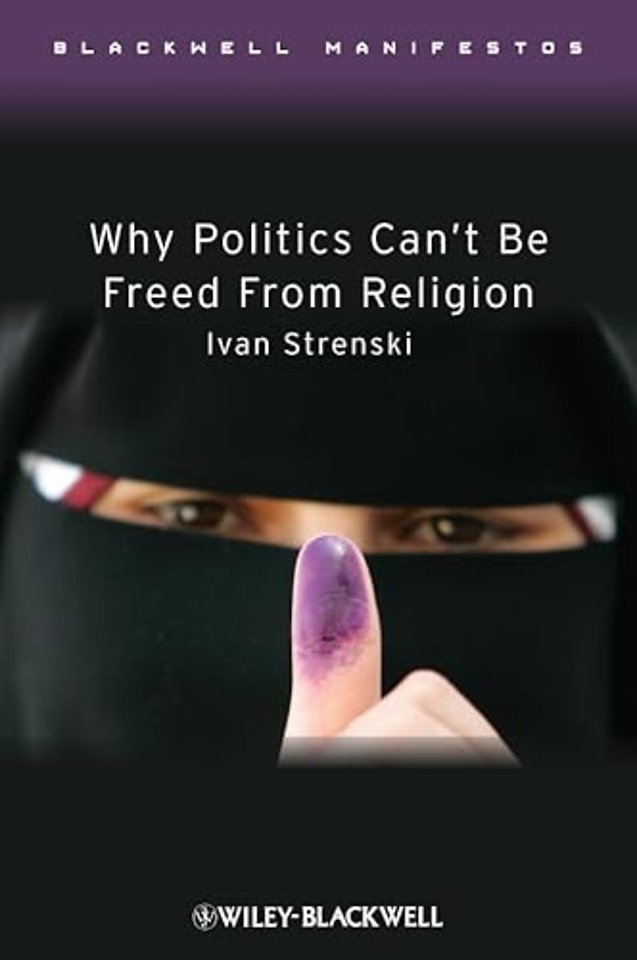
Why Politics Can′t Be Freed From Religion
Samenvatting
Why Politics Can′t be Freed From Religion is an original, erudite, and timely new book from Ivan Strenski. Itinterrogates the central ideas and contexts behind religion, politics, and power, proposing an alternative way in which we should think about these issues in the twenty–first century.
A timely and highly original contribution to debates about religion, politics and power and how historic and social influences have prejudiced our understanding of these concepts
Proposes a new theoretical framework to think about what these ideas and institutions mean in today&′s society
Applies this new perspective to a variety of real–world issues, including insights into suicide bombers in the Middle East
Includes radical critiques of the religious and political perspectives of thinkers such as Talal Asad and Michel Foucault
Dislodges our conventional thinking about politics and religion, and in doing so, helps make sense of the complexities of our twenty–first century world
Specificaties
Inhoudsopgave
<p>1 When God Plays Politics: Radical Interrogations of Religion, Power, and Politics 1</p>
<p>2 Interrogating Religion 8</p>
<p>1. Religion Trouble 8</p>
<p>2. Seeing Religion: Six Common Clichés 11</p>
<p>3. Gagging at the Feast of Two Unexamined Assumptions: Religion, All Good or All Bad 14</p>
<p>4. The Religion–Is–No–Good Cliché 21</p>
<p>5. The Second Set of Two Clichés: Religion Is Belief and Belief in God 24</p>
<p>6. Religion s Private Parts 33</p>
<p>7. Powerless in Paradise 35</p>
<p>8. Two Ways to Eliminate Religion 36</p>
<p>9. Is Religion Our Phlogiston? An Historical Test Case 39</p>
<p>10. Talal Asad s Religion Trouble 42</p>
<p>11. The Trick of Defining Religion 46</p>
<p>12. Owning Religion 50</p>
<p>13. How Durkheim Took Ownership of Religion 55</p>
<p>14. Religion and Its Despisers 59</p>
<p>3 Interrogating Power 62</p>
<p>1. Confronting the Paradox of Power 62</p>
<p>2. How Power Plays Havoc with Thinking about Institutional Violence 66</p>
<p>3. Whom Should We Blame? History on Trial 70</p>
<p>4. History s Helper: We Should Also Blame Foucault 81</p>
<p>5. Problematizing Power in South Africa 84</p>
<p>6. Foucault versus Foucault 88</p>
<p>7. Thinking about Power as Auctoritas and Hierarchy 90</p>
<p>8. What More Is to Be Done? Thinking about Power as Auctoritas and Social Force 97</p>
<p>4 Interrogating Politics 100</p>
<p>1. Defining Politics 100</p>
<p>2. Where There Is No Politics: Despotism and Totalitarianism 102</p>
<p>3. Autonomous Politics 105</p>
<p>4. Where Our Politics Makes No Sense 107</p>
<p>5. Politics, the Construct 109</p>
<p>6. Two Pernicious Views of Politics 112</p>
<p>7. History Lessons for Professor Morgenthau 116</p>
<p>8. What Constitutionalism Owes the Council of Constance 119</p>
<p>9. The Emergence of the Political . . . from the Religious 123</p>
<p>10. Machiavelli and Luther: Critical Contributions to the Autonomy of Politics 125</p>
<p>11. Foucault s Fault II: Everything Is Political 130</p>
<p>12. The Hidden Fascism of Thinking that Everything Is Political 133</p>
<p>13. Public and Private: No Absolute Line of Demarcation 135</p>
<p>14. Resisting the Panopticon 136</p>
<p>15. Afterword: The Autonomy of Politics and the Nation–State 140</p>
<p>5 Testing Interrogations of Religion, Power, and Politics : Human Bombers and the Authority of Sacrifice in the Middle East 142</p>
<p>1. Is Suicide Bombing Religious? 142</p>
<p>2. Making Too Much of Religion in Suicide Bombing: Islamofascism 144</p>
<p>3. Dying to Make Too Little of Religion in Suicide Bombing: Robert A. Pape 147</p>
<p>4. No Religion in Suicide Bombing: Talal Asad 150</p>
<p>5. How Religion Helps Explain Human Bombing 153</p>
<p>6. Human Bombing Is Catastrophe, but also a Triumph of Secular Immortality 155</p>
<p>7. Human Bombing = Jihad + Sacrifice 160</p>
<p>8. Sacrifice or Suicide? 164</p>
<p>9. But Do Any Muslims Really Think Human Bombers Are Sacrifices ? 168</p>
<p>10. Sacrifice Makes Authority 175</p>
<p>11. How and Why Sacrifice Works: The Authority of Sacralization 176</p>
<p>12. How and Why Sacrifice Works: No Free Gifts 180</p>
<p>13. Concluding Remarks 182</p>
<p>References 187</p>
<p>Index 196</p>
Net verschenen
Rubrieken
- aanbestedingsrecht
- aansprakelijkheids- en verzekeringsrecht
- accountancy
- algemeen juridisch
- arbeidsrecht
- bank- en effectenrecht
- bestuursrecht
- bouwrecht
- burgerlijk recht en procesrecht
- europees-internationaal recht
- fiscaal recht
- gezondheidsrecht
- insolventierecht
- intellectuele eigendom en ict-recht
- management
- mens en maatschappij
- milieu- en omgevingsrecht
- notarieel recht
- ondernemingsrecht
- pensioenrecht
- personen- en familierecht
- sociale zekerheidsrecht
- staatsrecht
- strafrecht en criminologie
- vastgoed- en huurrecht
- vreemdelingenrecht