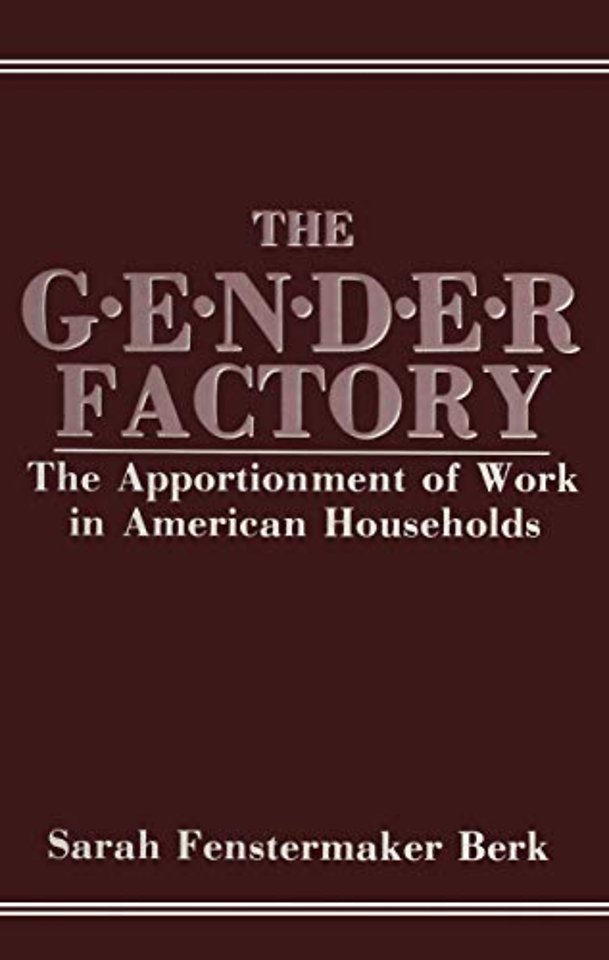
The Gender Factory
The Apportionment of Work in American Households
Samenvatting
tion addressed by this analysis centers on the reciprocal relation between 1 household domestic and market work efforts. It should be obvious by now that this chapter is not concerned ex plicitly with the contributions of individual members to household or mar ket activity, nor does it examine the mechanisms by which work tasks or time is apportioned among them. To reiterate, households per se are the unit of analysis; the division of labor within, with respect to either household or market activities, is ignored. In this chapter, one must pre tend that the social relations within the household productive unit, which critically shape both the nature of work and its allocation, are hidden from view. To return to the earlier metaphor, households establish a to tal household "pie," made up of all the market and domestic chores that they will undertake and the time required for them. Only after that "pie" is created can it be sliced and the pieces doled out to individual members. 2 The household and market pie defined and described here can be roughly conceptualized as the total productive capacity of the household, or as the result of a pooling of individual talents and resources. Indeed, were a measure of the time available for leisure incorporated into the measure of the pie, the household's full income (budget) constraint (i. e. , the total productive potential of the household) could be described.
Specificaties
Inhoudsopgave
Anderen die dit kochten, kochten ook
-
 Jitske Kramer€ 27,50
 -
Eelco Visser€ 19,95
-
Margaret Diekhuis-Kuiper€ 22,50
-
Tim 'S Jongers€ 22,00
-
Michael Benson€ 93,33
-
Paul Frissen€ 29,90




Net verschenen
Rubrieken
- aanbestedingsrecht
- aansprakelijkheids- en verzekeringsrecht
- accountancy
- algemeen juridisch
- arbeidsrecht
- bank- en effectenrecht
- bestuursrecht
- bouwrecht
- burgerlijk recht en procesrecht
- europees-internationaal recht
- fiscaal recht
- gezondheidsrecht
- insolventierecht
- intellectuele eigendom en ict-recht
- management
- mens en maatschappij
- milieu- en omgevingsrecht
- notarieel recht
- ondernemingsrecht
- pensioenrecht
- personen- en familierecht
- sociale zekerheidsrecht
- staatsrecht
- strafrecht en criminologie
- vastgoed- en huurrecht
- vreemdelingenrecht