Genomics of the Saccharinae
Samenvatting
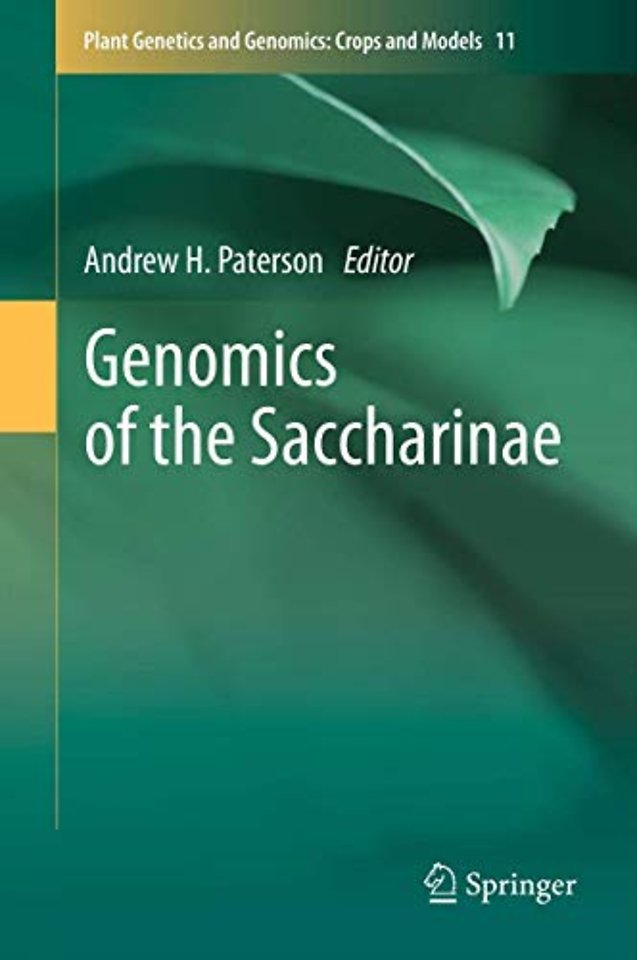
The Saccharinae clade of the Poaceae (grass) family of flowering plants includes several important crops with a rich history of contributions to humanity and the promise of still-greater contributions, as a result of some of the highest biomass productivity levels known, resilience to drought and other environmental challenges that are likely to increase, amenability to production systems that may mitigate or even reverse losses of ecological capital such as topsoil erosion, and the recent blossoming of sorghum as a botanical and genomic model for the clade.
In Genomics of the Saccharinae, advances of the past decade and earlier are summarized and synthesized to elucidate the current state of knowledge of the structure, function, and evolution of the Sorghum, Saccharum, and Miscanthus genera, and progress in the application of this knowledge to crop improvement. As a backdrop, it is important to understand the naturally occurring diversity in each genus, its organization and distribution, and its evolutionary history. Genomic tools and methods for Saccharinae biology and improvement have improved dramatically in the past few years – a detailed summary of these tools and their applications is a central element of this book. Application of genomic tools to priorities in crop improvement, including understanding and manipulating plant growth and development, composition, and defense, as well as increasing the quality and productivity of seed/grain, sugar, biomass, and other value-added products under a range of conditions and inputs, are addressed. In particular, as the first native African crop to emerge as a genomic model, sorghum offers an excellent case study of challenges and opportunities in linking new advances in biosciences to solving some of Africa’s major agricultural problems. Several members of the clade, exemplified by Sorghum halepense (Johnsongrass) offer insights into weediness and invasion biology. The first sequence for a member of the clade, sorghum, as well as progress and challenges toward sequencing of additional members and the new opportunities that this will create, are also explored. Indeed, the very complexities that have hindered study of some clade members also offer intriguing opportunities to gain insight into fundamental questions such as roles of polyploidy in agricultural productivity and post-polyploidy evolution.
Specificaties
Inhoudsopgave
Net verschenen
Rubrieken
- aanbestedingsrecht
- aansprakelijkheids- en verzekeringsrecht
- accountancy
- algemeen juridisch
- arbeidsrecht
- bank- en effectenrecht
- bestuursrecht
- bouwrecht
- burgerlijk recht en procesrecht
- europees-internationaal recht
- fiscaal recht
- gezondheidsrecht
- insolventierecht
- intellectuele eigendom en ict-recht
- management
- mens en maatschappij
- milieu- en omgevingsrecht
- notarieel recht
- ondernemingsrecht
- pensioenrecht
- personen- en familierecht
- sociale zekerheidsrecht
- staatsrecht
- strafrecht en criminologie
- vastgoed- en huurrecht
- vreemdelingenrecht