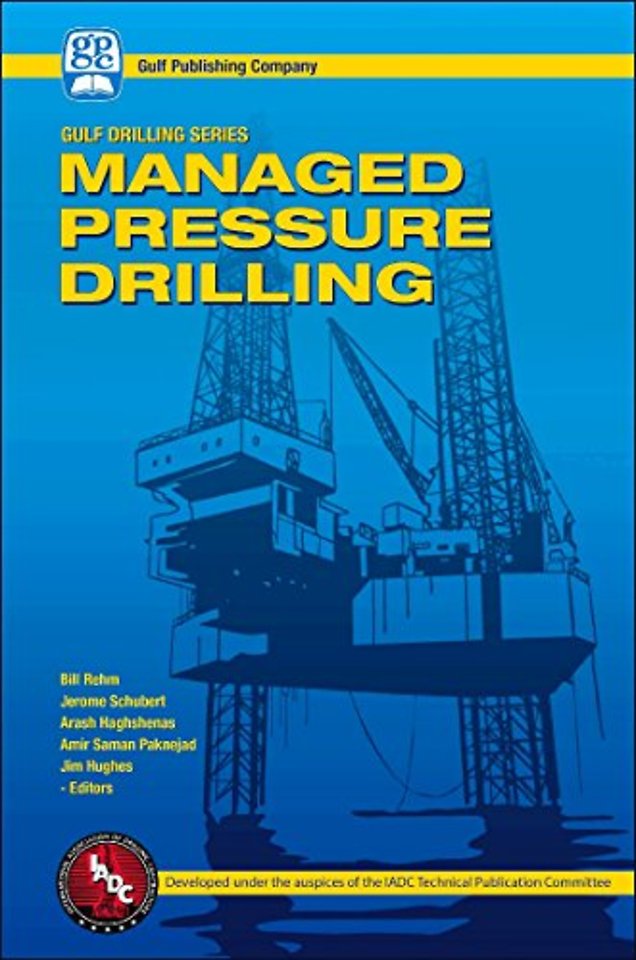
Bill Rehm,
Jerome Schubert,
Arash Haghshenas,
Amir Saman Paknejad,
Jim Hughes
e.a.
Elsevier Science
e druk, 2009
9781933762241
Managed Pressure Drilling
Specificaties
Gebonden, blz.
|
Engels
Elsevier Science |
e druk, 2009
ISBN13: 9781933762241
Rubricering
Juridisch
:
Onderdeel van serie
Gulf Drilling Guides
Levertijd ongeveer 9 werkdagen
Gratis verzonden
Samenvatting
With extraction out of depleted wells more important than ever, this new and developing technology is literally changing drilling engineering for future generations. Never before published in book form, these cutting-edge technologies and the processes that surround them are explained in easy-tounderstand language, complete with worked examples, problems and solutions. This volume is invaluable as a textbook for both the engineering student and the veteran engineer who needs to keep up with changing technology.
Specificaties
ISBN13:9781933762241
Taal:Engels
Bindwijze:Gebonden
Uitgever:Elsevier Science
Serie:Gulf Drilling Guides
Inhoudsopgave
<br>Preface</br><br>Contributors</br><br>List of Abbreviations</br><br>Chapter 1 The Why and Basic Principles of Managed Well-Bore Pressure</br><br> About This Chapter</br><br> 1.1 Introduction to Managed Pressure Drilling and Some Definitions</br><br> 1.2 History</br><br> 1.2.1 Old Ideas Made New</br><br> 1.2.2 New Ideas</br><br> 1.3 Advantages and Methods of Managed Pressure Drilling</br><br> 1.3.1 An Adaptive Process</br><br> 1.3.2 Extending the Casing Points</br><br> 1.3.3 Lost Circulation</br><br> 1.3.4 Well Kicks</br><br> 1.3.5 Differentially Stuck Drill Pipe</br><br> 1.3.6 Deepwater Drilling</br><br> 1.4 Basic Mathematical Ideas behind MPD</br><br> 1.4.1 Bottom-Hole Pressure Calculations with Liquids</br><br> 1.4.2 Expansion (or Compression) of a Gas Bubble with No Fluid Flow</br><br> 1.4.3 Ideal Gas Law</br><br> 1.4.4 Strong–White Equation</br><br> 1.4.5 The Effect of Annular Pressure Loss on Bubble Size</br><br> 1.5 Basic Well Control</br><br> 1.5.1 Driller’s Method of Well Control</br><br> 1.5.2 Wait and Weight Method of Well Control</br><br> 1.5.3 Basic Well-Control Formulas</br><br> 1.5.4 Lag Time—Choke to Bottom of the Hole or Choke to Standpipe</br><br> 1.6 Pore Pressure</br><br> 1.7 Overburden Pressure</br><br> 1.8 Rock Mechanics</br><br> 1.8.1 Fracture Pressure</br><br> 1.8.2 Well-Bore Ballooning and the Leak-off Test</br><br> Questions</br><br> References</br><br> Answers</br><br>Chapter 2 Situational Problems in MPD</br><br> About This Chapter</br><br> 2.1 Introduction</br><br> 2.2 ECD Manipulation—Pore Pressure and Fracture Pressure Convergence</br><br> 2.2.1 Chokes</br><br> 2.2.2 Pumps</br><br> 2.2.3 Pipe Movement</br><br> 2.2.4 "Ballooning"</br><br> 2.2.5 Precision</br><br> 2.2.6 Well Control</br><br> 2.2.7 Lag Time</br><br> 2.3 Total Lost Circulation</br><br> 2.4 Deepwater Marine Drilling</br><br> 2.4.1 The Problem in the Surface Hole</br><br> 2.4.2 Excessive Casing Strings</br><br> 2.4.3 U-Tube Effect in Riserless or Limited Riser Operations</br><br> 2.4.4 Hydrostatic Control Valve</br><br> 2.4.5 Annular Pressure Changes (ECD Problems)</br><br> 2.4.6 Well-Bore Ballooning</br><br> 2.4.7 Well Control</br><br> 2.5 Connections and Trips</br><br> 2.6 Annular Pressure Loss and Hydraulics</br><br> 2.6.1 Equivalent Circulating Density</br><br> 2.6.2 Historical Calculation of the ΔP in APL</br><br> 2.6.3 Annular Pressure Loss Calculations</br><br> 2.6.4 Hydraulics Equations</br><br> 2.6.5 Annular Frictional Pressure Loss Calculation, ΔPa</br><br> 2.7 The Effect of Pipe Movement</br><br> 2.7.1 Pipe Movement Changes the Bottom-Hole Pressure</br><br> 2.7.2 Estimating Pressure Surge and Swab</br><br> Questions</br><br> References</br><br> Answers</br><br>Chapter 3 Constant Bottom-Hole Pressure with Pressure as a Primary Control</br><br> About This Chapter</br><br> 3.1 Introduction</br><br> 3.2 Pressure Control</br><br> 3.3 Constant-BHP Choke Systems</br><br> 3.4 Operational Considerations</br><br> 3.5 DAPC System Description</br><br> 3.5.1 DAPC Choke Manifold</br><br> 3.5.2 DAPC Back-Pressure Pump</br><br> 3.5.3 Integrated Pressure Manager</br><br> 3.5.4 Case Study</br><br> Questions</br><br> References</br><br> Answers</br><br>Chapter 4 MPD with Flow Measurement as the Primary Control</br><br> About This Chapter</br><br> 4.1 Description of the Process</br><br> 4.2 Special Drilling Equipment</br><br> 4.2.1 Circulation Path</br><br> 4.2.2 Rotating Control Device</br><br> 4.2.3 Drilling Manifold</br><br> 4.3 Real-Time Data Acquisition and Control</br><br> 4.4 Drilling Applications</br><br> 4.4.1 Standard Approach</br><br> 4.4.2 Special Systems Approach</br><br> 4.5 Case Histories</br><br> Questions</br><br> References</br><br> Answers</br><br>Chapter 5 Continuous Circulation System</br><br> About This Chapter</br><br> 5.1 Introduction</br><br> 5.2 The System</br><br> 5.3 Development</br><br> 5.4 Control System</br><br> 5.5 Applications</br><br> 5.6 Operation</br><br> 5.7 Well Planning</br><br> 5.8 Records and Reporting</br><br> 5.9 Case History</br><br> 5.10 Safety</br><br> Questions</br><br> References</br><br> Answers</br><br>Chapter 6 A Simplified Approach to MPD</br><br> About This Chapter</br><br> 6.1 Introduction</br><br> 6.2 Discussion</br><br> 6.3 A Simplified Approach</br><br> 6.4 Implementation</br><br> 6.5 Conclusion</br><br> Questions</br><br> References</br><br> Answers</br><br>Chapter 7 Mud Cap Drilling</br><br> About This Chapter</br><br> 7.1 History of Mud Cap Drilling</br><br> 7.2 Pressurized Mud Cap</br><br> 7.3 Floating Mud Cap</br><br> 7.4 Mud Cap Operation</br><br> 7.4.1 Mud Cap Drilling</br><br> 7.4.2 Mud Cap Tripping</br><br> 7.5 Pressurized Mud Cap Operation</br><br> 7.5.1 Pressurized Mud Cap Drilling</br><br> 7.5.2 Pressurized Mud Cap Tripping</br><br> 7.6 Conclusion</br><br> Questions</br><br> References</br><br> Answers</br><br>Chapter 8 Dual-Gradient Drilling</br><br> About This Chapter</br><br> 8.1 Introduction</br><br> 8.2 Problems Associated with Conventional Riser Systems in Deep Water</br><br> 8.3 AGR Riserless Mud Return System</br><br> 8.3.1 Introduction</br><br> 8.3.2 Primary Uses</br><br> 8.3.3 Equipment</br><br> 8.3.4 Operation</br><br> 8.3.5 Critical Issues</br><br> 8.3.6 Summary</br><br> 8.4 AGR Dual-Gradient System</br><br> 8.4.1 Introduction</br><br> 8.4.2 Primary Uses</br><br> 8.4.3 Equipment</br><br> 8.4.4 Operation</br><br> 8.4.5 Critical Issues</br><br> 8.4.6 Summary</br><br> 8.5 Subsea Mud-Lift Drilling System (Joint Industry Project)</br><br> 8.5.1 SMD Equipment</br><br> 8.5.2 The U-Tube Phenomenon with DGD</br><br> 8.6 Dual-Gradient Well Control</br><br> 8.6.1 Recording Prekick Information</br><br> 8.6.2 Kick Detection</br><br> 8.6.3 Dynamic Shut-in of the DGD System</br><br> 8.6.4 Kick Circulation</br><br> 8.7 Additional Comments</br><br> 8.8 Examples</br><br> Questions</br><br> References</br><br> Answers</br><br>Chapter 9 Equipment Common to MPD Operations</br><br> About This Chapter</br><br> 9.1 Rotating Control Devices and Rotating Annular Preventers</br><br> 9.1.1 Rotating Control Devices (Passive Systems)</br><br> 9.1.2 Rotating Annular Preventors (Active Systems)</br><br> 9.1.3 Comments on the Use of Active or Passive Systems</br><br> 9.1.4 Rotating Control Devices on Risers</br><br> 9.2 Chokes</br><br> 9.2.1 Power Choke</br><br> 9.2.2 Swaco Super Choke</br><br> 9.2.3 Swaco Auto Super Choke</br><br> 9.3 Drill-Pipe Nonreturn Valves</br><br> 9.3.1 Basic Piston-Type Float</br><br> 9.3.2 Hydrostatic Control Valve</br><br> 9.3.3 Inside BOP (Pump-Down Check Valve)</br><br> 9.3.4 Retrievable NRV or Check Valve (Weatherford)</br><br> 9.4 Down-Hole Annular Valves</br><br> 9.4.1 Casing Isolation Valve</br><br> 9.4.2 Drilling Down-Hole Deployment Valve</br><br> 9.4.3 Quick Trip Valve</br><br> 9.5 ECD Reduction Tool</br><br> 9.5.1 Unique Considerations</br><br> 9.5.2 Advantages</br><br> 9.5.3 Challenges</br><br> 9.5.4 Description</br><br> 9.6 Coriolis Flowmeter</br><br> 9.7 Disc Pump (Friction Pump)</br><br> Questions</br><br> References</br><br> Answers</br><br>Chapter 10 MPD Candidate Selection</br><br> About This Chapter</br><br> 10.1 Introduction</br><br> 10.2 Candidate Selection and Feasibility Study</br><br> 10.3 What is MPD Candidate Selection?</br><br> 10.4 Steps Involved in Candidate Selection</br><br> 10.4.1 Purpose of the Study</br><br> 10.4.2 Procurement of Information</br><br> 10.4.3 Hydraulic Analysis</br><br> 10.4.4 Method Selection</br><br> 10.4.5 Viability of the Option</br><br> 10.4.6 Equipment</br><br> 10.4.7 HAZOP and HAZID (Optional)</br><br> 10.5 Examples</br><br> 10.5.1 CBHP</br><br> 10.5.2 Dual-Gradient SMD</br><br> Questions</br><br> Answers</br><br>Appendix A Rock Mechanics</br><br> A.1 Stress and Strain (Elastic and Nonelastic Deformation)</br><br> A.2 Horizontal and Vertical Rock Stress</br><br>Appendix B Rheology</br><br> B.1 Introduction</br><br> B.2 Shear Stress and Shear Rate</br><br> B.3 Newtonian Model</br><br> B.4 Non-Newtonian Model</br><br> B.4.1 Bingham Plastic Model</br><br> B.4.2 Power Law Model</br><br> B.4.3 API (Recommended Practice 13D, 2003) Model</br><br> B.4.4 Herschel–Bulkley Model</br><br> References</br><br>Appendix C Useful Conversion Factors</br><br>Appendix D IADC Well Classification System for Underbalanced Operations and Managed Pressure Drilling</br><br>Appendix E IADC Underbalanced and Managed Pressure Drilling Guidelines—HSE Planning Guidelines</br><br>Appendix F IADC UB and MPD Glossary</br><br>Index</br>
Net verschenen
Rubrieken
- aanbestedingsrecht
- aansprakelijkheids- en verzekeringsrecht
- accountancy
- algemeen juridisch
- arbeidsrecht
- bank- en effectenrecht
- bestuursrecht
- bouwrecht
- burgerlijk recht en procesrecht
- europees-internationaal recht
- fiscaal recht
- gezondheidsrecht
- insolventierecht
- intellectuele eigendom en ict-recht
- management
- mens en maatschappij
- milieu- en omgevingsrecht
- notarieel recht
- ondernemingsrecht
- pensioenrecht
- personen- en familierecht
- sociale zekerheidsrecht
- staatsrecht
- strafrecht en criminologie
- vastgoed- en huurrecht
- vreemdelingenrecht