,

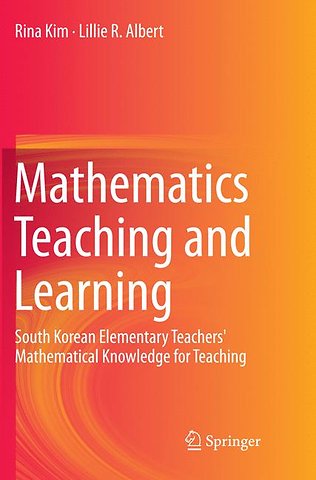
Mathematics Teaching and Learning

South Korean Elementary Teachers' Mathematical Knowledge for Teaching

Specificaties
Paperback, blz. | Engels
Springer International Publishing | e druk, 2016
ISBN13: 9783319366159
Rubricering
Juridisch :
Springer International Publishing e druk, 2016 9783319366159
€ 60,99
Levertijd ongeveer 9 werkdagen
Gratis verzonden

Samenvatting

The purpose of this research is to identify the categories of South Korean elementary teachers’ knowledge for teaching mathematics. Emerging from the data collected and the subsequent analysis are five categories of South Korean elementary teachers’ knowledge for teaching mathematics: Mathematics Curriculum Knowledge, Mathematics Learner Knowledge, Fundamental Mathematics Conceptual Knowledge, Mathematics Pedagogical Content Knowledge, and Mathematics Pedagogical Procedural Knowledge. The first three categories of knowledge play a significant role in mathematics instruction as an integrated form within Mathematics Pedagogical Content Knowledge. This study also demonstrated that Mathematics Pedagogical Procedural Knowledge might play a pivotal role in constructing Mathematics Pedagogical Content Knowledge. These findings are connected to results from relevant studies in terms of the significant role of teachers’ knowledge in mathematics instruction.

Specificaties

ISBN13:9783319366159
Taal:Engels
Bindwijze:paperback
Uitgever:Springer International Publishing

Inhoudsopgave

CHAPTER 1: Introduction.- 1.1. Why elementary teachers’ knowledge matter.- 1.2.  Purpose of the Study and Research Question.- 1.3. Framework.- 1.3.1. Theoretical Orientation.- 1.3.2. Conceptual Framework.- 1.4. Organization of the Book.- References.- CHAPTER 2: A Pedagogical Overview of Related Research.- 2.1. Introduction.- 2.2. Sociocultural Theory.- 2.3. Research on Teachers’ Mathematical Knowledge for Teaching.- 2.3.1. Shulman’s Research on Teachers’ Knowledge for Teaching.- 2.3.2. Fennema and Franke’s Research on Mathematics Teachers’ Knowledge  .- 2.3.3. Hill, Ball and Schilling’s Research on Teachers’ Mathematical Knowledge for Teaching.- 2.3.4. Mishra and Koehler’s New Category of Teachers’ Mathematical Knowledge for Teaching.- 2.5. Interpretive Summary and Critical Analysis.-References.- CHAPTER 3: Methodology.- 3.1. Introduction.- 3.2. Research Design.- 3.3. Participants.- 3.4. Settings.- 3.5. Data Collection.-3.6. Data Analysis.- References.- CHAPTER 4: Context of Elementary Mathematics Education in South Korea.- 4.1. Introduction.- 4.2. The National Curriculum in South Korea.- 4.3. The National Curriculum and Education Fever in South Korea.- 4.4. The National Mathematics Curriculum at the Elementary Level in South Korea .- 4.5. Summary.-References.- CHAPTER 5: Mathematics Curriculum Knowledge (MCK).- 5.1. Introduction.- 5.2. Mathematics Curriculum Knowledge in Mathematics Instruction.- 5.2.1. Using MCK When Developing and Instructional Process.- 5.2.2. Using MCK When Teaching the Lesson in a Classroom.- 5.2.3. Using MCK When Assessing Students’ Work.- 5.3. Interpretative Summary.- References.- CHAPTER 6: Mathematics Learner Knowledge (MLK).- 6.1. Introduction.- 6.2. Mathematics Learner Knowledge.- 6.3. Mathematics Learner Knowledge in Mathematics Instruction.- 6.3.1. Using MLK When Developing and Instructional Process.- 6.3.2. Using MCK When Teaching the Lesson in aClassroom.- 6.3.3. Using MLK When Assessing Students’ Work.- 6.4 Interpretative Summary.- References.- CHAPTER 7: Fundamental Mathematics Conceptual Knowledge (FMCK).- 7.1. Introduction.- 7.2. Fundamental Mathematics Conceptual Knowledge.- 7.3. Fundamental Mathematics Conceptual Knowledge in Mathematics Instruction.- 7.3.1. Using FMCK When Developing and Instructional Process.- 7.3.2. Using FMCK When Teaching the Lesson in a Classroom.- 7.3.3. Using FMLK When Assessing Students’ Work.- 7.4. Interpretative Summary.- References.- CHAPTER 8: Mathematics Pedagogical Content Knowledge (MPCK) and Mathematics Pedagogical Procedural Knowledge (MPPK).- 8.1. Introduction.- 8.2. The Nature of Categories of Knowledge for Teaching Mathematics.- 8.3. The Relationship Among Categories of Knowledge for Teaching Mathematics.- 8.4. Mathematics Pedagogical Content Knowledge.- 8.5. Mathematics Pedagogical Procedural Knowledge.- 8.6. The Structure of South Korean Elementary Teachers’ Knowledge for Teaching Mathematics.- 8.7. Interpretative Summary.- References.- CHAPTER 9: Concluding Remarks, Implications and Future Directions.- 9.1. Introduction.- 9.2. Relationship Among the Categories of Mathematical Knowledge.- 9.3. Conclusion and Implications.-9.5. Future Directions.- 9.6. Closing Comments.- References.

Net verschenen

€ 60,99
Levertijd ongeveer 9 werkdagen
Gratis verzonden

Rubrieken

    Personen

      Trefwoorden

        Mathematics Teaching and Learning