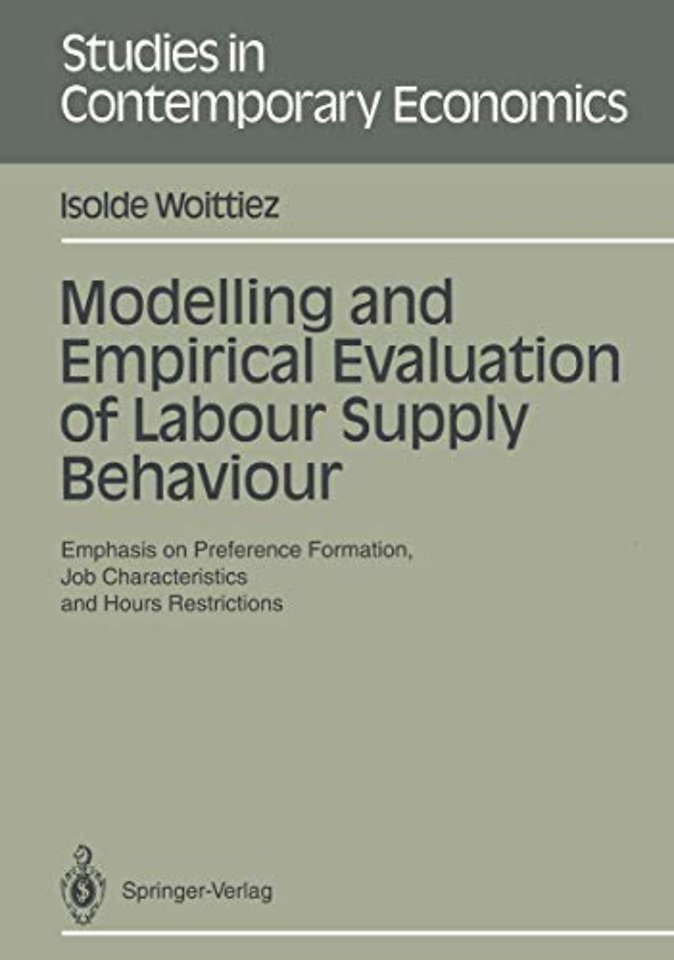
Modelling and Empirical Evaluation of Labour Supply Behaviour
Emphasis on Preference Formation, Job Characteristics and Hours Restrictions
Samenvatting
One of the major issues of policy makers in The Netherlands is to reduce the high unemployment rate. In 1988 economic growth was substantial in all OECD countries, which led to an increase in employment. The economic growth also induced extra labour supply, especially of married women, which altogether led to a smaller reduction in the unemployment rate than could have been expected in view of the economic growth (see Rapportage Arbeidsmarkt, 1989). The estimated official unemployment rate in 1988 is still 11. 0% of the total labour force. Therefore, there is a strong interest in policies that seek to increase employment (the demand side of the labour market) as well as in understanding the factors that influence labour supply. In this thesis we try to further such understanding by constructing a detailed model of household labour supply. The data we use relate t9 Dutch households in 1985. In that year the official rate of unemployment was 15. 9%. A distinguishing feature of Dutch labour supply is its very low level of female labour force participation, e. g. in 1985 it was only 35. 2%. Apart from Spain, which had a similar participation rate, most other industrialized OECD countries had a participation rate of around 60% (see OECD Labor Force Statistics).
Specificaties
Inhoudsopgave
Anderen die dit kochten, kochten ook
-
 Richard Janssen€ 39,95
 -
Wim Hulleman€ 60,95
-
Barbara Minto€ 47,95
-
Nassim Nicholas Taleb€ 24,99
-
Ha-Joon Chang€ 26,99
-
Norbert Telders€ 58,95





Net verschenen
Rubrieken
- aanbestedingsrecht
- aansprakelijkheids- en verzekeringsrecht
- accountancy
- algemeen juridisch
- arbeidsrecht
- bank- en effectenrecht
- bestuursrecht
- bouwrecht
- burgerlijk recht en procesrecht
- europees-internationaal recht
- fiscaal recht
- gezondheidsrecht
- insolventierecht
- intellectuele eigendom en ict-recht
- management
- mens en maatschappij
- milieu- en omgevingsrecht
- notarieel recht
- ondernemingsrecht
- pensioenrecht
- personen- en familierecht
- sociale zekerheidsrecht
- staatsrecht
- strafrecht en criminologie
- vastgoed- en huurrecht
- vreemdelingenrecht