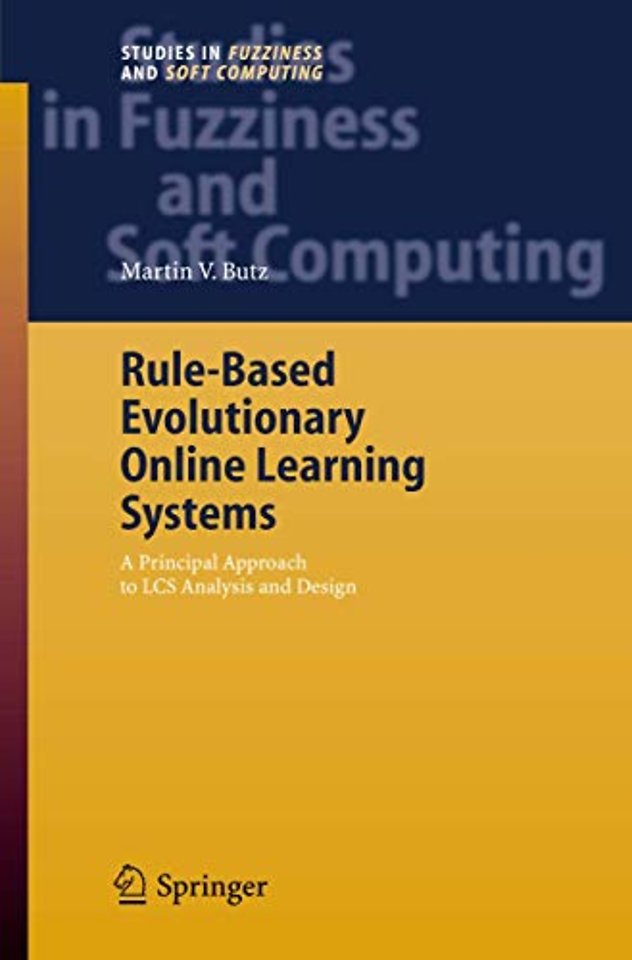
Rule-Based Evolutionary Online Learning Systems
A Principled Approach to LCS Analysis and Design
Samenvatting
Rule-basedevolutionaryonlinelearningsystems,oftenreferredtoasMichig- style learning classi?er systems (LCSs), were proposed nearly thirty years ago (Holland, 1976; Holland, 1977) originally calling them cognitive systems. LCSs combine the strength of reinforcement learning with the generali- tion capabilities of genetic algorithms promising a ?exible, online general- ing, solely reinforcement dependent learning system. However, despite several initial successful applications of LCSs and their interesting relations with a- mal learning and cognition, understanding of the systems remained somewhat obscured. Questions concerning learning complexity or convergence remained unanswered. Performance in di?erent problem types, problem structures, c- ceptspaces,andhypothesisspacesstayednearlyunpredictable. Thisbookhas the following three major objectives: (1) to establish a facetwise theory - proachforLCSsthatpromotessystemanalysis,understanding,anddesign;(2) to analyze, evaluate, and enhance the XCS classi?er system (Wilson, 1995) by the means of the facetwise approach establishing a fundamental XCS learning theory; (3) to identify both the major advantages of an LCS-based learning approach as well as the most promising potential application areas. Achieving these three objectives leads to a rigorous understanding of LCS functioning that enables the successful application of LCSs to diverse problem types and problem domains. The quantitative analysis of XCS shows that the inter- tive, evolutionary-based online learning mechanism works machine learning competitively yielding a low-order polynomial learning complexity. Moreover, the facetwise analysis approach facilitates the successful design of more - vanced LCSs including Holland’s originally envisioned cognitive systems. Martin V.
Specificaties
Inhoudsopgave
Net verschenen
Rubrieken
- aanbestedingsrecht
- aansprakelijkheids- en verzekeringsrecht
- accountancy
- algemeen juridisch
- arbeidsrecht
- bank- en effectenrecht
- bestuursrecht
- bouwrecht
- burgerlijk recht en procesrecht
- europees-internationaal recht
- fiscaal recht
- gezondheidsrecht
- insolventierecht
- intellectuele eigendom en ict-recht
- management
- mens en maatschappij
- milieu- en omgevingsrecht
- notarieel recht
- ondernemingsrecht
- pensioenrecht
- personen- en familierecht
- sociale zekerheidsrecht
- staatsrecht
- strafrecht en criminologie
- vastgoed- en huurrecht
- vreemdelingenrecht