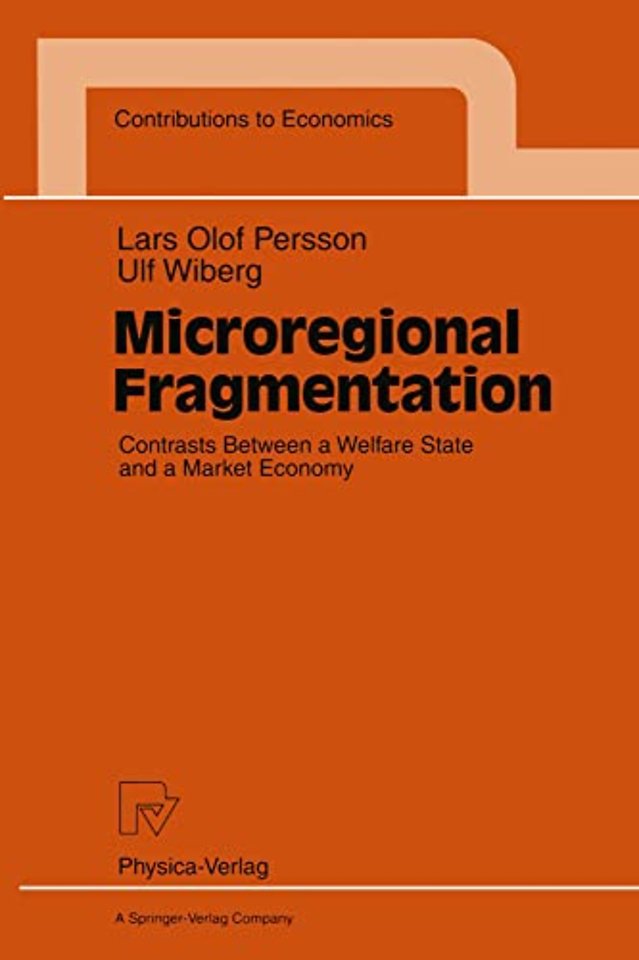
Microregional Fragmentation
Contrasts Between a Welfare State and a Market Economy
Samenvatting
This book is written primarily for a Scandinavian and European audience interested in regional policy and planning. Attention is placed on the transformation process in the Swedish economy and its implications for regional balances of socio-economic conditions and changes in spatial structures. Conditions in the United States, especially North Carolina, are used as a reference. The book is based on work originating within the framework of an international forum for exchange of ideas and co-operation between researchers, planners and practitioners, The Consortium for the Study of Perceived Planning Issues in Marginal Areas -PIMA. The group was established in 1989 and is interested in various aspects of marginal areas defined either in locational or developmental terms. Members of the core group represent universities in the United States, Sweden and Ireland. During recent years a subgroup within PIMA has focused attention on studies of areas located between urban centres and rural peripheries. These areas have been labelled Intermediate Socio-econornic Regions - ISER. Joint work between Sweden and North Carolina of a comparative nature has been conducted by the authors of this book and Professor Ole Gade and some of his students at Appalachian State University, North Carolina. This work has been published in proceedings from PIMA meetings (Planning Issues in Marginal Areas, Boone: Ole Gade, Vincent P. Miller Jr. and Lawrence M. Sommers, eds. 1991; Planning and Development of Marginal Areas, Galway: Micheal O'Cinneide and Seamus Grimes, eds.
Specificaties
Inhoudsopgave
Anderen die dit kochten, kochten ook
-
 Leon Lubbers€ 206,00
 -
Jona van Loenen€ 23,99
-
Stephen Covey€ 22,95
-
Damaris Matthijsen€ 38,50
-
Gijsbert Koren€ 15,99
-
Nassim Nicholas Taleb€ 24,99

Net verschenen
Rubrieken
- aanbestedingsrecht
- aansprakelijkheids- en verzekeringsrecht
- accountancy
- algemeen juridisch
- arbeidsrecht
- bank- en effectenrecht
- bestuursrecht
- bouwrecht
- burgerlijk recht en procesrecht
- europees-internationaal recht
- fiscaal recht
- gezondheidsrecht
- insolventierecht
- intellectuele eigendom en ict-recht
- management
- mens en maatschappij
- milieu- en omgevingsrecht
- notarieel recht
- ondernemingsrecht
- pensioenrecht
- personen- en familierecht
- sociale zekerheidsrecht
- staatsrecht
- strafrecht en criminologie
- vastgoed- en huurrecht
- vreemdelingenrecht