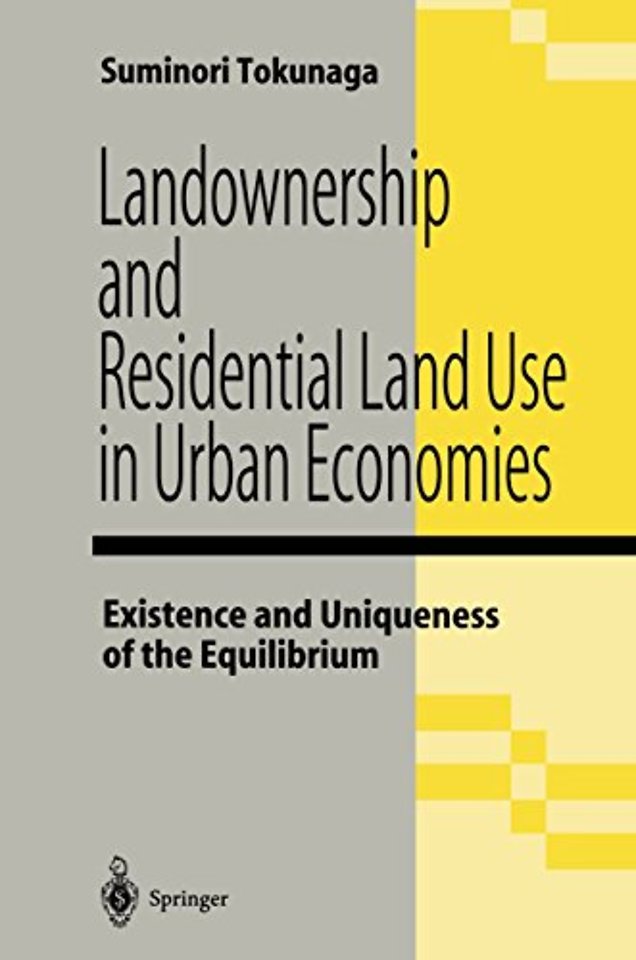
Suminori Tokunaga
Springer Japan
0e druk, 2012
9784431684121
Landownership and Residential Land Use in Urban Economies
Existence and Uniqueness of the Equilibrium
Specificaties
Paperback, 127 blz.
|
Engels
Springer Japan |
0e druk, 2012
ISBN13: 9784431684121
Rubricering
Juridisch
:
Levertijd ongeveer 9 werkdagen
Gratis verzonden
Samenvatting
A basic model of residential land use is proposed, in which a group of city residents is assumed to jointly own a circular area of land extending from the central business district. This basic model then allows the existence and uniqueness of the land-use equilibrium to be shown, as well as the effects of land ownership, household income, and population. By extending this model to an arbitrary subset of the city land and by introducing a crowding externalities variable, the effects of land ownership on the land-use equilibrium are examined using comparative statistics. Extremely useful to everyone whose work or research covers the fields of economics, urban planning, or regional studies.
Specificaties
ISBN13:9784431684121
Taal:Engels
Bindwijze:paperback
Aantal pagina's:127
Uitgever:Springer Japan
Druk:0
Hoofdrubriek:Economie
Inhoudsopgave
1. Introduction.- 1.1. Objective of the book.- 1.2. Review of Related Research.- 1.3. Plan of the book.- 2. Behavior of the Household with Land.- 2.1. Introduction.- 2.2. Basic Model of the Household with Land.- 2.3. Characteristics of Maximum Utility.- 2.4. Characteristics of the Optimal Lot Size and the Autarkic Land Rent.- 2.5. Conclusion.- 3. Impact of ?-landownership on Residential Land Use Equilibria.- 3.1. Introduction.- 3.2. The ?-landownership Model.- 3.3. Definition of the Land Use Equilibrium.- 3.4. Existence and Uniqueness of the Land Use Equilibrium.- 3.4.1. Existence of the Equilibria.- 3.4.2. Uniqueness of the Equilibrium.- 3.5. Comparative Statics.- 3.5.1 Changes in ? and Y02.- 3.5.2 Changes in Y01, N1 and N2.- 3.6. Conclusion.- Appendix 3.A: Proof of Lemma 3.6.- Appendix 3.B: Proof of Proposition 3.2.- Appendix 3.C: Proof of relation (3.31).- Appendix 3.D: Formal derivation of results for case 1 in Section 3.5.2.- Appendix 3.E Formal derivation of results for case 2 in Section 3.5.2.- 4. Impact of S-landownership on Residential Land Use Equilibria.- 4.1. Introduction.- 4.2. The S-landownership Model.- 4.3. Existence and Uniqueness of the Equilibrium.- 4.4. Comparative Statics.- 4.5. Conclusion.- Appendix 4.A: Proof of relation (4.22).- Appendix 4.B: Proof of Proposition 4.2.- Appendix 4.C: Proof of relation (4.25).- 5. Landownership and Welfare Impacts of Zoning Regulations.- 5.1. Introduction.- 5.2. A Crowding Externalities Model without a Zoning Regulation.- 5.2.1. The Residential Choice Behavior.- 5.2.2. The Land Use Equilibrium.- 5.3. A Crowding Externalities Model with a Zoning Regulation.- 5.3.1. The Residential Choice Behavior.- 5.3.2. The Land Use Equilibrium.- 5.4. Impact of Minimum Lot Size Regulation on Residential Land Use Equilibria.- 5.5. Conclusion.- Appendix 5.A: Case of a Large MLS Regulation.- 6. Conclusion.- References.- Author index.




Net verschenen
Rubrieken
- aanbestedingsrecht
- aansprakelijkheids- en verzekeringsrecht
- accountancy
- algemeen juridisch
- arbeidsrecht
- bank- en effectenrecht
- bestuursrecht
- bouwrecht
- burgerlijk recht en procesrecht
- europees-internationaal recht
- fiscaal recht
- gezondheidsrecht
- insolventierecht
- intellectuele eigendom en ict-recht
- management
- mens en maatschappij
- milieu- en omgevingsrecht
- notarieel recht
- ondernemingsrecht
- pensioenrecht
- personen- en familierecht
- sociale zekerheidsrecht
- staatsrecht
- strafrecht en criminologie
- vastgoed- en huurrecht
- vreemdelingenrecht