
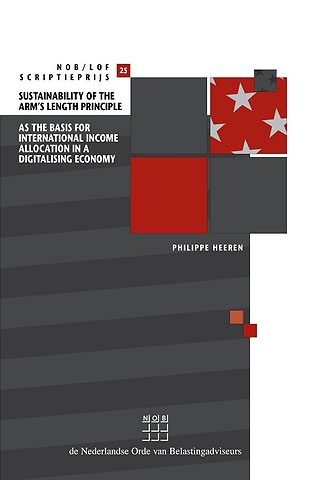
Sustainability of the Arm's Length Principle
Samenvatting
De digitalisering van de economie verandert de manier waarop ondernemingen worden georganiseerd. De verhoogde mobiliteit, de afhankelijkheid van data en netwerkeffecten, alsook het unieke karakter van ‘nieuwe’ ondernemingen, leiden tot structurele wijzigingen in het handelsverkeer. De bestaande druk op de verdeling van de heffingsbevoegdheden tussen staten, welke vertrekt vanuit het arm’s length beginsel, verhoogt onder impuls van de digitaliseringstrend. Het recente OESO/G20 BEPS-project tracht onder meer een antwoord te bieden op deze prangende evolutie.
Net zoals het OESO/G20 BEPS-project vertrekt de scriptie vanuit de idee dat de belastingheffing plaatsvindt waar de waarde gecreëerd wordt. De auteur grijpt terug naar de basisbeginselen van het belastingrecht om dit schijnbaar evidente startpunt te rechtvaardigen. De digitaliseringstrend blijkt potentieel aanleiding te geven tot de ontwikkeling van een holistische eerder dan een ondernemingsgerichte visie op waardecreatie.
In welke mate het Nederlandse rechtskader inzake het heffingsrecht aansluit bij het startpunt van waardecreatie wordt getoetst na descriptieve en rechtsvergelijkende analyse. De conceptuele houdbaarheid van het arm’s length beginsel, de voorgestelde wijzigingen in de context van het OESO/G20 BEPS-project, alsook het complexe (fiscale) karakter van data komen aan bod. De auteur gaat tot slot dieper in op de geneugten en beperkingen van eventuele alternatieven voor het bestaande systeem, om te besluiten tot een reeks vaststellingen en aanbevelingen.
Specificaties
Inhoudsopgave
CHAPTER 1: INTRODUCTION 1
1.1 Globalisation and Digitalisation of the Economy 1
1.1.1 Trend of Globalisation and Global Value Chains 2
1.1.2 Trend of Digitalisation: Introducing a Digital Economy 4
1.2 Transfer Pricing in a Digitalising Environment 4
1.3 Developing a Research Question 5
1.3.1 Normative Aspect – Principle-Based Approach towards Transfer Pricing 5
1.3.2 Descriptive and Comparative Aspect – Eucotax Wintercourse 5
1.3.3 Contemplative Aspect – Considering (Potential) Allocation of Taxing Rights 6
1.3.4 Research Question 6
1.4 Research Design 7
1.5 Research Methodology 7
1.6 Exemplary Approach – Fictitious Case of VirtusCo MNE 8
CHAPTER 2: DIGITALISATION AND THE EVOLVING ECONOMY 11
2.1 Digital Economy and Its Characteristics 11
2.1.1 Defining Digital Economy in a Broad Sense 11
2.1.1.1 Mobility – Intangible Assets, Business Functions, and Users 12
2.1.1.2 Reliance on Data 13
2.1.1.3 Network Effects and Multi-Sided Business Models 14
2.1.2 Digital Economy in a Narrow Sense: The Emergence of New Business Models 15
2.1.2.1 OECD/G20 BEPS Project Action 1 Deliverable 16
2.1.2.2 Common Denominators and the Characteristics of the Digital Economy 17
2.2 Beneficial Effect of the Digital Economy 18
2.3 Conclusion: Enabling Organisational Change 19
CHAPTER 3: TRANSFER PRICING AND PROFIT SHIFTING 21
3.1 The Arm’s Length Principle 22
3.1.1 Advantages of the Arm’s Length Principle 22
3.1.2 Disadvantages of the Arm’s Length Principle 23
3.2 Shifting of Profits through Transfer Pricing in the Digital Economy 24
3.2.1 Empirical Evidence of Profit Shifting by MNEs 24
3.2.2 OECD/G20 BEPS Project 27
3.2.2.1 What the BEPS Are We Talking About? 28
3.2.2.2 Main Actions Relevant in the Context of Transfer Pricing 28
3.2.2.2.a Action 1 – Digital Economy 29
3.2.2.2.b Action 5 – Agreement on Modified Nexus Approach to Determine Substance for IP Regimes 29
3.2.2.2.c Action 8, 9, and 10 – Transfer Pricing Outcomes in Line with Value Creation 30
3.2.2.2.d Action 13 and 14 – Formal Aspects of Transfer Pricing and BEPS 30
3.2.3 Issues of Profit Shifting in a Transfer Pricing Context 30
3.2.3.1 Manipulation of Transfer Prices: Milking and Parking 31
3.2.3.2 Use of Cost Contribution Arrangements and Intangibles 31
3.2.3.3 Shifting of Functions, Assets, and Risks 32
3.3 Conclusion: Arm’s Length Principle under Pressure 33
CHAPTER 4: TAXATION IN THE JURISDICTION OF VALUE CREATION 35
4.1 Division of International Taxing Rights 35
4.1.1 Taxation as a Derivative of Sovereignty 35
4.1.2 Inter-Nation Equity to Justify Taxation 36
4.1.2.1 Direct Benefit and Ability-to-Pay 37
4.1.2.2 Economic Allegiance 39
4.1.2.3 Conclusion: Principle-Based Taxation Where the Value is Created 40
4.2 Looking for Place of Value Creation 41
4.2.1 External Dimension: Market Determines the Amount of Value Created 41
4.2.2 Internal Dimension: Who Creates Value and Where is the Value Created? 42
4.2.2.1 Personal Analysis: Human Intervention is the Key Factor 42
4.2.2.2 Geographical Analysis: Localising the Value Creation in the Digital Economy 44
4.3 Conclusion: Burdensome Identification of Value Creation 46
CHAPTER 5: EXISTING FRAMEWORKS ON TRANSFER PRICING 49
5.1 Legal Framework on Transfer Pricing 49
5.1.1 Dutch Domestic Legal Framework 49
5.1.1.1 Article 8b CITA 50
5.1.1.2 Decree Transfer Pricing 2013 and OECD Transfer Pricing Guidelines 2010 51
5.1.1.3 Dutch Standard Treaty and the OECD Model Tax Convention 53
5.1.2 Comparison: Legal Status of the OECD Transfer Pricing Guidelines 54
5.2 Application of the Functional Analysis 55
5.2.1 OECD Transfer Pricing Guidelines and the Functional Analysis 56
5.2.1.1 Functions Performed 56
5.2.1.2 Assets Employed 57
5.2.1.3 Risks Assumed 57
5.2.2 Functional Analysis in the Netherlands 58
5.3 Selection of the Appropriate Transfer Pricing Method 59
5.3.1 No Hierarchy in the OECD Transfer Pricing Guidelines? 59
5.3.2 Dutch Domestic Approach: No Hierarchy 60
5.3.3 Comparison: Best Method, Hierarchy, Limited Hierarchy, or No Hierarchy 61
5.4 Treatment of Intangibles 61
5.4.1 Defining Intangibles 62
5.4.1.1 OECD Approach and Intangibles Project: Towards a Definition of Intangibles 62
5.4.1.2 Dutch Domestic Approach: No Definition of Intangibles for Taxation Purposes 63
5.4.1.3 Comparison: Several Jurisdictions Define Intangibles 63
5.4.2 Determining the Ownership of Intangibles 64
5.4.2.1 OECD Approach: No Clear Differentiation between Forms of Ownership 65
5.4.2.2 Dutch Domestic Approach: Importance of the Economic Owner 66
5.4.2.3 Comparison: General Primacy of Economic Ownership? 66
5.4.3 Cost Contribution Arrangements 68
5.4.3.1 OECD Approach: Separate Chapter on CCAs 68
5.4.3.2 Dutch Domestic Approach: Adherence to the OECD Approach 70
5.4.3.3 Comparison: Limited Guidance in National Regulations 70
5.4.4 Determination of the Appropriate Transfer Pricing Method 72
CHAPTER 6: CURRENT SYSTEM IN LINE WITH VALUE CREATION? 77
6.1 Application of the Arm’s Length Principle and Value Creation 77
6.1.1 Conceptual Tenability of the Arm’s Length Principle 77
6.1.2 OECD’s (Lack of) Power and Diversity in National Approaches 80
6.1.3 General Reflections on the New Business Models 81
6.2 Proposed Revisions by the OECD/G20 BEPS Project 82
6.2.1 Action 5 – Determining Substance for Intellectual Property Regimes 82
6.2.2 Action 8 – Transfer Pricing Aspects of Intangibles 83
6.2.2.1 Importance of Economic Ownership Confirmed and Explicated 83
6.2.2.2 Transfer Pricing Methods and the Use of Valuation Techniques 84
6.2.2.3 No Synergy Intangible, but Comparability Factor 84
6.2.3 Action 8 – Revisions to Chapter VIII of the Transfer Pricing Guidelines on CCAs 85
6.2.4 Action 8, 9, and 10 – Revisions to Chapter I of the Transfer Pricing Guidelines 86
6.2.4.1 Revisions to Guidance for Applying the Arm’s Length Principle 86
6.2.4.2 Introduction of Special Measures 87
6.2.5 Action 10 – Profit Splits in the Context of Global Value Chains 88
6.2.6 Action 10 – Cross-Border Commodity Transactions 89
6.2.7 Action 10 – Low Value-Adding Intra-Group Services 90
6.2.8 Actions 13 and 14 – Formal Elements of Transfer Pricing 90
6.2.9 Conclusion on the Proposed Changes by the OECD/G20 BEPS Project 91
6.3 Value Creating Effects of and Value Attribution to Data 93
6.3.1 Value of Data and Value Creation through Data 93
6.3.1.1 Particular Characteristics of Data 93
6.3.1.2 Chartered Institute of Taxation: Data Have no Value 94
6.3.1.3 Collin – Colin Report: Data Providers as Company Workers 94
6.3.2 Individual Data Not Considered for Taxation 95
6.3.3 Conclusion: Value Creation Through and not By Data 96
6.4 Conclusion: Acceptable Results, to a Certain Extent 97
CHAPTER 7: FORMULARY APPORTIONMENT: VALID ALTERNATIVE? 99
7.1 Global Formulary Apportionment 100
7.1.1 Advantages of Formulary-Based Approach 101
7.1.2 Disadvantages of Formulary-Based Approach 101
7.2 The Common Consolidated Corporate Tax Base 103
7.2.1 CCCTB Proposal of the European Commission 103
7.2.2 Change in the Dutch Approach towards a CCCTB? 104
7.2.3 Comparison: Limited Support for a CCCTB 105
7.3 Comparing with Arm’s Length: No Best Approach? 106
7.3.1 Analysis of the (Dis)Advantages of Global Formulary Apportionment 106
7.3.2 Conclusion: Towards a Hybrid Regime? 108
CHAPTER 8: CONCLUSIONS AND RECOMMENDATIONS 111
Annexes Overview 117
ANNEX I – OECD BEPS Timeline 119
ANNEX II – OECD Project on the Transfer Pricing of Intangibles Timeline 120
ANNEX III – Importance of Commodities 121
ANNEX IV – Functional Analysis 122
ANNEX V – French Tax on Data 125
ANNEX VI – Bibliography 126
Anderen die dit boek kochten, kochten ook
-
 Mariette Lokin€ 93,95
 -
Arnoud Engelfriet€ 99,00
-
André Nollkaemper€ 89,95
-
K. Lindenberg€ 62,50
-
B.F. Keulen€ 81,00
-
C.E. Huls€ 21,00




Net verschenen
Rubrieken
- aanbestedingsrecht
- aansprakelijkheids- en verzekeringsrecht
- accountancy
- algemeen juridisch
- arbeidsrecht
- bank- en effectenrecht
- bestuursrecht
- bouwrecht
- burgerlijk recht en procesrecht
- europees-internationaal recht
- fiscaal recht
- gezondheidsrecht
- insolventierecht
- intellectuele eigendom en ict-recht
- management
- mens en maatschappij
- milieu- en omgevingsrecht
- notarieel recht
- ondernemingsrecht
- pensioenrecht
- personen- en familierecht
- sociale zekerheidsrecht
- staatsrecht
- strafrecht en criminologie
- vastgoed- en huurrecht
- vreemdelingenrecht