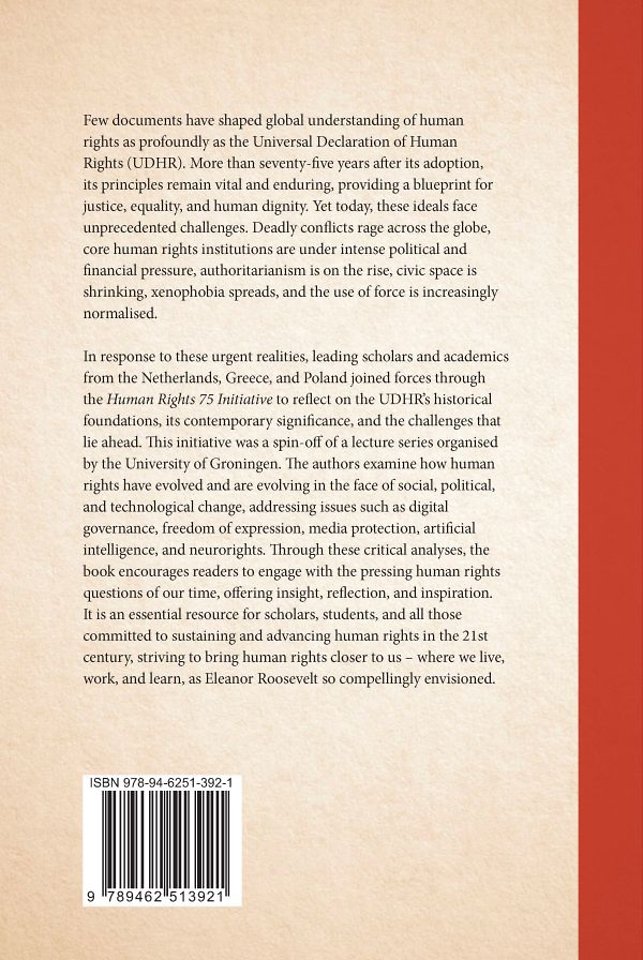

The Universal Declaration of Human Rights at 75 and beyond:
historical, contemporary, and future perspectives
Samenvatting
Few documents have shaped global understanding of human rights as profoundly as the Universal Declaration of Human Rights (UDHR). More than seventy-five years after its adoption, its principles remain vital and enduring, providing a blueprint for justice, equality, and human dignity. Yet today, these ideals face unprecedented challenges. Deadly conflicts rage across the globe, core human rights institutions are under intense political and financial pressure, authoritarianism is on the rise, civic space is shrinking, xenophobia spreads, and the use of force is increasingly normalised. In response to these urgent realities, leading scholars and academics from the Netherlands, Greece, and Poland joined forces through the Human Rights 75 Initiative to reflect on the UDHR’s historical foundations, its contemporary significance, and the challenges that lie ahead. This initiative was a spin-off of a lecture series organized by the University of Groningen.
The authors examine how human rights have evolved and are evolving in the face of social, political, and technological change, addressing issues such as digital governance, freedom of expression, media protection, artificial intelligence, and neurorights. Through these critical analyses, the book encourages readers to engage with the pressing human rights questions of our time, offering insight, reflection, and inspiration. It is an essential resource for scholars, students, and all those committed to sustaining and advancing human rights in the 21st century, striving to bring human rights closer to us – where we live, work, and learn, as Eleanor Roosevelt so compellingly envisioned.
Trefwoorden
Specificaties
Inhoudsopgave
Foreword
Introduction
The View of the Past in the Universal
Declaration of Human Rights – Antoon De Baets
1. Introduction
2. Mindset and vocabulary of the drafters
3. History of the historical recitals
3.1 The recital on barbarism
3.2 The recital on rebellion
4. Features of the view of the past in the Universal Declaration
4.1 A view with eighteenth-century precedents
4.2 A holistic view
4.3 An abstract – not an ahistorical or transhistorical – view
4.4 A view marked but not determined by natural law
4.5 A view containing the claim to be the interpreter of human conscience
4.6 A manifest anti-dictatorial and discreet pro-democratic view
4.7 A unique view
5. Conclusion
From ‘universal’ acceptance of slavery to its ‘universal’ prohibition. Some remarks on the prelude to Article 4 UDHR – Peter A.J. van den Berg
1. Introduction
2. Changing attitudes towards slavery in the Western world
2.1 Legitimation of slavery
2.2 Rising criticism of slavery after 1750
3. (Inter)national legal instruments against slavery in the nineteenth century
3.1 International legal instruments against the slave trade
3.2 National legal instruments against slavery
4. Developments in the twentieth century: the road to the UDHR and beyond
5. Conclusion
The freedom of religion in the Netherlands under the ‘aegis’ of Article 18 UDHR, 1948-2023 – Vincent Tassenaar
1. Introduction
2. Freedom of religion in the Republic of the United Provinces (1579-1795)
3. Freedom of religion in the Kingdom of the Netherlands until 1945
4. Developments after the Second World War
5. Decision-making autonomy
6. Conclusion
Legal certainty and shifting boundaries in Dutch rape legislation – Nicolle Zeegers
1. Introduction
2. The acknowledgement of VAW in the human rights discourse
3. Method
4. Widening the scope of rape law and legal certainty
4.1 The context of the 1988-1991 parliamentary debate on rape law
4.2 The analysis of the 1988-1991 parliamentary debate
4.3 Reopening the debate about the scope of rape law
4.4 Debating the recent widening of the scope of rape and legal certainty
4.4.1 Responsibility shift
4.4.2 Distinction between intentional and culpa rape
4.4.3 Lowest limit culpa
5. Conclusion
Sex-selective abortions of intersex foetuses in Europe. Social, ethical and legal considerations – Nikoletta Pikramenou & Bartosz Cyran
1. Introduction
2. Sex-selective abortions of female foetuses
2.1 Ethical and social considerations
2.2 Legal considerations
3. Sex-selective abortions of intersex foetuses
3.1 Social and ethical considerations
3.2 Legal considerations
4. Concluding remarks: sex-selection and the spectrum of sex
Defending the defenders: safeguarding journalists’ rights in shrinking civic spaces – Roxani Fragou
1. Introduction
2. Defending the defenders: mechanisms and challenges in the protection of journalists as HRDs
2.1 Protection frameworks for journalists and HRDs: two sides of the same coin?
2.1.1 Journalists’ protection regimes and mechanisms
2.1.2 HRDs’ protection regimes and mechanisms
2.2 Reality check: protection frameworks for journalists as HRDs under pressure in shrinking civic spaces
3. Defending media freedom and pluralism: the EU’s role in protecting journalists as HRDs
3.1 The EU’s evolving approach to safeguarding journalists as HRDs through strengthening democracy
3.2 Upholding media freedom: the impact of the European Media Freedom Act (EMFA) on journalists as HRDs
4. Concluding remarks: building public support for journalists as HRDs
The UDHR reinvented? Modern challenges to the freedom of expression and the importance of the UDHR – Vassilios Grammatikas
1. The creation of the Universal Declaration of Human Rights
2. The indivisibility (?) of human rights
2.1 The theoretical foundation
2.2 The ‘ranking’ of the FoE
3. Historical evolution of the freedom of expression
3.1 From antiquity to the UDHR
3.2 Global and regional instruments
3.3 Limits to the freedom of expression
3.3.1 The UDHR
3.3.2 Limitations in international treaties
3.4 Categories of limitations
3.4.1 Limitations on the basis of public order/national security
3.4.2 Protection of the rights of others
3.4.3 ‘Problematic’ limitations
4. Can the UDHR respond to modern challenges to FoE?
4.1 The UDHR as customary international law (?)
4.2 The UDHR as ‘guiding principles’
5. Concluding remarks
Freedom on Mute: Internet Shutdowns, and the Erosion of Speech in Digital India – Ritumbra Manuvie, Jeanne Mifsud Bonnici
1. Introduction
2. Right to Freedom of Speech and of Internet
3. State of exception
4. The paradox of inclusion through exclusion
5. Creation of exception in India
6. Conclusion
Health inequalities and the right to health in the AI era: critical issues of governance – Elisavet Athanasia Alexiadou
1. Introduction
2. Unpacking the nexus between AI and health inequalities
3. Navigating the governance of AI in healthcare through a right to health lens
4. Concluding remarks
The so-called ‘Neurorights’: A critical vision of new fundamental rights – María Lorena Flórez Rojas
1. Introduction
2. Neurotechnology’s expanding horizons
3. How does the neurorights initiative bridge human rights and scientific innovation?
4. Do we need new fundamental rights?
4.1 Human rights inflation
4.2 Insufficient legal foundation
4.3 Methodological concerns
4.4 Technical and practical implementation challenges
4.5 Alternative approaches and recommendations
5. Conclusions
Biographical notes on the authors
Anderen die dit boek kochten, kochten ook
-
 Rob Widdershoven€ 89,50
 -
Jonathan Soeharno€ 39,90
-
Steven Jellinghaus€ 101,21
-
Ministerie van Justitie€ 64,84
-
Simon Cornielje€ 57,50
-
Alex Meijer€ 29,50



Net verschenen
Rubrieken
- aanbestedingsrecht
- aansprakelijkheids- en verzekeringsrecht
- accountancy
- algemeen juridisch
- arbeidsrecht
- bank- en effectenrecht
- bestuursrecht
- bouwrecht
- burgerlijk recht en procesrecht
- europees-internationaal recht
- fiscaal recht
- gezondheidsrecht
- insolventierecht
- intellectuele eigendom en ict-recht
- management
- mens en maatschappij
- milieu- en omgevingsrecht
- notarieel recht
- ondernemingsrecht
- pensioenrecht
- personen- en familierecht
- sociale zekerheidsrecht
- staatsrecht
- strafrecht en criminologie
- vastgoed- en huurrecht
- vreemdelingenrecht