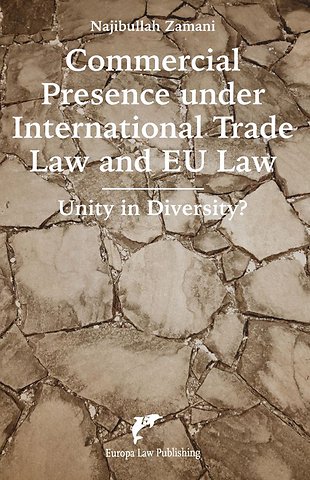
Commercial Presence under International Trade Law and EU Law
Unity in Diversity?
Samenvatting
In the 21st century, the services sector has become of increasing importance. Nowadays, in the European Union (EU), it makes up the largest part of the Gross Domestic Product and generates the vast majority of employment opportunities. The EU’s economy is therefore often rightly characterised as a service economy. Consequently, the regulation of services may be qualified as both a highly complex as well as a vital issue.
Trade in services is regulated simultaneously by multiple international agreements. At the multilateral level, the subject has been governed by the General Agreement on Trade in Services (GATS). Since the turn of the century, it is moreover addressed in an ever-growing number of Free Trade Agreements (FTAs). Finally, the law of the EU itself plays a role in shaping the conditions under which service providers may conduct their activities within the European Single Market.
Due to the simultaneous application of multiple sources, problematic overlaps are likely to arise in various situations. The current volume seeks to specifically address the challenges related to these overlaps revolving around the supply of services through commercial presence. The main point of departure of this book is the EU, an actor that remains globally at the forefront of concluding FTAs, and has also positioned itself as one of the important players within the framework of the World Trade Organisation (WTO). Proceeding from this perspective, the author examines first to which extent the parallel application of the GATS and FTAs to which the EU is party, may give rise to the fragmentation of the rules aimed at liberalising the supply of services through commercial presence. Secondly, the author explores the extent to which these rules as laid down in the GATS and the selected FTAs, are inconsistent with EU law. In so doing, this book demonstrates that the degree of fragmentation depends on the specific provisions concerned. Moreover, it reveals an ongoing process of fragmentation within the EU’s own external trade regime. Finally, it highlights numerous inconsistencies between the norms contained in the GATS and FTAs, on the one hand, and EU law, on the other.
The present study draws comprehensively on treaties, legislation, case law, policy documents and legal literature. Ultimately, it yields important and original insights that feed usefully into the broader debates on the fragmentation and consistency of international trade law and EU law.
Trefwoorden
Specificaties
Anderen die dit boek kochten, kochten ook
-
 Rob Widdershoven€ 89,50
 -
Alex Meijer€ 29,50
-
Simon Cornielje€ 57,50
-
Remco Spithoven€ 69,95
-
Albertjan Tollenaar€ 36,00
-
Hans Faber€ 23,99





Net verschenen
Rubrieken
- aanbestedingsrecht
- aansprakelijkheids- en verzekeringsrecht
- accountancy
- algemeen juridisch
- arbeidsrecht
- bank- en effectenrecht
- bestuursrecht
- bouwrecht
- burgerlijk recht en procesrecht
- europees-internationaal recht
- fiscaal recht
- gezondheidsrecht
- insolventierecht
- intellectuele eigendom en ict-recht
- management
- mens en maatschappij
- milieu- en omgevingsrecht
- notarieel recht
- ondernemingsrecht
- pensioenrecht
- personen- en familierecht
- sociale zekerheidsrecht
- staatsrecht
- strafrecht en criminologie
- vastgoed- en huurrecht
- vreemdelingenrecht